
Domestic Debt Interest Surpasses Education Funding in 2027 Draft Budget
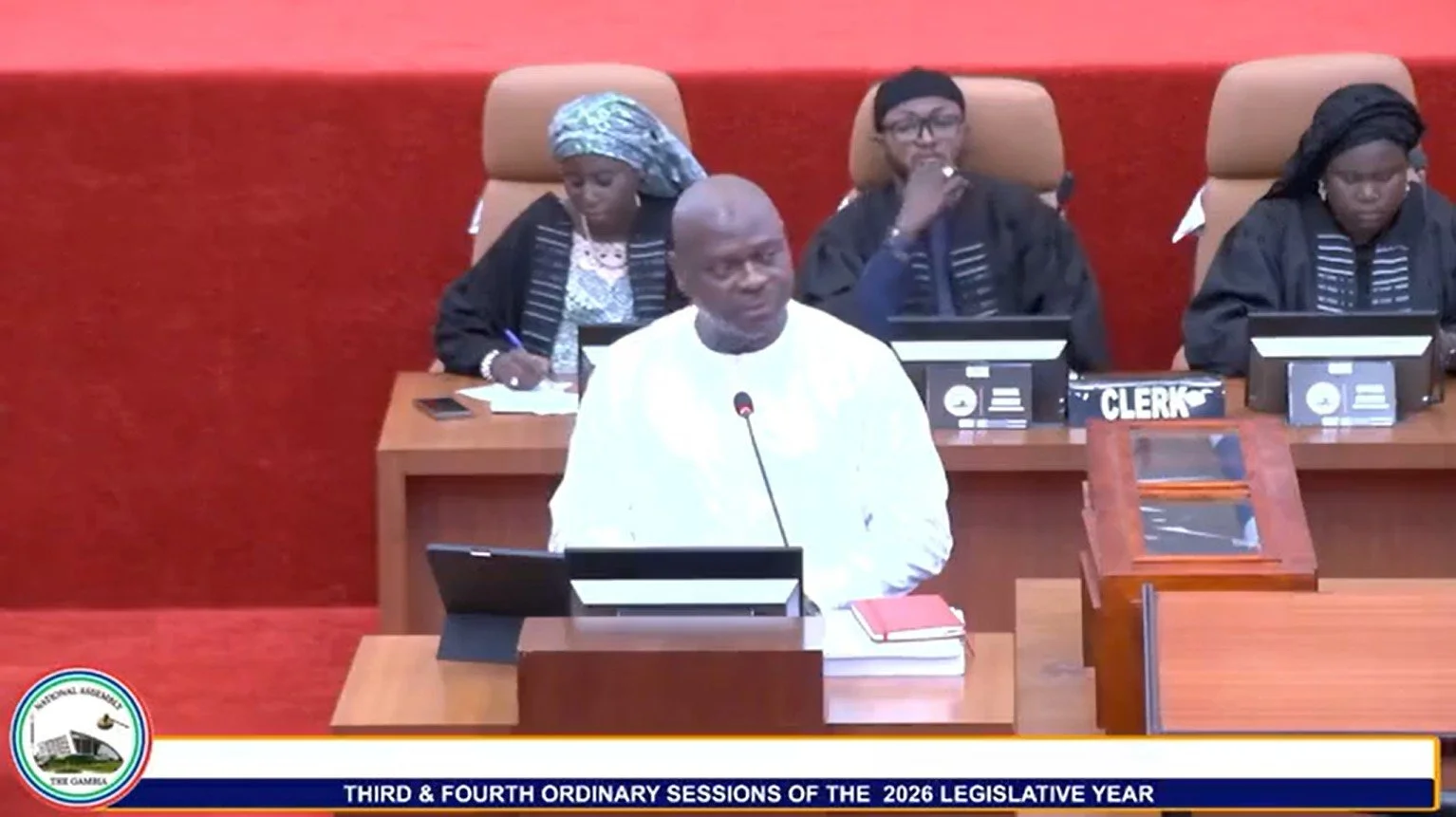
Finance Minister tables 2027 Draft Budget in Parliament © National Assembly of The Gambia
By Edward Dalliah Jr.
The Gambia’s Minister of Finance tabled the 2027 Draft Budget in Parliament on 25th September 2026, requesting a domestic debt interest payment exceeding funding for education and health separately. Askanwi’s budget research has revealed that in 2025 and 2026, education funding (MoBSE and MoHERST) was above domestic debt interest. However, this is all set to change in the 2027 Draft Budget.
This highlights the government’s rising cost of borrowing and the crowding-out effect on key sectors such as health and education.
Speaking to parliamentarians during the tabling of the budget, Finance Minister Hon. Seedy Keita highlighted that “Debt Service (Interest + Principal) is projected to increase by 20.2%, from GMD 13.46 billion in 2026 to GMD 16.17 billion in 2027, mainly due to a projected 34.0% rise in interest payments on domestic debt”.
Our budget research has revealed that back in 2025, The Gambia paid a total of D10.8 billion in debt service, and approximately half of this consisted of domestic debt interest, as shown in the chart below.
However, in just three years, total debt service is projected to increase by over 50%, from D10.8 billion in 2025 to D16.17 billion in 2027.
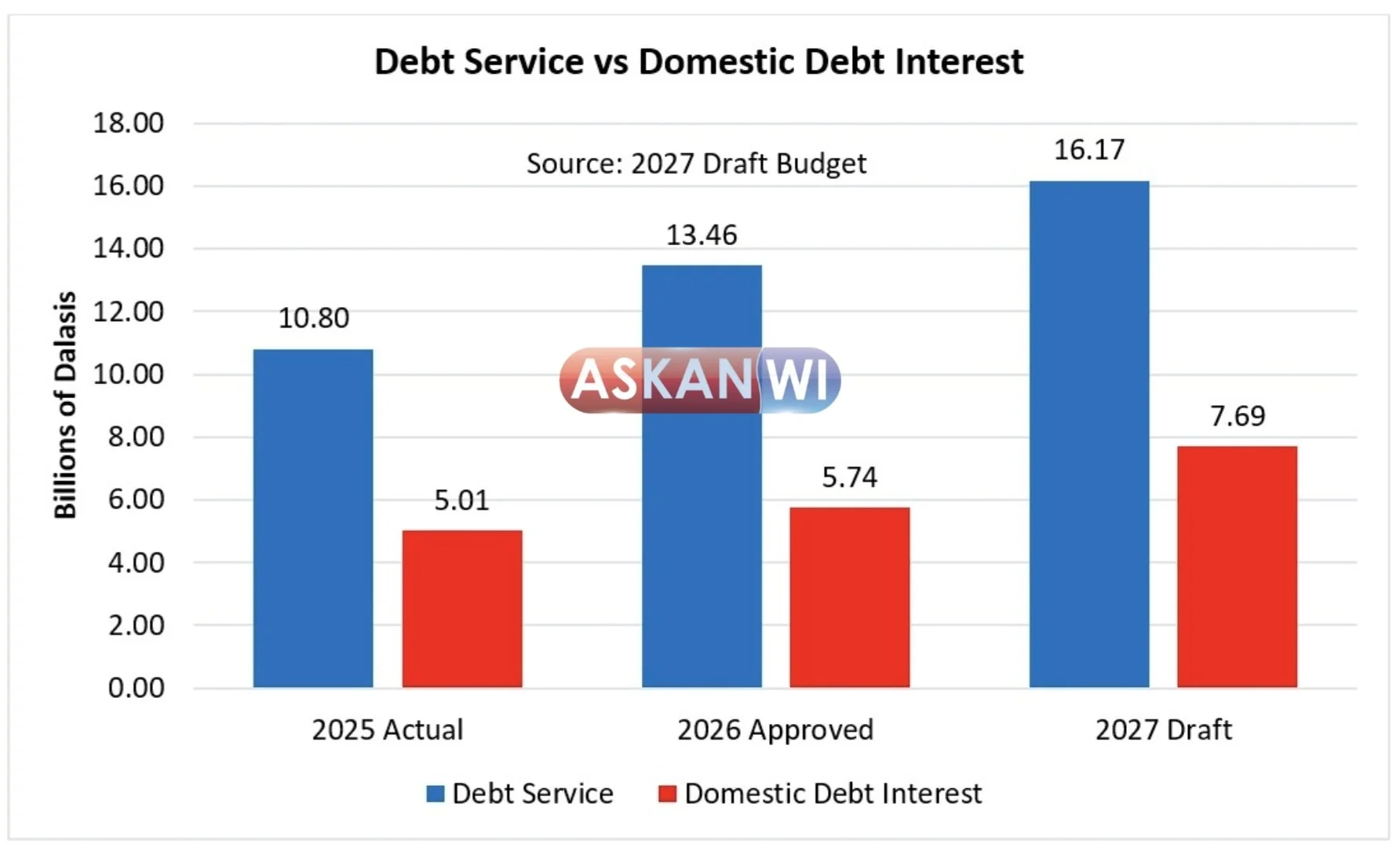
Debt Service vs Domestic Debt Interest © Askanwi Media
After spending over D5 billion on domestic debt interest back in 2025, our budget research reveals that domestic debt interest is projected to increase from D5.74 billion in 2026 to D7.69 billion in 2027.
Although the 2027 Draft Budget presents fiscal sustainability as one of its central themes, the increase in domestic debt interest illustrates one of the pressures facing that objective.
Comparing the 2027 Draft Budget’s allocations for domestic debt interest, education, and health over the past three years shows how funding the rising domestic debt interest coincides with reduced funding for other key sectors.
After consuming just over D5 billion in domestic debt interest in 2025, education, which comprises the Ministry of Basic and Secondary Education and the Ministry of Higher Education, Research, Science, and Technology, consumed over D6.1 billion. That same year, health consumed only D2.75 billion.
This placed domestic debt interest spending above only health back in 2025. The trend continued in 2026, with domestic debt interest outspending health.
According to the 2027 Draft Budget, the government plans to spend D5.74 billion on domestic debt interest, which is projected to surpass spending on health by D2.6 billion. However, education spending is projected to surpass domestic debt interest spending by D1.21 billion.
In 2027, however, the government’s domestic debt interest is projected to surpass education funding. Projected to consume D7.69 billion, domestic debt interest will surpass education funding by D1.12 billion and health funding by D3.59 billion.
The chart below compares funding for domestic debt interest, education, and health from 2025 to 2027.
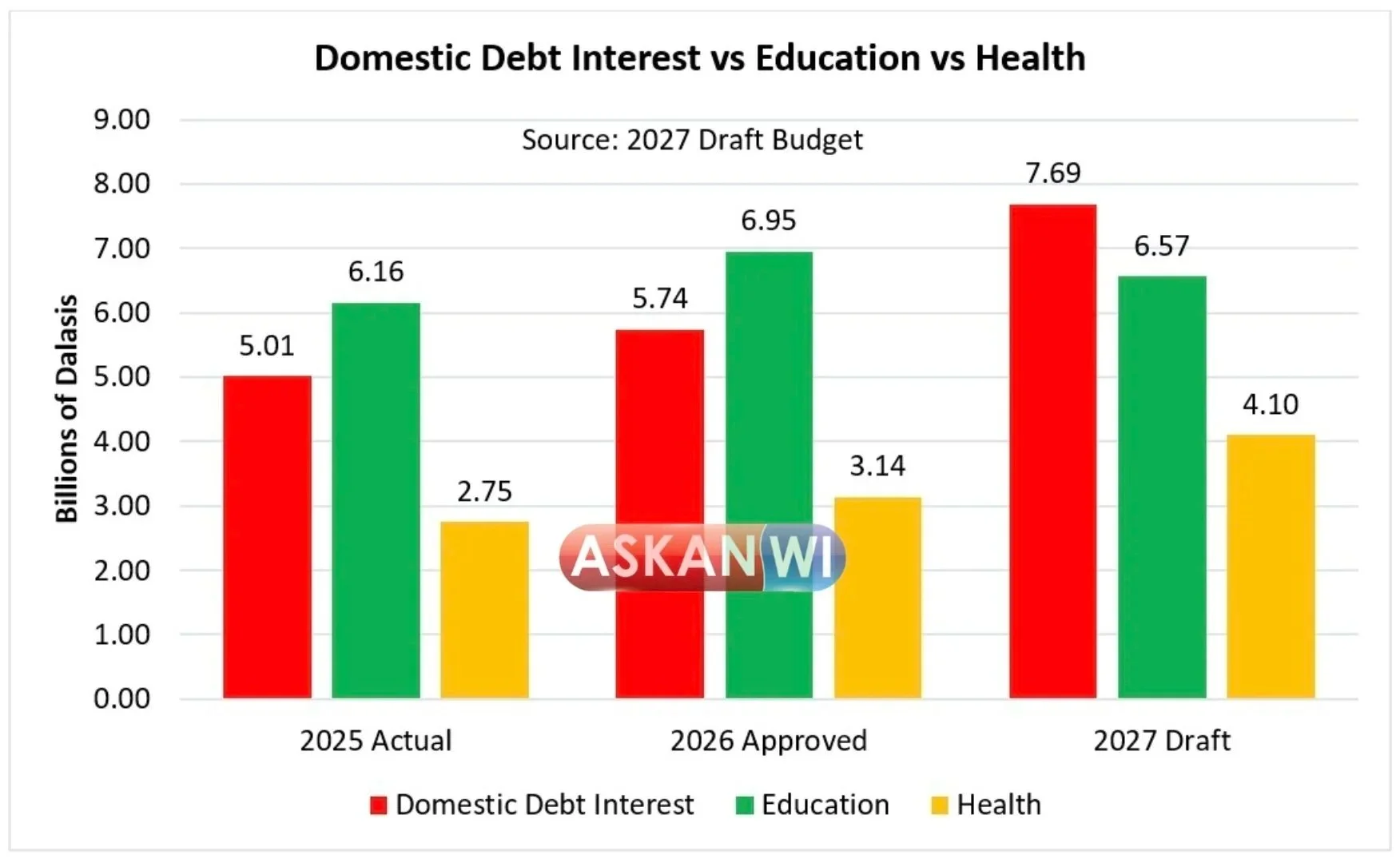
Domestic Debt Service vs Education vs Health © Askanwi Media
What is domestic debt interest?
Domestic debt interest is the additional charges a government pays on top of the money it borrows from domestic lenders, including through instruments such as Treasury Bills and government bonds.
A previous Askanwi publication on the country's debt reported that during the first and second quarters of 2026, the Government had paid approximately D2.88 billion in domestic debt interest. This shows that the country’s continuous borrowing is putting financial pressure on the government's coffers and allocation priorities.
According to the Governor of the Central Bank, Buah Saidy, during a Monetary Policy Committee press briefing on 20th August 2026, the country's domestic debt stock increased to D55.43 billion, equivalent to 24.4% of GDP, at the end of June 2026, from D51.99 billion at the end of 2025.
As the Government borrows, it incurs additional obligations to service that borrowing. Unless borrowing costs or debt levels fall, future budgets will continue to accommodate those obligations. Looking beyond domestic borrowing, the Government has proposed approximately D9.07 billion in total interest payments in 2027, covering both domestic and external debt.
The central question for 2027 is therefore not simply how much the Government plans to spend, but how much of its available fiscal resources will be absorbed by the cost of borrowing and how much will be available for public services and development programmes.
