
Finance Minister: D10 Billion Domestic Debt is Legacy Debt from Previous Regime
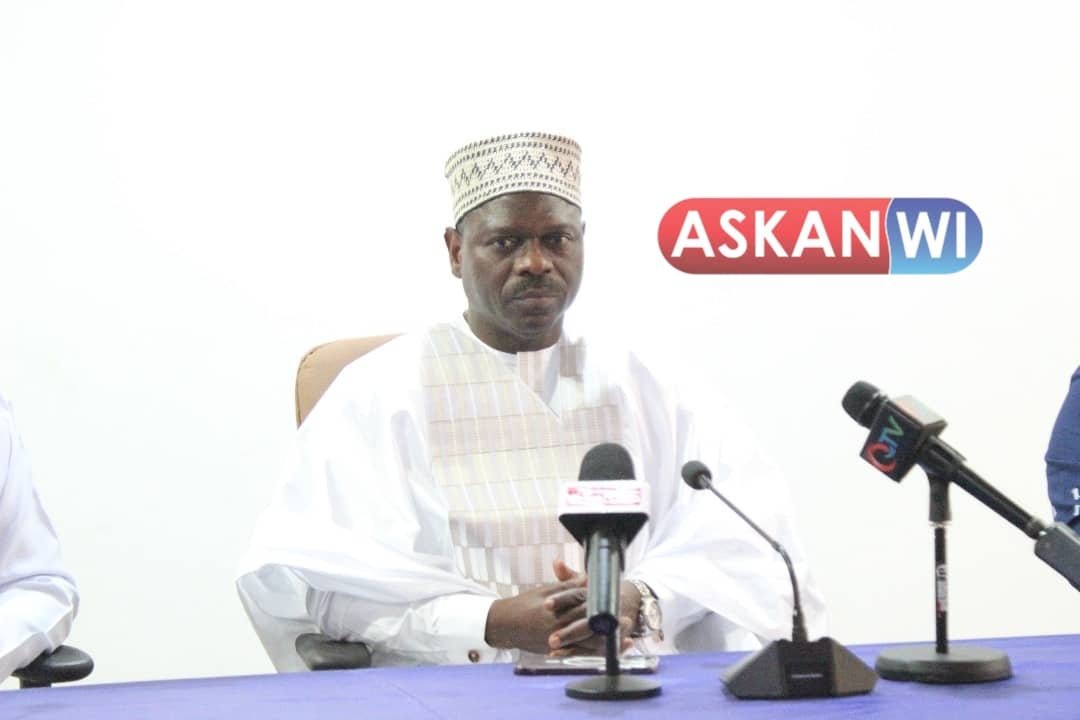
Finance Minister Hon. Seedy S. Keita © Askanwi Media
By Yusef Taylor, @FlexDan_YT
The Gambia’s Finance Minister, Hon. Seedy S. Keita, has revealed that approximately D10 billion of the country’s D52.91 billion domestic debt stock consists of legacy debts inherited from the previous administration of former President Yahya Jammeh. Our budget research reveals that this only accounts for 19% of the total domestic debt.
Minister Keita made the disclosure while responding to a question from Hon. Almameh Gibba, National Assembly Member for Foni Kansala, during a parliamentary question-and-answer session following his oral statement on the implementation and monitoring of the 2026 annual budget.
Presenting his statement to the National Assembly on 21st September 2026, Minister Keita reported that the government raised D15.35 billion in total revenue, excluding project grants, during the first six months of the year. Government expenditure, meanwhile, stood at D15.42 billion, resulting in a budget deficit of D68.86 million.
More significantly, the Finance Minister said that “the gross deficit of GMD68.86 million was significantly driven by the fiscal pressures emanating from domestic debt service.”
During his presentation, Minister Keita further noted that, compared with the previous year’s spending, “Debt Interest expenditures grew by 18% to reach GMD3.10 billion – representing 45% of the annual budgeted amount.”
He added that total debt-interest payments comprised GMD600 million in external debt interest, representing a 21% annual increase, and GMD2.50 billion in domestic debt interest, representing a 17% annual increase.
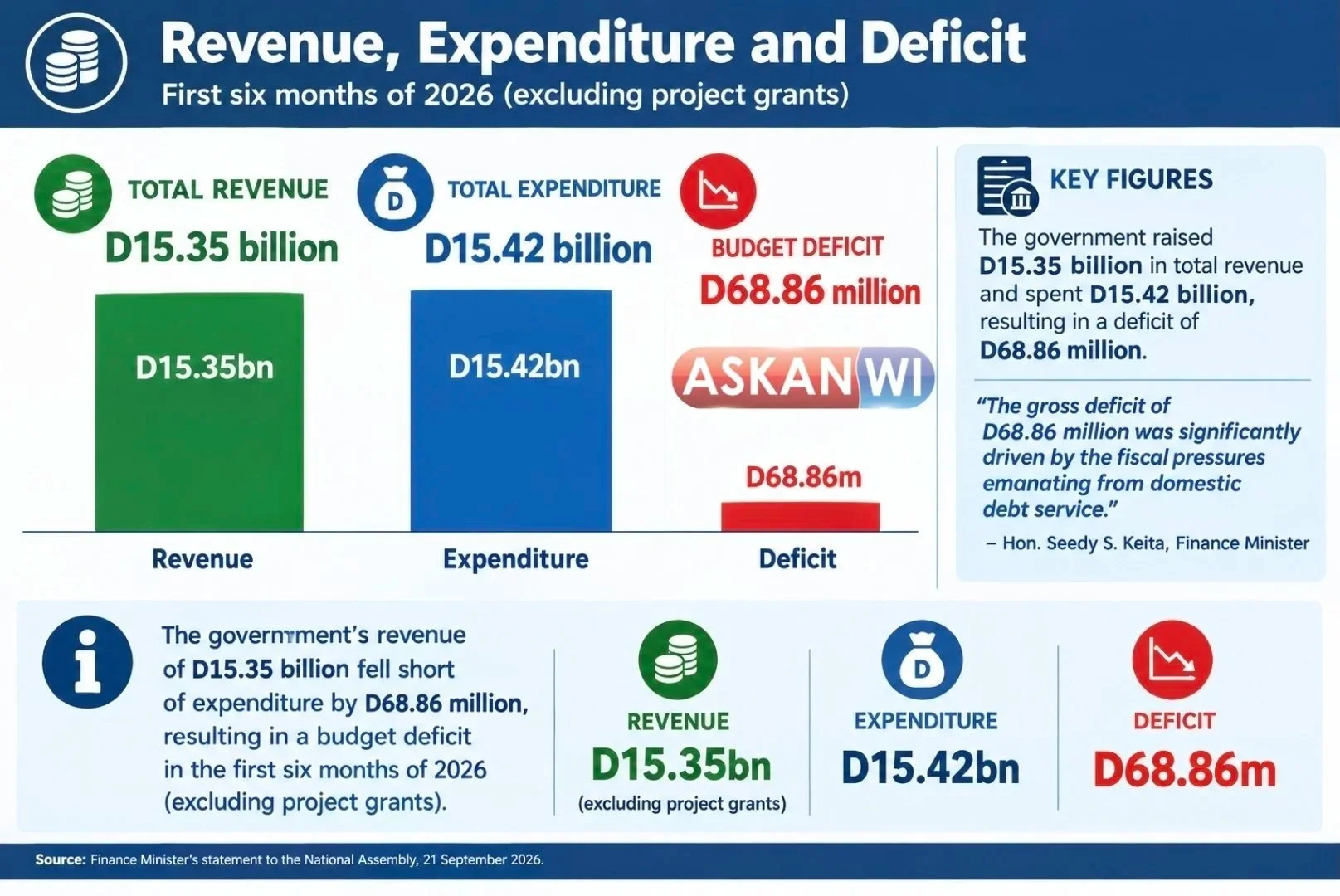
Revenue, Expenditure, and Deficit © By Askanwi after MoFEA
Parliamentary Inquiry into the Domestic Debt Situation
The issue of domestic debt came into sharper focus when Hon. Almameh Gibba of Foni Kansala became the first parliamentarian to pose a question during the question-and-answer session.
Following the Speaker’s decision to limit Hon. Gibba to one question at a time, the Foni Kansala lawmaker asked the Finance Minister what measures the government was taking to reduce the cost of domestic borrowing during the remaining six months of 2026.
Hon. Gibba pointed to the Minister’s report, which showed that D3.10 billion had been spent on debt interest during the first half of 2026, including D2.50 billion in domestic debt interest.
He asked:
“What specific measures is the government taking to reduce the cost in domestic borrowing during the remaining six months of this year?”
In response, Minister Keita acknowledged the significant increase in debt-servicing costs.
“Yes, total debt service, as we can see, registered an elevated increase of 18%, D3 billion of which principally the domestic interest payments,” he said. “This is on the backdrop of the current domestic debt stock as well as the heightened interest rate that was prevailing before the central bank commenced reducing the interest rates.”
The Finance Minister explained that the Central Bank had reduced its policy rate to 14% in recent months, but that interest rates had previously been hovering around 17%.
“This applied to the domestic debt stock of more than D50 billion [and] explains the amount spent on the domestic interest,” he said.
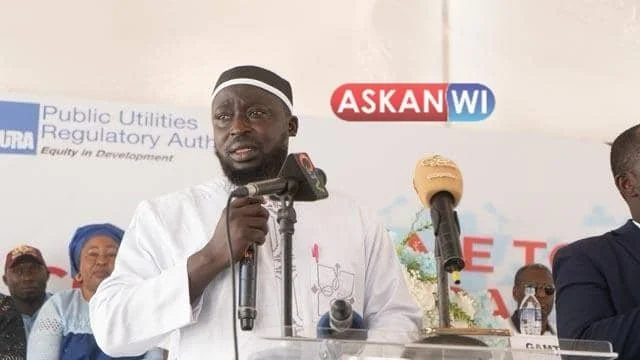
Hon Alammeh Gibba of Foni Kansala © Askanwi Media
Government Seeks to Minimise New Domestic Borrowing
Addressing the measures being taken to contain domestic debt-servicing costs, Minister Keita said the government was seeking to keep new domestic borrowing “to the barest minimum possible” within the limits of the approved budget.
“The way we are trying to minimize the domestic interest payment is to ensure that our domestic borrowing is kept to the barest minimum possible within our envelope that we have for the budget,” he explained.
He added that although domestic debt-service costs were somewhat elevated compared with the previous year, they remained within the budgetary framework.
However, the most significant part of the Minister’s response concerned the composition of the domestic debt stock.
Keita explained that the country’s domestic debt did not consist entirely of borrowing undertaken by the current administration. According to him, a substantial portion comprises legacy debts inherited from the previous regime.
“This domestic debt stock is not just only current issuances but this comprises of legacy debts,” he said.
The Minister specifically referred to a 30-year bond amounting to D7.95 billion, which he said was still being serviced and therefore continued to contribute to domestic interest costs. He also cited the NAWEC bond as another component of the legacy debt portfolio.
In his concluding remarks, Minister Keita said:
“Total legacy debt portfolio is about D10 billion out of our total domestic debt stock. And these were not necessarily new borrowings of the government but they were just consolidated from the previous regime.”
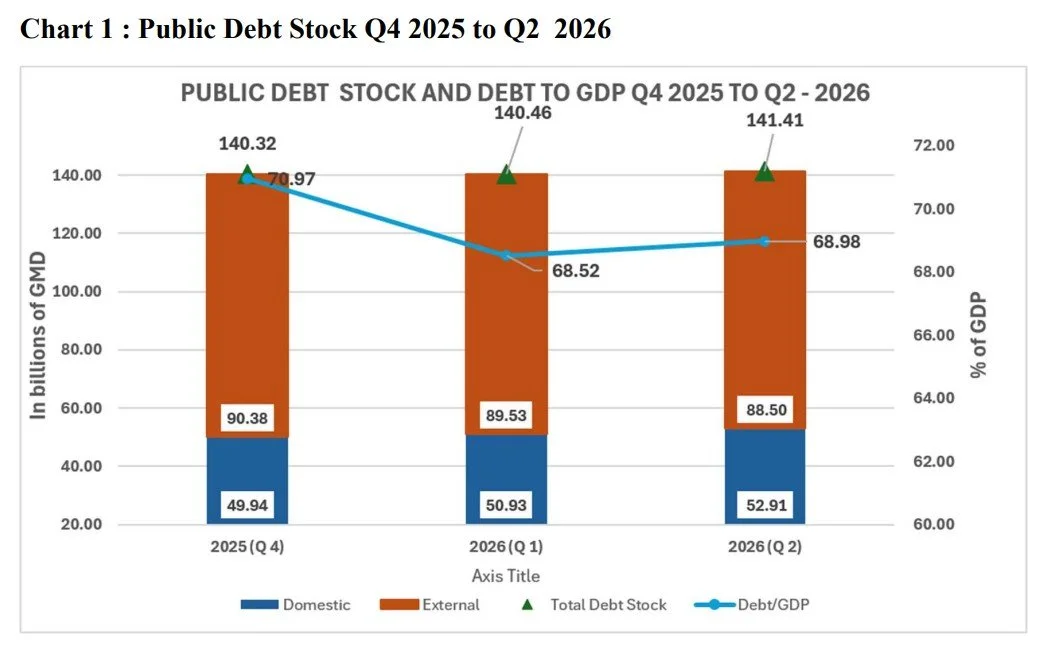
Second Quarter 2026 Public Debt Bulletin © MoFEA
Legacy Domestic Debt Accounts for About 19% of Domestic Debt Stock
The Minister’s disclosure comes against the backdrop of the government’s overall debt position.
According to the Q2 2026 Public Debt Bulletin, The Gambia’s total public debt stood at D141.41 billion, equivalent to a debt-to-GDP ratio of 68.98%.
Of this amount, D88.50 billion was external debt, while D52.91 billion constituted domestic debt.
If Minister Keita’s figure of approximately D10 billion in legacy domestic debt is used, that amount represents roughly 7% of the country’s total public debt and approximately 19% of the total domestic debt stock.
On that basis, approximately D42.91 billion, or 81% of the domestic debt stock, would consist of debt accumulated outside the legacy portfolio identified by the Minister.
However, this calculation should not automatically be interpreted as meaning that all of the remaining D42.91 billion was borrowed by the current administration. The Minister did not provide a complete breakdown showing how much of the domestic debt was accumulated under each administration. Similarly, no corresponding figure for legacy external debt was provided.
As a result, a complete comparison between inherited debt and debt accumulated under the current administration would require a more detailed historical breakdown of both domestic and external debt.
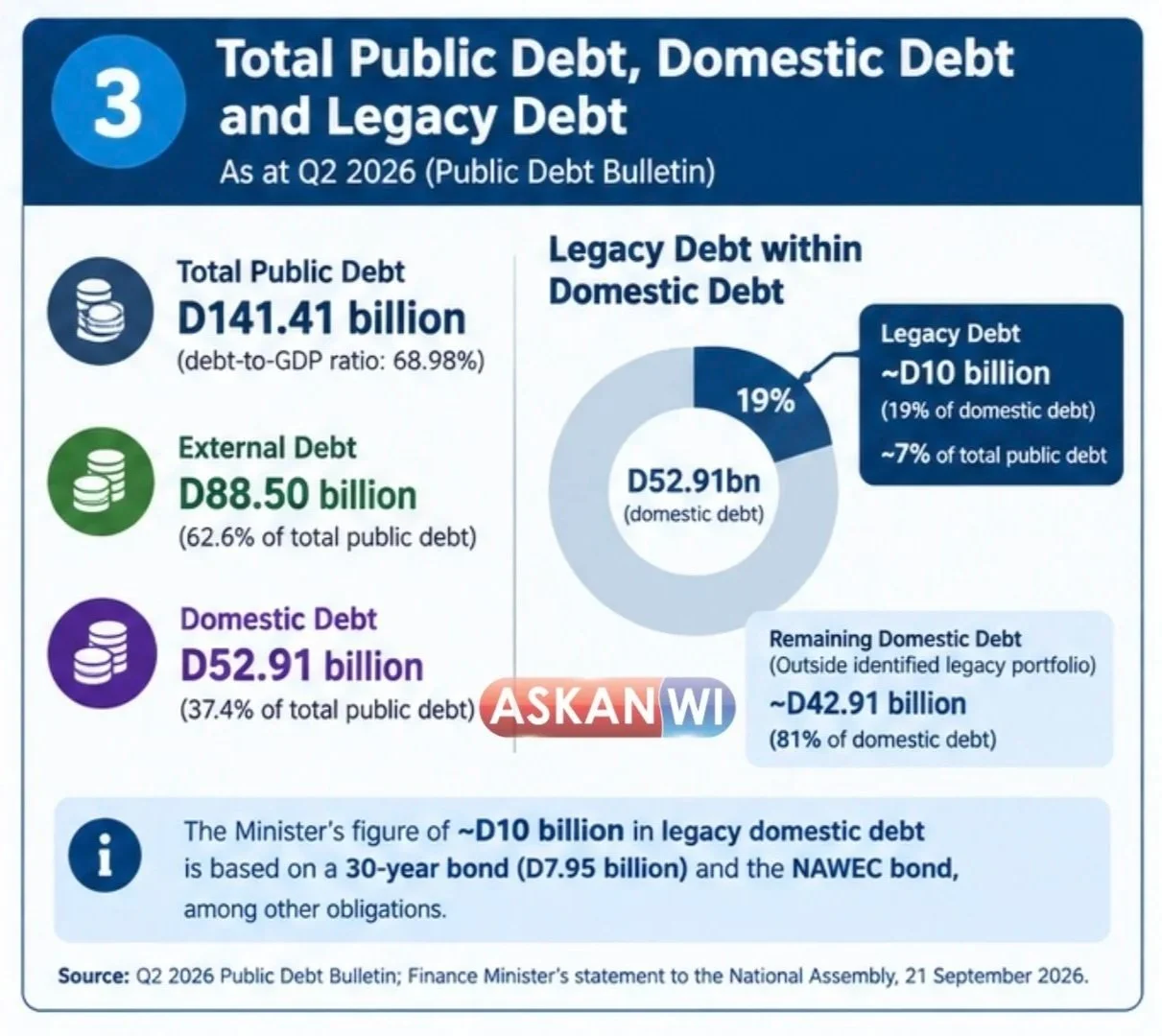
Legacy Debt and Total Public Debt © By Askanwi Media after MoFEA
What Does the 81%–19% Split Mean?
The figures nevertheless raise an important question about the government’s domestic borrowing strategy.
If approximately 19% of the domestic debt stock is attributable to legacy debt, then the remaining 81% represents debt outside that legacy portfolio. This does not, by itself, establish that the current government incurred all of that debt, but it does highlight the scale of domestic borrowing that has accumulated beyond the debts identified as inherited.
The issue is particularly significant because domestic borrowing carries substantial interest costs. The Finance Minister reported that D2.50 billion was spent on domestic debt interest during the first six months of 2026 alone, contributing significantly to fiscal pressures.
The parliamentary exchange therefore leaves two important questions for further scrutiny: How much of the current domestic debt was accumulated under the Barrow administration, and what concrete measures are being taken to reduce the country’s reliance on costly domestic borrowing?
Those figures, alongside a full historical breakdown of the country’s debt portfolio, would provide a clearer picture of how much of The Gambia’s current debt burden is inherited and how much has accumulated under the current government.
