
Four Advocates Win Supreme Court Case Against Finance Minister on Late Budget Tabling
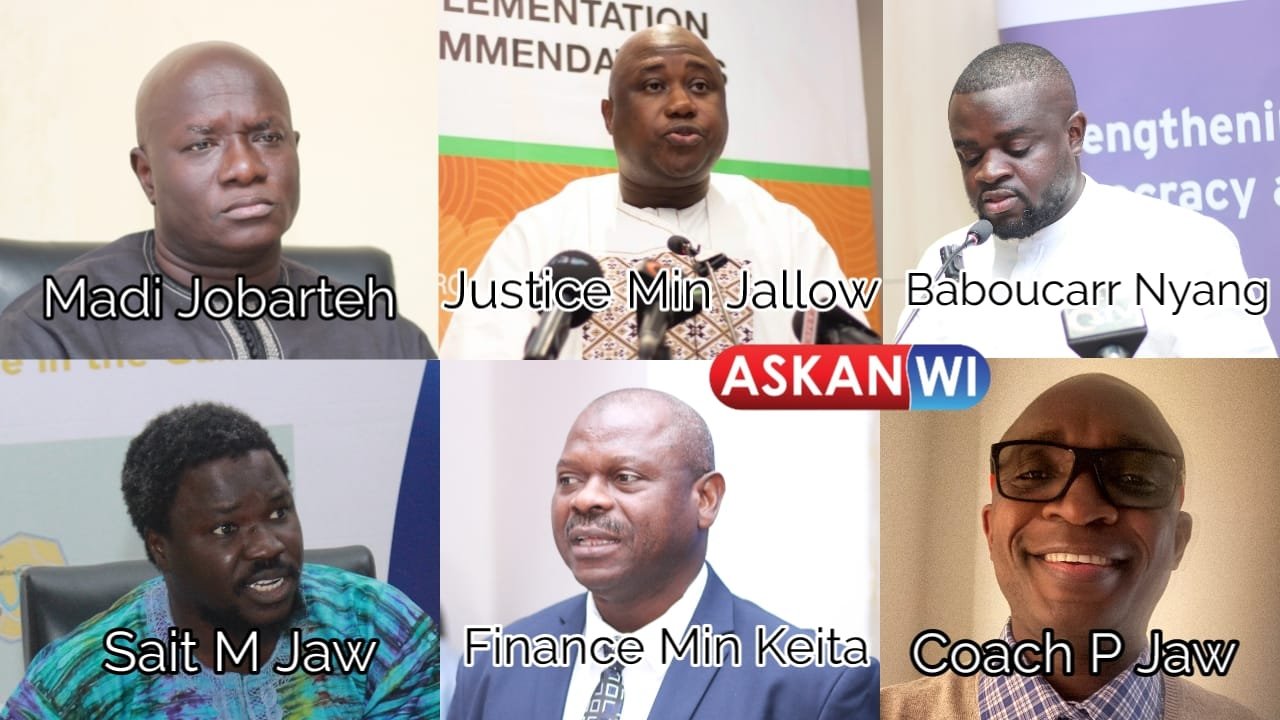
Four Advocates and Cabinet Ministers © Asakanwi
By Fatoumata Jaiteh,
The Gambia’s Supreme Court has ruled in favour of four civil society advocates, holding that the Minister for Finance and Economic Affairs, Hon. Seedy S. Keita, violated the 1997 Constitution by tabling the 2025 National Budget late.
The ruling followed a lawsuit filed on 19th December 2024 by Lawyers Abdoulie Fatty, Salieu Taal, and Lamin J. Dabo on behalf of civil society advocates Sait Matty Jaw, Madi Jobarteh, Pa Samba Jaw, and Baboucarr Nyang. The suit named the Minister for Finance and Economic Affairs, the Clerk of the National Assembly, and the Attorney General as defendants.
Askanwi Media was the first to raise the alarm over the Finance Minister’s late tabling of the 2025 budget, after observing that it was not presented within the constitutionally required timeframe. Section 152(1) of the 1997 Constitution provides that “the President shall cause the Secretary of State responsible for finance to prepare and lay before the National Assembly at least sixty days before the end of the financial year, estimates of the revenue and expenditure of The Gambia for the following financial year.”
This provision was previously amended through a private member’s bill, extending the period for budget consideration from 30 to 60 days in order to give lawmakers adequate time to scrutinise government spending proposals and to promote transparency, accountability, and fiscal discipline.
The plaintiffs argued that the Minister for Finance tabled the 2025 estimates of revenue and expenditure before the National Assembly on 15th November 2024, leaving lawmakers with approximately 42 days instead of the constitutionally mandated 60 days before the end of the fiscal year.
Aggrieved by what they described as a clear breach of the Constitution, the plaintiffs approached the Supreme Court seeking several reliefs, including:
A declaration that the decision of the National Assembly, through the Speaker, to permit the late tabling of the 2025 budget estimates constituted a violation of Section 152(1) of the Constitution (sustained).
An order declaring the late submission of the estimates unconstitutional, illegal, and void.
A declaration nullifying all proceedings, decisions, or actions taken in relation to the 2025 budget laid outside the prescribed timeframe.
Any other order the court deemed fit.
During the proceedings, the plaintiffs abandoned reliefs two and three, leaving the court to determine primarily whether Section 152(1) of the Constitution had been breached.
In defending the late tabling of the budget, the Finance Minister explained to Parliamentarians that the delay was due to ongoing discussions with the World Bank and the International Monetary Fund (IMF), which he said were critical to finalising the budget.
The matter sparked debate in the National Assembly, but lawmakers failed to reach a consensus on whether the estimates should be rejected. The Speaker subsequently ruled that the Constitution did not mandate the Assembly to refuse the tabling of budget estimates solely on the basis of lateness.
Relying on Order 8 of the Standing Orders of the National Assembly, the Speaker allowed the process to proceed. The budget estimates were eventually approved on 16th December 2024, thereby authorising government expenditure for the 2025 financial year.
Dissatisfied with the Speaker’s ruling, the plaintiffs argued that the decision undermined constitutionalism and the rule of law. They maintained that all state power must be exercised strictly within the confines of the Constitution and that where any provision of the Standing Orders conflicts with the Constitution, the Constitution—as the supreme law of the land—must prevail.
Judgment in the matter was delivered on 15th December 2025. In addressing the central issue of whether Section 152(1) of the Constitution had been contravened, the court held that it was an undisputed fact that the Finance Minister tabled the budget estimates on 15th November 2024, outside the 60-day timeframe required by law.
The court found that this delay constituted a clear violation of Section 152(1) of the Constitution.
While noting that the plaintiffs had abandoned reliefs relating to the validity of the budget itself, the court clarified that it would not extensively address arguments on whether the approved estimates were null and void. However, it observed that although the Minister acted outside the constitutionally mandated timeframe, the National Assembly could not have lawfully refused to receive the estimates once they were presented, as the Constitution does not provide for such refusal, even in cases of late submission.
In its final judgment, the Supreme Court declared that the Minister for Finance and Economic Affairs had indeed contravened Section 152(1) of the Constitution by failing to table the 2025 estimates of revenue and expenditure at least 60 days before the end of the financial year.
Editor’s Note:
Askanwi Media has consistently reported on the Finance Minister’s late tabling of the 2025 budget from the outset. Our coverage began with an editorial that first blew the whistle and questioned the delay. This was followed by a report quoting the Minority Leader who doubles as the Chair of Parliament’s Finance and Public Accounts Committee (FPAC), who described the late tabling as unconstitutional.
Askanwi further documented the Speaker’s ruling, which demanded an apology from the Finance Minister, and subsequently published an editorial titled “Is an Apology Sufficient When the President or Minister Violates the Constitution?”—questioning the adequacy of such a response and highlighting the combined failure of the President and the Finance Minister.
In response to the lack of accountability, four civil society actors—Sait Matty Jaw, Madi Jobarteh, Pa Samba Jaw, and Baboucarr Nyang—filed a lawsuit at the Supreme Court against the Clerk of the National Assembly, the Minister for Finance and Economic Affairs, and the Attorney General. This action was documented in a subsequent feature article.
The ruling reinforces the supremacy of the Constitution and underscores the obligation of public officials to strictly adhere to constitutional timelines, regardless of administrative or external challenges. Prior to the Supreme Court’s ruling, the Finance Minister made sure the 2026 Budget was tabled on time.
