
The Price of Being a Citizen: How Ordinary Citizens Capitalise on the National ID Card Process
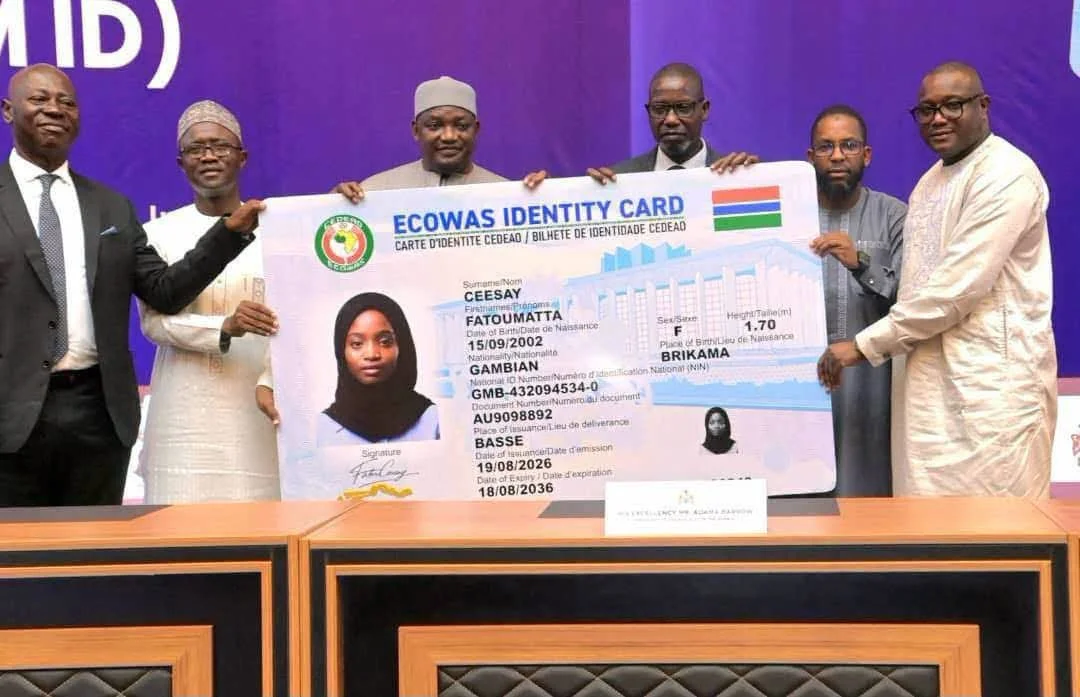
President Barrow and Interior Minister Launch National ID Card © Unknown
By Askanwi Media
Askanwi Media’s investigation into the National ID Card application process has uncovered that applicants have to pay more than the announced D450 at Ecobank. This second part of this investigation highlights that applicants are paying as much as D815 from additional charges for Immigration Forms and authorisation stamps.
Without considering the cost of transportation and a series of trips, the cost of a National ID Card could cost applicants up to D1,000 and so much time lost waiting to be seen. After paying for National ID Cards via Ecobank, our reporters braved the long queues at the Gambia Immigration Department’s (GID) offices to secure their National ID cards, where they observed people selling the forms and charging to fill and stamp forms, further increasing the cost of National ID Cards.
What Our Reporters Found
Askanwi Media reporters visited the Immigration Department offices in Kanifing, next to the Ministry of Higher Education, and the Brusubi branch to observe the application process firsthand.
At both locations, our reporters arrived well before the official closing time but were told that application forms were no longer being distributed to applicants.
This raised another concern: if the forms are free and applicants can only obtain a limited number of hard copies each day, what happens to those who arrive after the daily allocation has been exhausted?
One complaint received by Askanwi Media alleged that the Brusubi branch was printing only 15 National ID cards per day. This was denied by Mr Cham; however, he acknowledged that the department was facing challenges with electricity and internet connections, making it difficult to enrol all the applicants issued in a day.
“We understood that we’re facing some challenges as a new project. And we also look at some logistical issues.” According to Mr Cham, some of those challenges were related to power supply and internet connectivity.
When asked about the number of cards being printed at the various issuing centres, he pointed to Banjul, Abuko and Brikama as locations where significant numbers of cards were being printed. He said that, based on the department’s statistics, no issuing centre was printing fewer than 50 cards per day.
Why Are Applicants Told to Come Early?
The issue of access to application forms presented another apparent gap between official procedure and what our reporters encountered on the ground.
At one of the locations, our reporter was told that applicants needed to arrive as early as after Fajr prayer if they wanted to secure a form and submit their application. Askanwi Media asked Mr Cham whether this was an official practice and whether citizens were expected to arrive that early to access the service. He denied that the Immigration Department had instructed applicants to come at such an early hour.
According to Mr Cham, the high demand for National ID Cards is partly a result of the fact that card printing had been suspended for a period. The department is therefore controlling the number of forms distributed each day in an effort to ensure that applications received can be processed.
He explained, “For people to come and have access to the forms, some of them on their own decided to come early and queue because with that, they will easily have access to forms. But this is not from us. We never asked anybody to come early.”
Limited Forms Printed a Day
Mr Cham explained that the department is deliberately limiting the number of hard-copy forms distributed each day. According to Mr Cham at least 50 forms are being distributed per day, allowing the department to manage the applications and ensure that the cards can be processed.
“What we do is that we have to control the number of forms given out to applicants because if you give a large number of forms to applicants, you will not be able to address all of them that day.”
He further stated that the expectation is for an applicant to receive their National ID Card on the same day once the application and enrolment processes have been completed.
“When you apply, that’s the very day you get your ID card. It may take a space of five to 10 minutes. However, it also depends on the flow of internet connectivity.”
Mr Cham said that, where the enrolment process has been completed successfully, the department expects applicants to receive their cards within five to 10 minutes, subject to internet connectivity.
Although Mr Cham claims that the process should take 5 to 10 minutes, our reporter has had to visit the Immigration Office for enrolment three times. On the first occasion, only the form was bought. On the second occasion the form was filled and returned with an instruction to return it the following day. Finally, on the third occasion, our reporter was enrolled late in the evening as immigration staff stayed behind to ensure applicants on the queue were registered.
Free Forms — But Not Everyone Knows
Another important point raised by Mr Cham is that National ID Card application forms are free of charge.
He informed Askanwi Media that the forms are available for download through the Ministry of Interior’s website and the Gambia Immigration Department’s online portal.
This means applicants who are unable to obtain one of the limited hard copies can, in principle, download and print the form themselves without paying anyone for it.
But this is where our reporters encountered another development.
The D250 Forms and D100 Filling and Authorisation
At the Kanifing Immigration office, our reporter observed individuals offering application forms to people who had arrived after the available hard copies had been exhausted.
Some applicants appeared unaware that the forms could be downloaded and printed free of charge online. Instead, individuals at the location were offering to provide the forms for D250 each.
The situation created an opportunity for some individuals to capitalise on the limited availability of hard-copy forms. Our reporter was approached and offered a form at a discounted price.
In addition to paying for a form, our reporter had to pay D100 for his form to be filled and stamped by individuals hanging around the GID offices. It’s generally understood that without the stamps, the forms will not be accepted.
The reporter paid for the form.
While the Immigration Department says the forms are free and available online, applicants without access to the internet, smartphones, printers or sufficient information about the online option may find themselves dependent on others.
And where demand exceeds the number of hard-copy forms available each day, an informal market can emerge.
Far from the announced D450 fee, applicants have to pay for a National ID Card; the lowest applicants must pay is the D450 Announced Fee, D10 Ecobank Counter Charge, D0 Immigration Form & D100 Filling and Stamp = D560.
Meanwhile, on the other end of the scale, one of our reporters has had to pay the D450 Announced Fee, D15 Ecobank Mobile App Charge, D250 Immigration Form & D100 Filling and Stamp = D815.
Our investigation has demonstrated that applicants usually have to pay well above the D450 announced fee, with some having to pay up to D815 without considering the multiple transportation fees and time lost at the Immigration Office.
It appears that individuals are trying to capitalise on the National ID Card Application process, including Ecobank. It’s possible that applicants have been issued their cards within 5 to 10 minutes, but our reporters' experiences highlight that for most applicants they will have to make multiple visits to the immigration offices just to secure their National ID card.
The price of being a citizen doesn’t only require money, but it also requires significant patience and persistence.
This is Part 2 of our investigation into the National ID Card application process.
Read the first publication in this series in the link: The Price of Being a Citizen: Capitalising on the National ID Card Application Process.
Read the second publication in this series in the link: The Price of Being a Citizen: Is Ecobank Capitalising on the National ID Card Process?
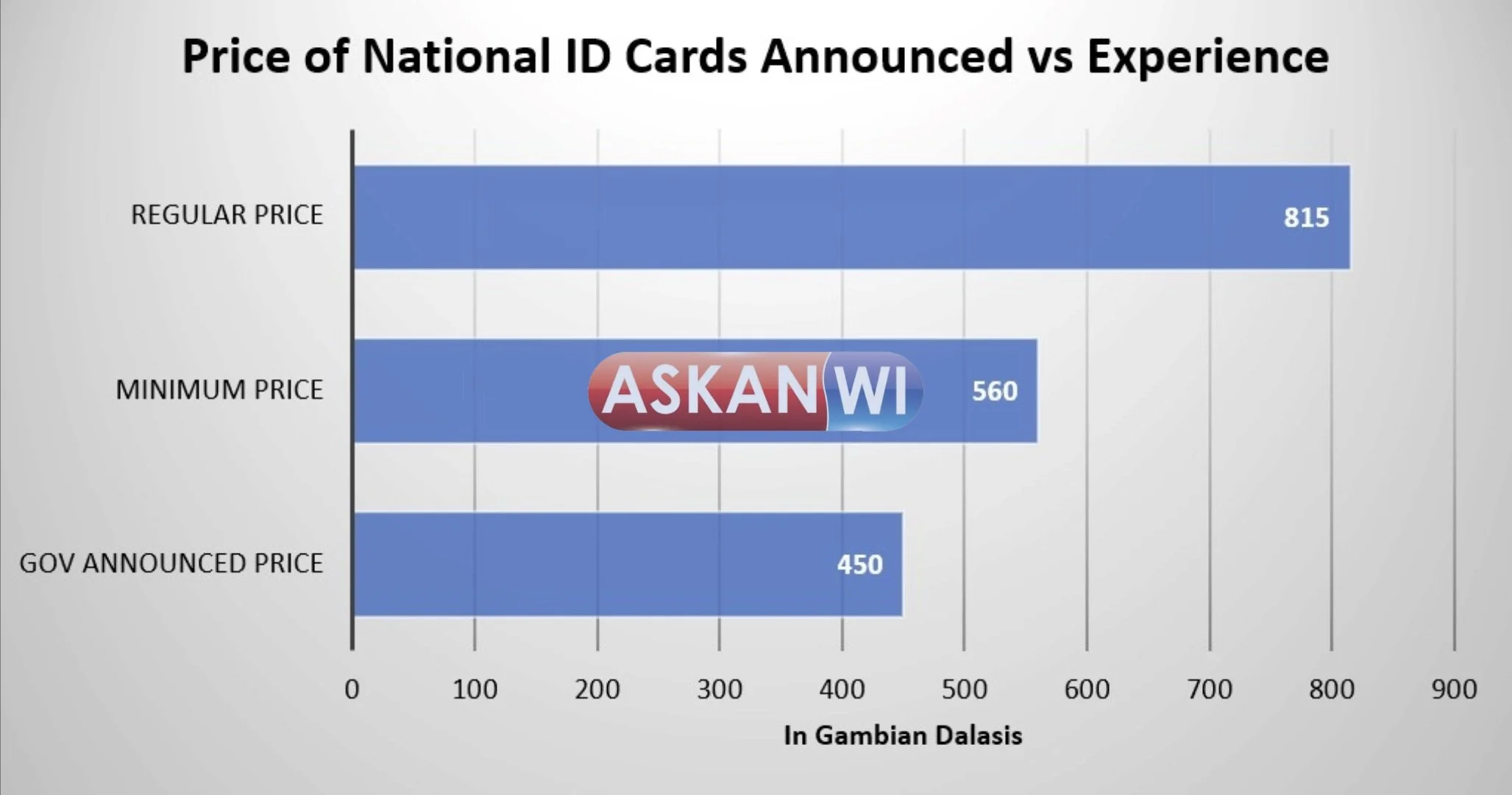
Government Announced Price vs Min and Regular Price © Askanwi Media
Support Independent Journalism in The Gambia
If you believe in accountability, fact-based reporting, and citizen journalism, support Askanwi Media's work.
Your contribution—big or small—helps us continue reporting stories that matter.
You can support us through:
GoFundMe - https://www.gofundme.com/f/support-askanwi-reliable-news-for-the-gambia
Bank Transfer - Access Bank (Gambia) Ltd - Account Name: Askanwi Media - Account Number: 0030110000086 - BBAN: 007301011000008608
WAVE - Yusef Taylor - 87 772 4140
Every donation keeps independent journalism alive. Thank you for standing with Askanwi.
