
A Park Divided: Unresolved Manjai Park Ownership Casts Shadow Over 2026 Nawettan
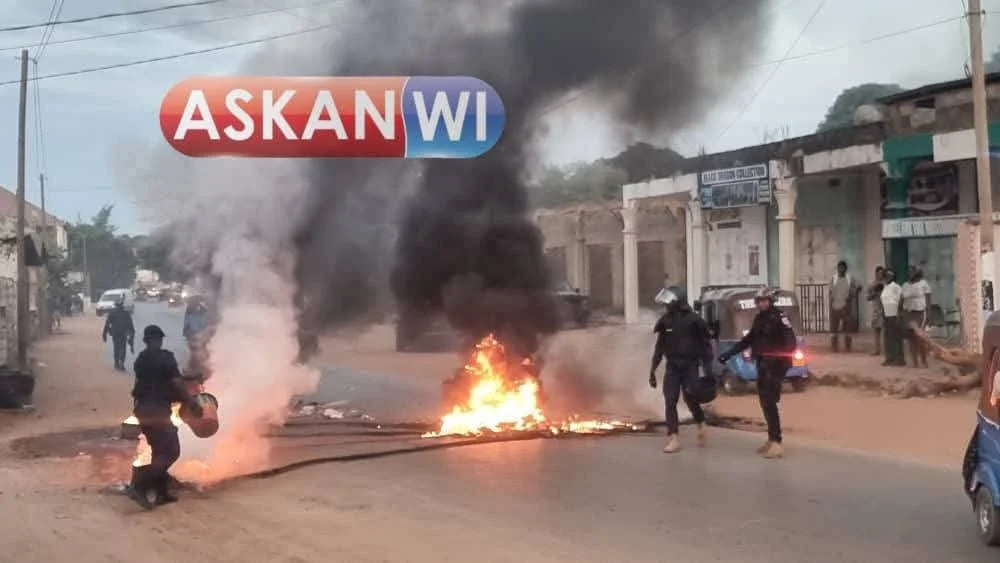
New Year Tensions Doused by Police © Askanwi Media
By Askanwi Media
The Father Gough Sports Complex, commonly known as Manjai Park, finally reopened its gates in May 2026 after four months of closure. However, the deepening dispute over its ownership, which led to its closure, remains unresolved. This dispute is expected to escalate into a legal battle at Bundung High Court tomorrow, 7th July 2026, where a successful injunction application could halt the Nawettan and any activities at Manjai Park.
For months, the Kanifing Municipal Council (KMC) attempted to broker a solution with the Manjai Kunda Village Development Committee (Development Committee), which believes the park belongs to the community. After the Development Committee accused the KMC of being biased, the Office of the Kanifing Municipality (KM) Executive Coordinator took over the negotiations, leading to the signing of a Memorandum of Understanding (MoU) between the Development Committee and the Manjai Sports Association (MSA) on 16th August 2025. The agreement allowed the 2025 Nawettan to proceed, but the respite proved short-lived.
Last year, the ownership dispute prompted all five Manjai teams to boycott the 2025 Nawettan, and with negotiations once again at an impasse, their participation in this year's tournament remains uncertain.
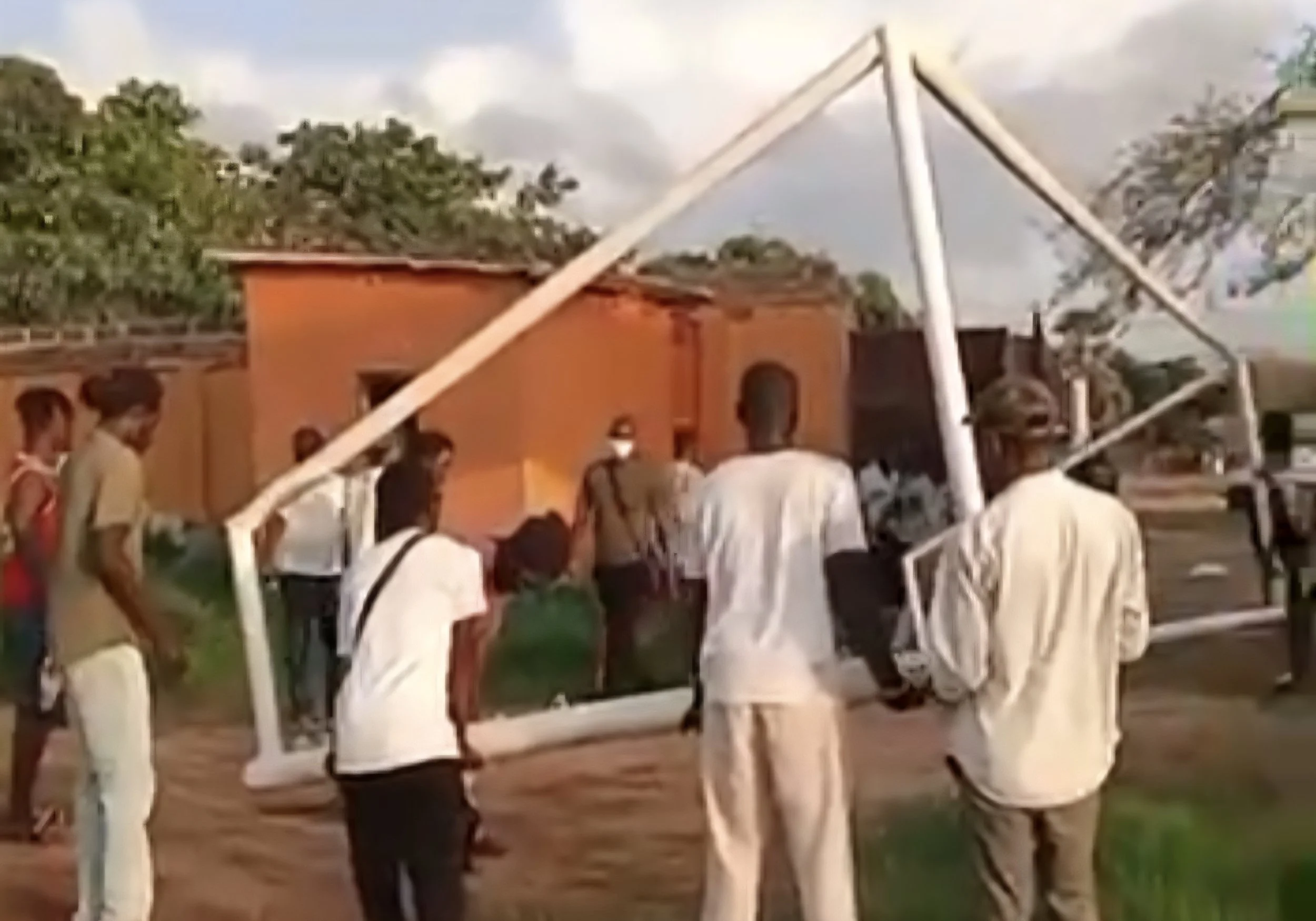
Manjai Community Leaders Seize Goal Post © Image from Ebrima KB Sonko Video
Rising Tensions Threaten Nawettan Tournament
Tensions reached fever pitch on 13th August 2025, just days before the signing of the 2025 MoU, when community members reportedly entered the park, removed goalposts and attempted to halt Nawettan activities. The KM Executive Coordinator's Office eventually negotiated an agreement that allowed the tournament to proceed.
Nawettan is a widely popular grassroots zonal football tournament held during the rainy season and is regarded as a breeding ground for football talent in the country.
Tensions resurfaced on New Year's Day (1st January 2026) when members of the community attempted to play a match but were denied access to the facility. Officers of the Police Intervention Unit (PIU) were subsequently deployed to the area, where they dispersed the gathering and arrested several individuals.
In reaction, some youths took to the streets in protest and burnt tyres on the road. Our reporter, who was at the scene, later observed PIU officers removing the burning tyres and engaging the youths to restore calm and normal traffic flow. No further arrests were made, and those arrested before the protest were later released without charge, according to a statement issued by the Development Committee.
The standoff intensified on 13th February 2026, when members of the local community were again denied access to the park following a press conference.
During the presser, held at the park as part of the Development Committee's Manjai Week Tournament, the group announced that it was "reasserting its legal and rightful ownership" of the facility. The declaration prompted the KM Executive Coordinator, Hon Bakary Kara Singhateh, to temporarily close the sports complex to allow dialogue between the parties.
Those discussions produced a draft MoU prepared by the KM Executive Coordinator. However, the Development Committee rejected the proposal and said it had submitted its own draft MoU. As of now, no agreement has been signed between the Development Committee and the MSA to guarantee an uninterrupted 2026 Nawettan tournament in the Manjai Zone.
Currently, Manjai Park is managed by the MSA, which organises the Nawettan tournament and rents out the facility. Over the years, the park has also served as a hub for youth engagement, Gambia Football Federation divisional matches and entertainment events, particularly during festive periods.
Although the park has reopened, the underlying ownership dispute remains unresolved. To better understand the origins of the conflict, our reporter interviewed stakeholders and reviewed historical records.
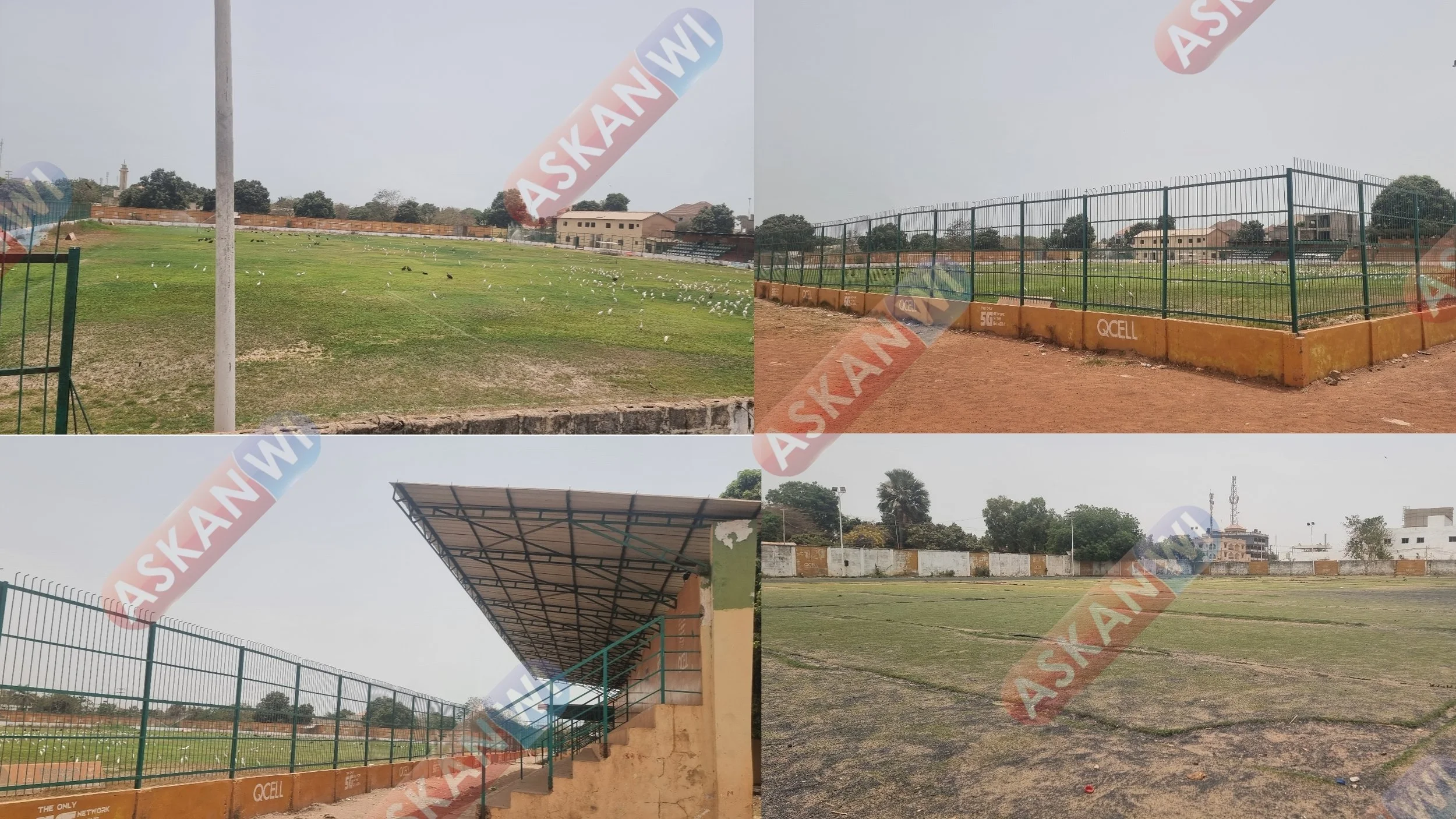
Manjai Park © Askanwi Media
Origins of the Ownership Dispute
Competing narratives exist over the history of the land on which the park is built. According to the Development Committee, the land originally formed "part of the historical farmlands of the people of Manjai Kunda" before it was later earmarked to serve as a "barracks for the defunct Senegambia Confederation army". The plan, they said, never materialised, and the land eventually reverted to community use before being transformed into a football field.
However, Lamin Keita, former secretary of the Manjai Youth Development Association (MYDA), offered a slightly different account, stating that the land had initially been "reserved for the Ministry of Interior" before later becoming a sports ground. Despite these differing narratives, both accounts converge on the community's role in the early development of the facility.
Prior to the MSA taking control of the park, MYDA managed the facility until 2014, when the KMC handed it over to another Manjai Sports Committee, which eventually became the MSA.
Keita told Askanwi that in 1996, the Yahya Jammeh-led government awarded the Manjai Community $1,000 as part of a national initiative recognising "organised community projects". According to him, community elders used part of the funds to build a mosque, while the remaining amount went towards fencing and securing the football field. The project, he explained, was facilitated by KMC and Gamworks, which later constructed a pavilion after completing the fencing.
The Development Committee is the executive of the Manjai Community.
Former KMC councillor Hon. Momodou Lamin Badjie, who once chaired the Council's Youth and Sports Committee, confirmed that the fencing project was undertaken with support from KMC and Gamworks under the leadership of then-Mayor Abdoulie Conteh after the Jammeh government donated the $1,000 to the Manjai Community.
A KMC fact-finding report dated 17th March 2025 and seen by Askanwi also confirmed that former President Jammeh contributed financially towards fencing the park. However, the local community gradually lost exclusive control of the facility after it became the home of Manjai Zone, which serves multiple communities within the municipality.
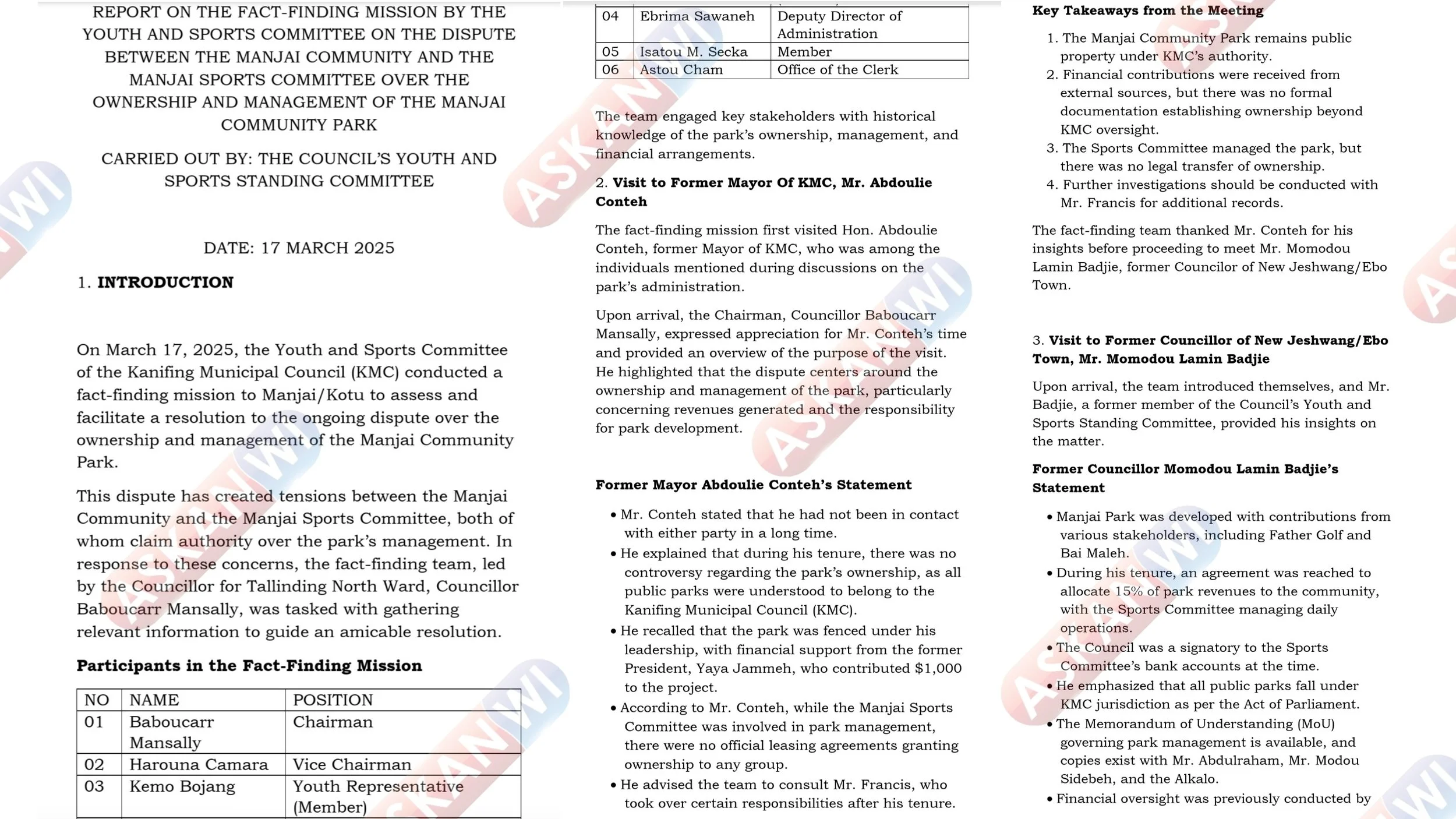
KMC Factfinding Report © Askanwi Media
From Community Control to Municipal Oversight
In its early years, the facility was largely managed by MYDA, which organised sporting competitions and oversaw daily activities at the park. Keita noted that MYDA was formally entrusted with management responsibilities in 2002 through the village Alkalo, with revenue generated from the park being reinvested into maintenance and community projects.
The governance structure began to shift in 2011 when Manjai was officially recognised as a Nawettan Zone. That recognition expanded participation beyond Manjai to surrounding communities such as Bakoteh, Kololi and Kotu, effectively placing the facility within a wider municipal sports governance system.
Former councillor Badjie explained that "once Manjai became a zone, it was no longer solely a community facility" because it now served other communities within the Manjai Zone.
Research by Askanwi uncovered earlier reports published by Foroyaa indicating that sports authorities had advocated for the sports committee to operate independently from MYDA, similar to arrangements in other Nawettan zones.
The transition from community-led management to institutional oversight was far from smooth. Keita explained that tensions escalated around 2013 and 2014 after concerns emerged within MYDA that the organisation was becoming too focused on Nawettan activities. According to him, this led to reforms that limited MYDA's direct involvement in the sports committee while allowing certain MYDA officials to remain part of the Nawettan structure.
Keita said a 2013 MoU was subsequently signed requiring the sports committee to pay D50,000 in maintenance fees for use of the facility. However, he alleged that only half of the agreed amount was paid, forcing MYDA to withdraw the remaining D25,000 from the QCell League prize money cheque. This further strained relations between MYDA and the now-defunct Manjai Sports Committee and eventually led to fresh consultations involving both stakeholders and the KMC.
Keita further claimed that a draft MoU was later prepared and boycotted by MYDA. This was confirmed by KMC Councillor Hon. Bubacarr Mansally, who chairs the Youth and Sports Committee at the Council when he told our reporter that the draft MoU "was not completed because one party refused to sign". Nearly a decade later, the dispute has resurfaced following a new development proposal.
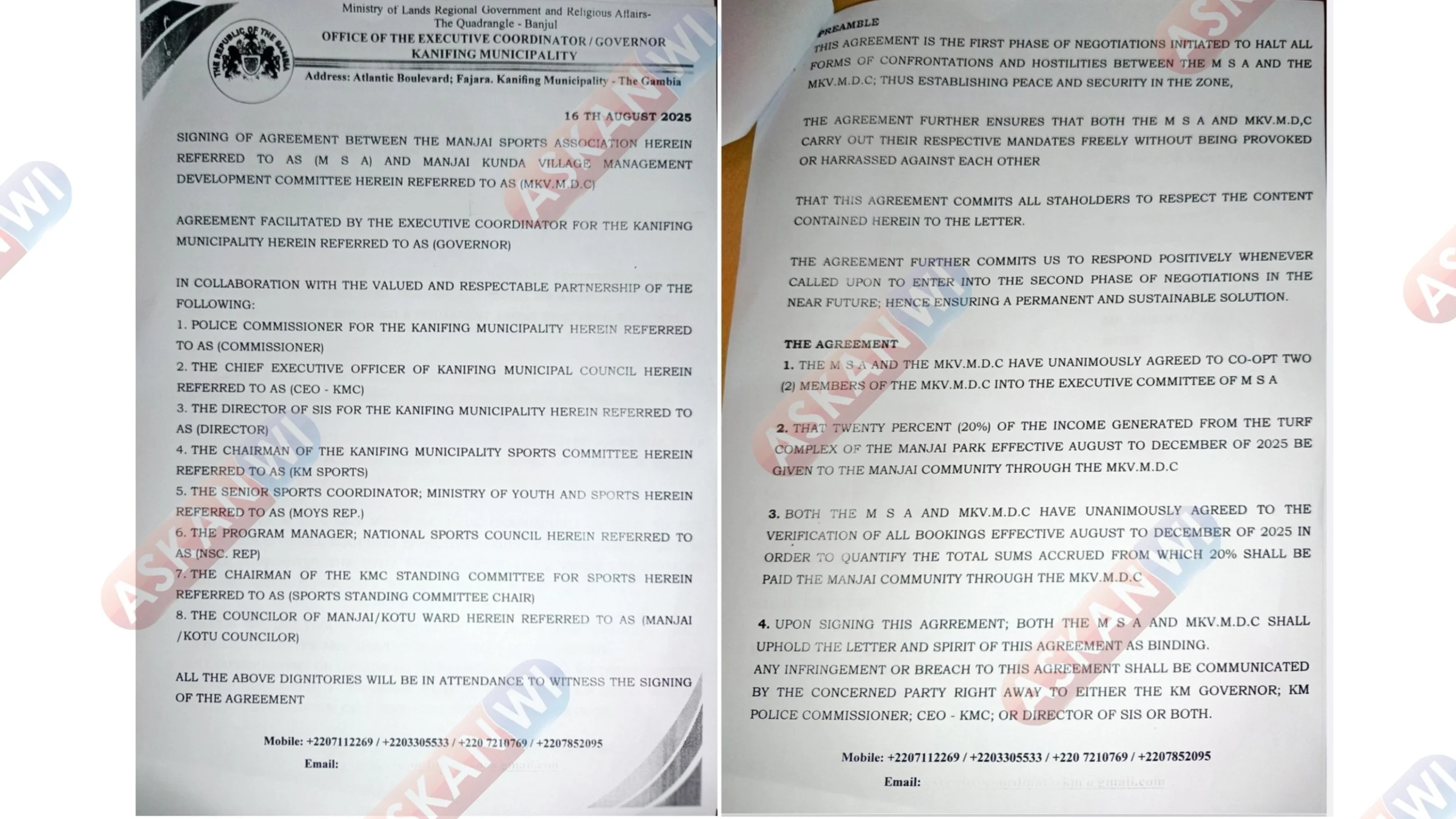
Last successful KM Exec Coordinator 2025 MoU Signed by all parties © Askanwi Media
Development Plans Unearth Historical Ownership Dispute
The current phase of the conflict was triggered by proposed partnership arrangements to renovate the Biri Biri Artificial Turf in 2024. According to former MSA President Pa Ebrima Sawaneh, opposition emerged after Manjai/Kotu Ward Councillor Hon. Lamin Jammeh allegedly "mobilised sections of the community against the proposal, portraying it as an attempt to privatise the facility".
The Biri Biri Artificial Turf is a smaller football pitch within the Manjai Park complex. It was developed by the Father Gough Foundation but has since fallen into a dilapidated state.
Efforts by Askanwi to obtain a response from Hon. Jammeh were unsuccessful. However, Hon. Mansally suggested that the councillor may have alerted the community after learning about the proposal during council discussions.
The MSA maintains that the proposals were submitted through standard municipal procedures and were intended "solely to support renovation and development works at the facility". The proposal, however, revived longstanding questions over the historical ownership of the park.
At the heart of the dispute is a fundamental disagreement between historical ownership claims and legal custodianship. KMC officials insist that, under the Local Government Act, all community parks fall under the authority of the Council. They argue that this challenge is mirrored in numerous communities across the country where government has failed to produce title deeds for community parks.
Hon. Mansally stressed that while management responsibilities may be delegated, ownership itself cannot legally be transferred. This position is supported by the Council's fact-finding report and echoed by former KMC councillor Hon. Badjie.
However, the Development Committee rejects this interpretation, arguing that the community's historical connection to the land and its contribution to the development of the facility give it a legitimate claim over the park.
Currently, the Development Committee has rejected the new draft MoU, which sought to broker the conflict by offering the Manjai Community authority to manage and control the Biri Biri Artificial Turf.
Instead, they have submitted their own draft calling on the MSA and the KM Executive Coordinator to hand over control of the entire park, casting a shadow over the 2026 Nawettan season. Tomorrow, 7th July 2026, the Manjai Community has summoned MSA and the KM Executive to Bundung High Court seeking an injunction against their use of Manjai Park pending the determination of the case proper, which is legal custody of Manjai Park.
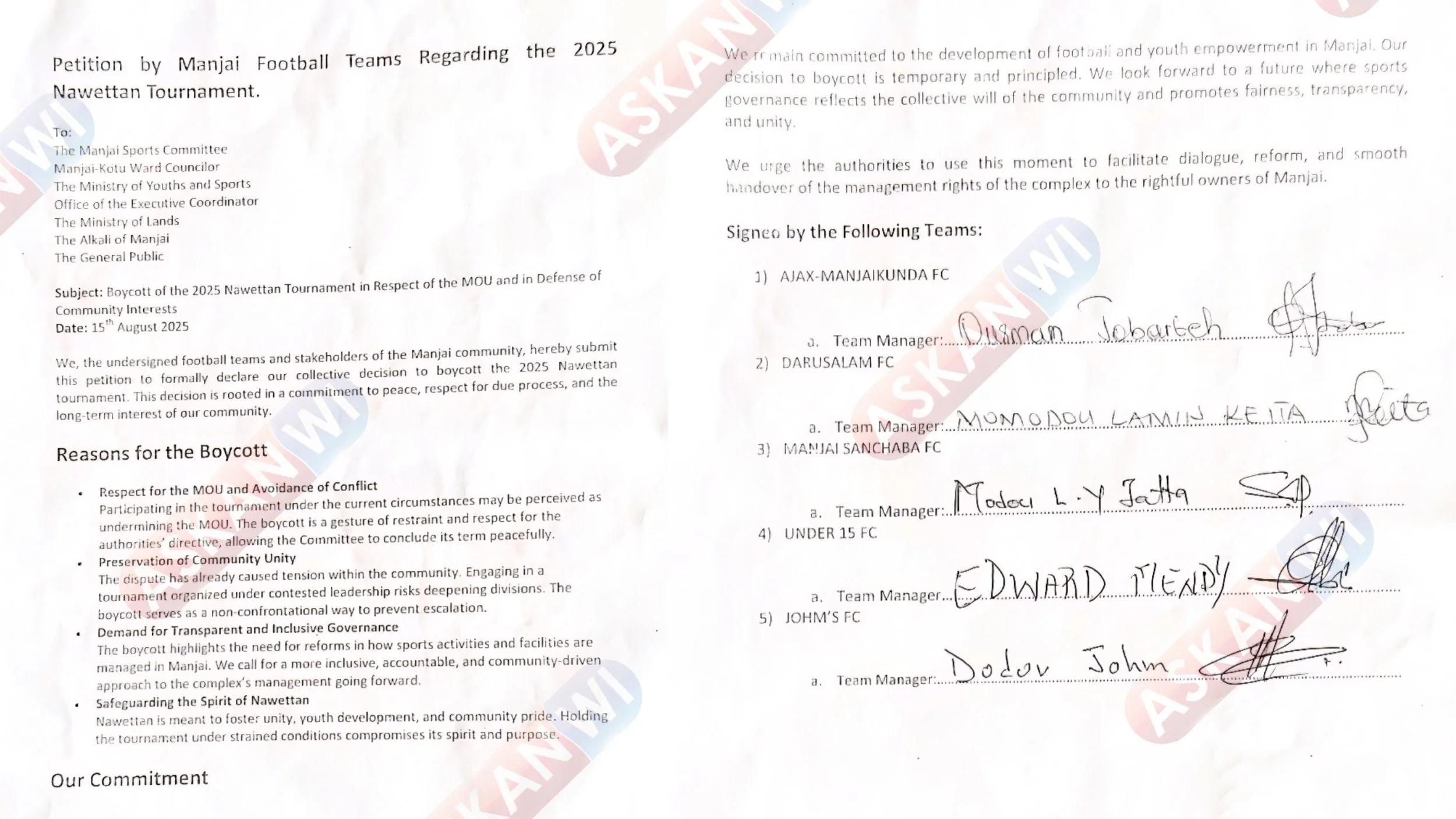
Boycott Petition by Five Manjai Teams in 2025 © Askanwi Media
