
NAWEC PRO Speaks to Askanwi © Askanwi Media
By Edward Dalliah, Jr.
As Gambians continue to endure prolonged power outages, questions continue to mount over the National Water and Electricity Company’s (NAWEC) promise to restore stable electricity supply by mid-June, after publishing a load-shedding roster that extends to the end of June 2026. NAWEC Public Relations Officer Mr Buba Badjie, held an exclusive interview with Askanwi Media on 10th June, responding to the public’s concerns, just five days before the deadline.
The publication of the roster has fuelled public scepticism, as it appears to contradict assurances previously given by NAWEC Managing Director Gallo Saidy that the blackouts would return to normal by the middle of the month. What started as blackouts in the Greater Banjul Area (GBA) and the West Coast Region (WCR) has now expanded to rural areas.
Many consumers have complained about the impact of the blackouts on businesses, healthcare services, education and household livelihoods, particularly during the period of the Muslim feast of “Tobaski.” The worsening situation has also triggered public demonstrations online and the announcement of a planned peaceful protest on 19th June 2026 by Gambians Against Looted Assets, who submitted a protest permit request from the office of the Inspector General of Police.
Additionally, the electricity blackout took centre stage at the National Assembly, where lawmakers raised concerns about electricity supply challenges and the country's continued dependence on imported power.
During a Matter of the Day raised by the National Assembly Member for Latrikunda Sabiji, Hon. Yahya Menteng Sanyang, on Thursday 11th June 2026, he stated that “millions of Gambians across the GBA, WCR and beyond are being subjected to unendurable darkness. This is no longer a mere inconvenience; it is a full-blown economic and social emergency.”
Hon. Sanyang added that many businesses are losing revenue because of the ongoing electricity crisis. Despite the growing frustration, NAWEC maintains that it remains committed to meeting its restoration target.
In an exclusive interview with Askanwi, NAWEC's PRO Mr Buba Badjie was asked if the publication of the roster meant that load shedding will continue until the end of June.
In his response Mr Badjie reaffirmed NAWEC’s commitment to restore electricity by mid-June and explained that the roster serves as a guide for customers and is not an indication that they have abandoned their mid-June target.
The utility's position is consistent with assurances previously given by both NAWEC and its Managing Director, Mr Gallo Saidy. In a press statement issued on 30th May 2026, NAWEC attributed the worsening electricity situation to challenges affecting both regional imports and domestic generation capacity.
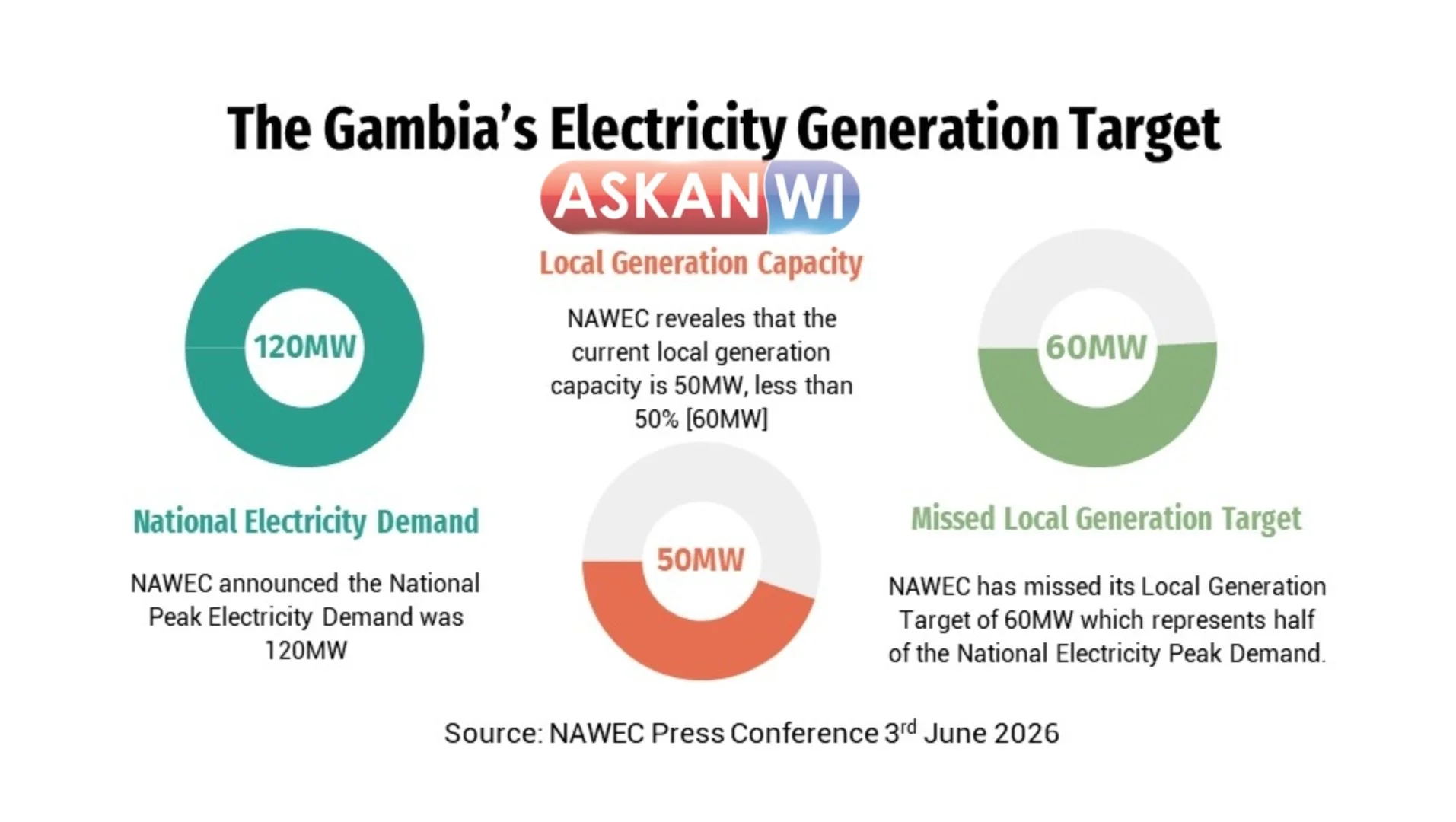
Infographics on NAWEC Local Electricity Generation Demand and Target © Askanwi
According to the utility company, electricity imports had been reduced by up to 60 megawatts due to technical issues and fuel shortages affecting generation facilities within the regional power network.
“At the same time, domestic backup generation is not yet fully available due to ongoing maintenance activities and operational constraints. As a result, there is currently a significant shortfall exceeding 50% of electricity demand,” the statement noted.
At a recently held press conference, NAWEC revealed that they are currently generating about 50 MW of electricity locally while the country requires 120 MW nationally. NAWEC PRO Mr Badjie admitted that currently they have not achieved their target of producing 60 MW locally.
Despite these challenges, the state-owned enterprise assured customers that “based on current assessments, NAWEC expects a gradual return to normal electricity supply by mid-June 2026, subject to the timely restoration of regional imports and completion of ongoing maintenance works.”
The situation has reignited longstanding concerns about investment in domestic power generation despite significant financial support received by the energy sector over the past several years, which critics estimate exceeds US$440 million.
Critics argue that despite the substantial investments made in energy infrastructure and sector reforms since 2017, the country remains heavily reliant on imported electricity and vulnerable to disruptions originating outside its borders. They contend that NAWEC has “neglected” domestic generation while focusing on expanding electricity access and frequently highlighting the electrification of communities across the country.
However, according to Mr Badjie, these funds have been used to improve the company’s infrastructure, including investments in transmission and distribution networks, as well as power lines connecting communities and linking the country to the OMVG network.
For many Gambians, however, the immediate concern remains whether NAWEC will fulfil its promise of restoring stable electricity by mid-June or whether the load-shedding schedule extending to the end of the month signals a longer period of uncertainty ahead.
