
‘Any Serious Country Would Consider Backway Deaths a National Tragedy,’ Says NAFAA Leader
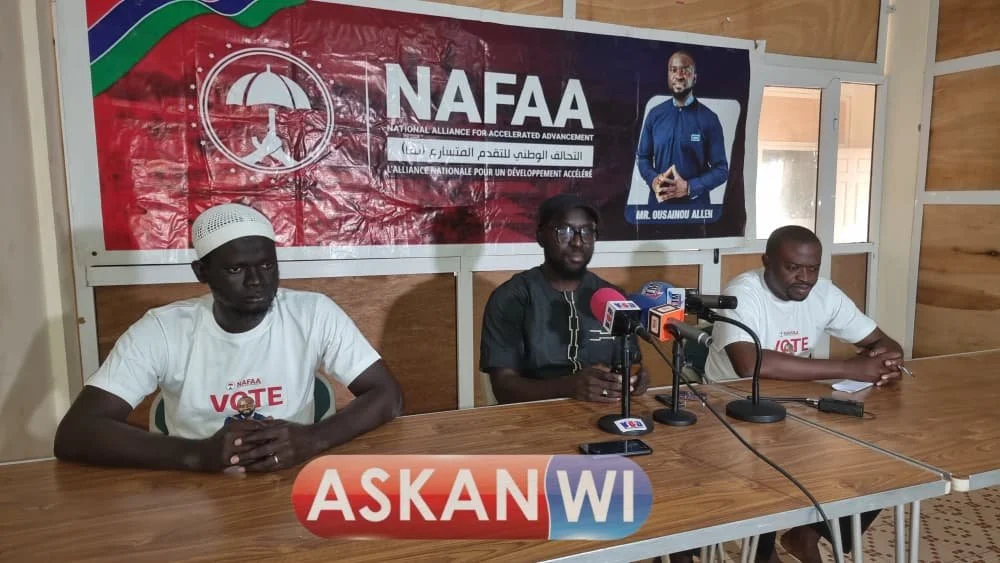
NAFAA Press Conference © Askanwi
By Edward Francis Dalliah, Jr.
The interim leader of the National Alliance Accelerated Advancement (NAFAA), Ousainou Allen, has called for the recent irregular migration deaths off the coast of Jinack to be treated as “a national tragedy,” as official figures confirm dozens dead and others still missing.
Mr. Allen made the remarks during a press conference on Monday, 5th January 2026, describing the incident as one that should prompt urgent national reflection and decisive action. He told journalists that “any serious country would consider this a national tragedy, and whatever necessities need to be put in place to mitigate it should be done.”
According to migration activist Ebrima Drammeh, as of 5th January 2026, 25 bodies had been recovered, while around 80 people remain missing after the boat capsized on the night of 31st December 2025. Drammeh further revealed that nearly 900 Gambians died attempting to reach Europe in 2025 alone, including 840 at sea and 26 on land, with some believed to be missing after 72 boats disappeared without a trace.
In a separate statement, the Gambia Immigration Department (GID) confirmed that 102 migrants were rescued, while a joint search and rescue operation, led by the Gambia Navy with support from local fishing communities, recovered 15 bodies in The Gambia and 16 in Senegal as of 4th January 2026.

President Adama Barrow © State House of The Gambia
The GID disclosed that ‘23 survivors remain hospitalised, while 82 individuals have been handed over to immigration authorities, processed, and provided medical assistance and family-tracing support in collaboration with the Gambia Red Cross Society and the National Disaster Management Agency (NDMA).’ Of the 82 survivors, the immigration stated that “40 are Gambians, 31 Senegalese, 7 Guineans, 2 Ivorians, and 2 Malians. [The group includes] 73 males and eight females, among them two minors.” [And] among those hospitalised include 10 Gambians, 7 Senegalese, 4 Guineans, and 2 Malians.”
However, a more recent update from the Ministry of Defence dated 6th January 2026 reported that “a total of 112 persons were successfully rescued, comprising 54 Gambians, 42 Senegalese, 9 Guineans, 3 Malians, 2 Ivoirians, 1 Burkinabe, and 1 Sierra Leonean.” The statement from the ministry further noted that “39 deceased persons were recovered, of which 24 were recovered within Gambian territory and 15 within Senegalese territory.”
With this tragedy, efforts are made by the authorities to crack down on suspected would-be migrants and migrant smugglers. From 3rd to 6th January 2025, 277 suspected would-be migrants have been reported to have been intercepted by the GID. In addition to this, “on Monday, 5th January 2026, an alleged migrant smuggler, Karamo Njie of Ginak Kajata,” was reported to be arrested. The GID as of 6th January 2026 reported that they have “about seven suspected migrant smugglers in custody at the Migration Management Center in Tanji, awaiting further investigation and necessary legal action.”
Following the Ginack incident, President Adama Barrow, in a national address, warned that anyone found responsible or complicit would be dealt with according to the law. However, investigations by Askanwi indicate that The Gambia lacks specific legislation criminalising migrant smuggling, limiting the state’s ability to prosecute offenders. Although a new Immigration Bill, which includes provisions to criminalise migrant smuggling, has been drafted, a source told Askanwi that it is currently undergoing review and yet to receive parliamentary approval, raising concerns about how those arrested will be prosecuted as irregular migration continues to claim lives.
NAFAA, currently a political movement seeking registration with the Independent Electoral Commission (IEC) ahead of the 2026–2027 election cycle, said it intends to pursue legislative reforms to combat irregular migration. Mr Allen noted that the movement would push for laws that criminalise individuals who profit from organising dangerous migration journeys.
