

Launch of AVLO Youth Wing © Askanwi Media
By Haddy Ceesay
The Alliance of Victim-Led Organisations (AVLO) has launched its youth wing, the Next-Generation Peacemakers (NEXT-PJ) Project, alongside the opening of a two-day residential capacity-building training aimed at strengthening youth participation in transitional justice and peacebuilding in The Gambia.
The initiative, funded by the European Union (EU), commenced on Wednesday, 11th November 2026, at Sarge’s Hotel in Kololi and will run until 12th November.
The project aims to strengthen young relatives of victims by equipping them with the knowledge and skills to participate in transitional justice processes, advocate for victims’ rights and contribute to sustainable peacebuilding.
Speaking at the opening ceremony, Sirra Ndow of the Alliance of Victim-Led Organisations noted that the initiative seeks to engage young people as active stakeholders in transitional justice, national reconciliation and rebuilding efforts.
She explained that the project would provide a platform for young people to amplify their voices and contribute meaningfully to their communities and beyond.
“These initiatives are intended to ensure that the Youth Wing is not simply a platform for learning but an active structure through which young people can contribute meaningfully to the work of AVLO, the wider transitional justice project and the national peacebuilding programme,” she said.
Ndow emphasised that the initiative was more than just a workshop, describing it as the beginning of a journey for young people to become promoters of justice and peacebuilders.
She encouraged participants to embrace the opportunity, contribute their experiences and perspectives, and take ownership of the initiative.
“This country belongs to you, so take charge,” she told the participants.
During the two-day training, participants will explore several important topics, including human rights and the rule of law, transitional justice, accountability, reparations, memory and memorialisation, compensation, peace and reconciliation.
Ndow expressed hope that the discussions would strengthen participants’ understanding of these issues and prepare them to play active roles in promoting human rights within their communities and beyond.
She also expressed appreciation to the government, project partners and Democracy International for their support in making the initiative possible.
She further acknowledged the contributions of the Center for Research Policy and Development (CRPD), Think Young Women (TYW) and the National Women’s Council for supporting the selection process of the young leaders participating in the programme.
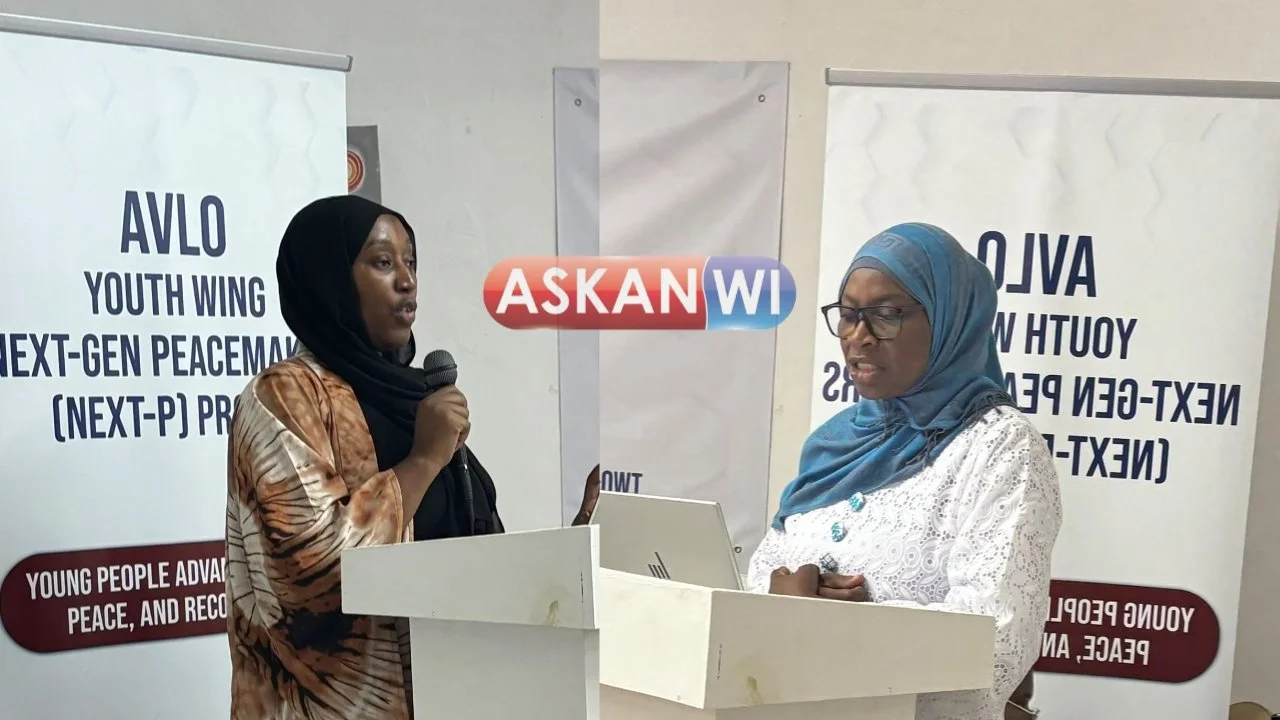
Speakers Ngoneh Jeng (left) and Sirra Ndow (right) © Askanwi Media
Meanwhile, Ndaye Ngoneh Jeng, Project Manager at Democracy International, reaffirmed the organisation’s commitment to strengthening youth participation in transitional justice and peacebuilding.
She told delegates that the project seeks to strengthen cooperation between the National Youth Council, the Ministry of Justice and civil society organisations to ensure the effective implementation of the National Action Plan on Women, Peace and Security and the wider post-TRRC agenda.
According to Jeng, the initiative aims to increase youth participation by 2028 while ensuring that at least half of the participants are women and that young people from communities outside the Greater Banjul Area are significantly represented.
She described AVLO as an important partner in advancing transitional justice and youth participation in The Gambia.
Jeng noted that since its establishment in 2024, AVLO has faced challenges in securing the financial resources needed to implement its activities and programmes, particularly amid changes in the operating environment for civil society organisations.
She explained that Democracy International was pleased to support AVLO in achieving some of its objectives, expressing hope that by the end of the project in 2028, the organisation would have made significant progress in strengthening its capacity and contribution to transitional justice and peacebuilding.
Jeng also urged participants to make the most of the training, stressing that young people working with AVLO in their respective communities must understand the transitional justice process, the progress The Gambia has made the government’s commitments and the outstanding issues that still need to be addressed.
She added that such knowledge would enable participants to explain transitional justice processes to their communities and contribute meaningfully to ongoing national efforts.
The NEXT-PJ initiative is expected to provide young people, particularly relatives of victims, with opportunities to participate in discussions, advocacy and community-based activities relating to human rights, accountability, victims’ rights, peace and reconciliation.
The project will continue until 2028, with a focus on strengthening youth leadership and ensuring that young people have a meaningful role in The Gambia’s transitional justice and peacebuilding processes
