
Door-to-Door: South African Mobs Escalate Xenophobic Violence Against Suspected Migrants
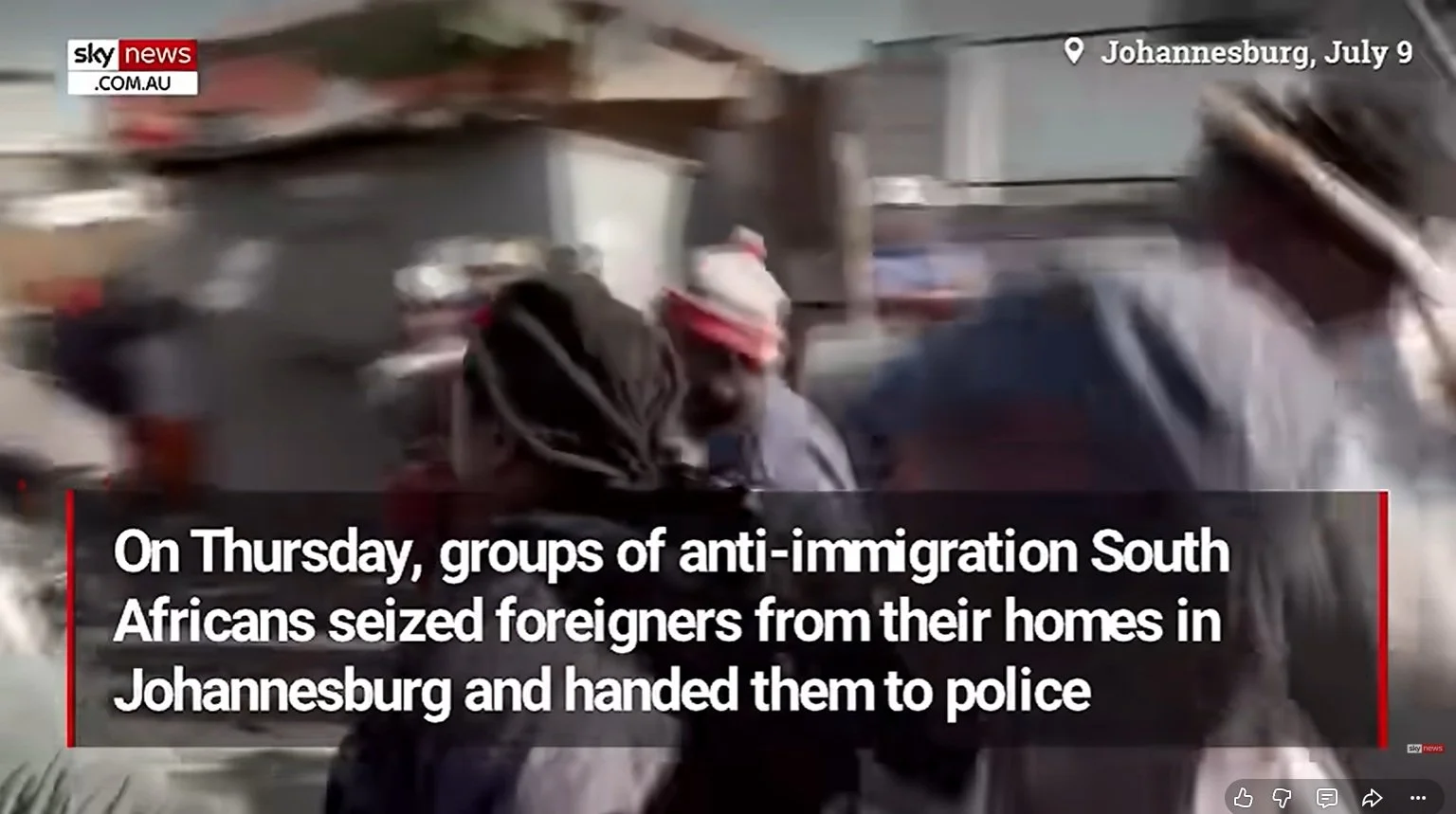
Sky News Screenshot of a suspected Migrant being paraded and handed over to Police.
By Yusef Taylor, @FlexDan_YT
Multiple news outlets have reported that South African mobs have broken into homes where African migrants reside, arresting them, parading them through the streets, and handing them over to the police on 9th July 2026.
Last Tuesday, 30th June 2026, saw a large-scale protest against both undocumented and documented migrants in South Africa, who were ordered by anti-immigrant protest leaders to leave the country or face the consequences. Protest organisers declared the deadline a resounding success as multiple groups took to the streets under the leadership of the March and March pressure group, led by former radio presenter turned anti-immigrant activist Jacinta Ngobese-Zuma.
Addressing thousands of protesters on 30th June, Ms Ngobese-Zuma declared that demonstrations would continue every Thursday until their demands were met, further emboldening supporters.
As supporters take matters into their own hands in townships where African migrants live alongside South Africans, videos circulating across numerous media platforms show mobs going door-to-door, targeting suspected African migrants and handing them over to the police.
Although protest leaders vehemently insist that the demonstrations were peaceful, reports by The Guardian, Reuters, and the Associated Press place the death toll at between 4 and 8 people. Those reported killed are believed to include five Mozambicans, two Nigerians, and one Ghanaian.
Anti-immigrant protesters blame migrants for taking jobs, driving crime, and placing pressure on public services—claims that, according to our analysis, lack supporting evidence.
Malawi's government reported that more than 38,000 of its citizens have returned from South Africa due to safety concerns, while approximately 60,000 have returned to Zimbabwe.
Although South African President Cyril Ramaphosa warned citizens against scapegoating immigrants, stressing that they cannot take law enforcement into their own hands, it appears that many mobs have thrown caution to the wind.
The latest developments have seen mobs harassing suspected migrants, parading them through the streets, where waiting police vans readily take them into custody. Speaking to Reuters, one Zimbabwean man seized by a mob said he was legally in South Africa. However, that did not spare him from harassment and abuse.
Mobs have also been seen carrying clubs, cutlasses, and traditional Zulu shields and spears.
Several surveys show that South Africans significantly overestimate the number of migrants living in the country.
Official estimates indicate that migrants account for about 4.1% of South Africa's population, yet public surveys often find that people believe the figure is between 20% and 30%, or even higher.
False claims that migrants are responsible for unemployment, crime, and housing shortages continue to circulate widely despite limited evidence. Reuters noted during the 2026 protests that these misconceptions have played a significant role in fuelling anti-migrant sentiment.
Our research has revealed that the long history of xenophobic attacks against Africans living in South Africa dates back to 1994/1995, in the post-apartheid era, particularly in Alexandra Township, where foreign nationals were assaulted and forcibly removed from their homes.
In 2008, the deadliest nationwide outbreak occurred, resulting in the deaths of at least 62 people, the displacement of more than 100,000, and the destruction of thousands of businesses.
In 2015, another wave of deadly attacks erupted in KwaZulu-Natal and Gauteng, escalating the crisis further. Four years later, 68 verified incidents were recorded by Xenowatch, representing the third-highest annual total after the violence witnessed in 2008 and 2015.
Now, in 2026, the cycle appears to be repeating itself as a renewed nationwide surge engulfs South Africa. The violence is having a significant impact on Pan-African unity and has led to several diplomatic disputes between South Africa and other African countries, most notably Ghana, Nigeria, and others whose citizens have been affected.
Meanwhile, activists in several African countries are calling for retaliatory measures against South African businesses and nationals. Some are urging their governments to terminate or refuse to renew contracts with South African companies such as MTN, while others are calling for South African nationals to leave their countries and return home.
