
Local Government Commission: President Barrow Vows to Implement Recommendations Accepted in White Paper
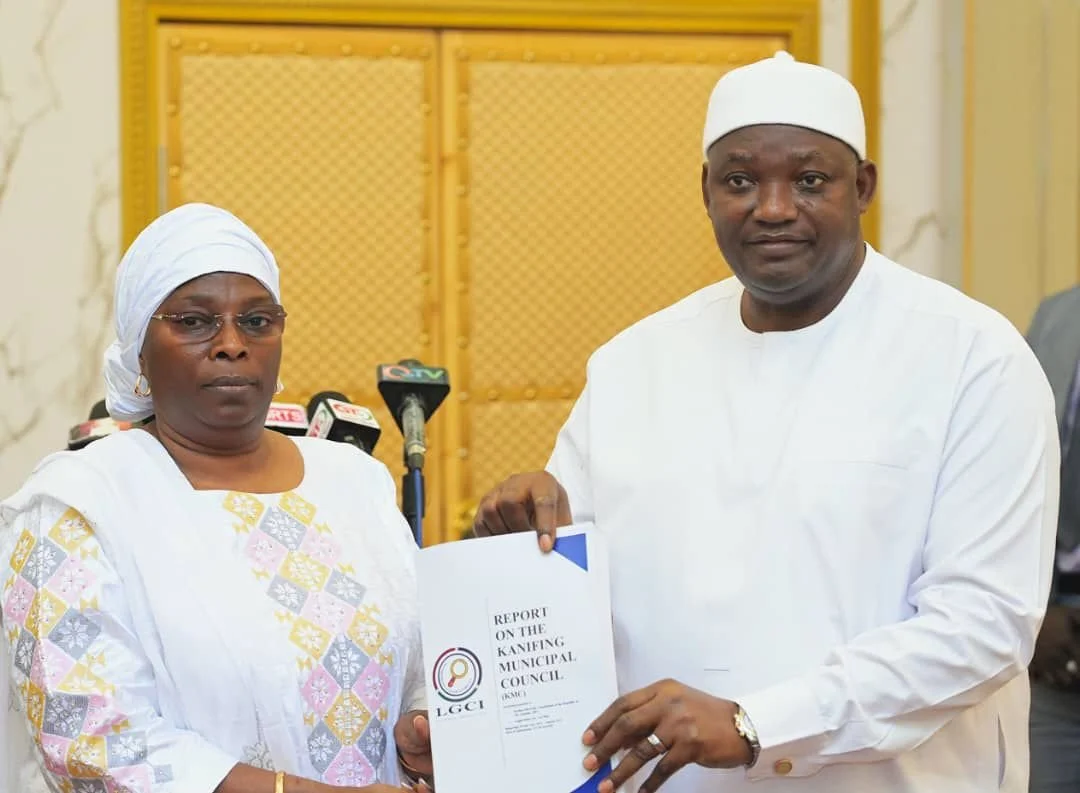
President Barrow and Commission Chairperson Counsel Bah © State House
By Edward Francis Dalliah, Jr.
President Adama Barrow has assured Gambians that his government will issue a White Paper and implement all accepted recommendations contained in the report of the Commission of Inquiry into Local Government Councils and Connected Matters in accordance with the constitution.
Speaking on Monday, 11th May 2026, during the formal submission of the Commission’s report at the State House, Barrow said the government would carefully review the findings and recommendations through appropriate legal, administrative, and institutional channels before it “will prepare and issue a White Paper outlining its position and the next steps and actions to take.”
The Commission of Inquiry into the Conduct of Local Government Councils and Connected Matters was established by the government in February 2023 and began hearings in May of the same year.
The inquiry was aimed at examining concerns surrounding the financial and administrative operations of local councils, improving governance, strengthening accountability, and supporting decentralisation.
Presenting the report to President Barrow alongside four other commissioners, the Chairperson of the Commission, Senior Lawyer Jainaba Bah, warned that weak systems, poor oversight, and repeated disregard for regulations had significantly undermined accountability within local councils across the country.
Counsel Bah said the inquiry uncovered widespread shortcomings in financial management, procurement processes, staffing systems, land administration, and governance practices in councils and related institutions.
She explained that “in all the councils, the Commission found recurring weaknesses in financial control, revenue administration, procurement compliance, banking discipline, record keeping, internal audit effectiveness, payroll control, land administration, contract management, and oversight enforcement.”
According to her, the Commission relied on testimonies from witnesses and extensive documentary evidence gathered throughout the inquiry.
“Their evidence, together with documentary records, financial statements, audit materials, procurement files, personnel records, bank analyses and institutional correspondence, forms the evidentiary foundation upon which this Report rests,” the Chair of the now-defunct commission noted.
She added that the report was submitted in line with the mandate given to the Commission to investigate the “financial, administrative, procurement, revenue, land, staffing, and governance affairs of local government councils and connected public institutions.”
President Barrow commended the commissioners for their work, highlighting that he is “confident that [their] work will assist the government in taking informed policy, legal, and administrative decisions.”
He added: “We believe that your report will support our broader effort of strengthening local government administration, public finance management, procurement governance, internal audit, and decentralisation.”
Local government in the Gambia consists of eight main local areas governed by elected councils, including two municipal councils headed by mayors. Their mandate, as provided under the Local Government Act, is to promote democratic participation, manage local affairs, and deliver public services.
President Barrow noted that “as decentralised governance structures, the Local Government Councils are the closest administrative bodies to the people. They collect revenue, manage community facilities, support local development, and deliver services that affect the citizens directly.”
He therefore said it “is essential --- that they operate efficiently, transparently, professionally, and within the scope of the law.”
The anticipated White Paper on the Local Government Commission will add to a series of White Papers issued under President Barrow’s administration following major national inquiries and commissions.
In 2019, the government issued a White Paper on the findings of the Janneh Commission, which investigated the financial activities of former President Yahya Jammeh and his associates.
The government accepted many of the Commission’s findings and pursued asset recovery processes, including the seizure and sale of several properties and assets linked to the former president.
It is worth noting that despite the government's commitment to implementing those recommendations, several of them remain unimplemented.
Similarly, in 2022, the government released its White Paper on the recommendations of the Truth, Reconciliation and Reparations Commission (TRRC), accepting 262 out of 265 recommendations aimed at addressing human rights abuses committed during the Jammeh era.
However, implementation of some recommendations in the TRRC White Paper has faced criticism from rights groups and accountability advocates over the pace of execution.
A 2024 report by the National Human Rights Commission indicated that only 16 out of 262 accepted recommendations had been fully implemented between 2021 and 2023.
The most recent report released by the NHRC, which shifted the tracking from recommendations to activities based on the government's implementation plan document published in 2023, revealed that out of the 304 activities highlighted, only 60 have been implemented, 101 remain unimplemented, and 143 are ongoing as of 2025.
Despite the shortfalls recorded in the implementation of previous commission recommendations, President Barrow pointed out that his “government will implement all recommendations accepted in the White Paper [on the Local Government Commission] in accordance with the Constitution.”
He further noted that, “in fulfilment of Government’s responsibilities, no person will suffer any unjust treatment.”
As the public awaits the White Paper, critics of the government argue that the report may be used as a “witch hunt” against the Mayor of the Kanifing Municipal Council, Talib Ahmed Bensouda, who has been leading the Unite Movement for Change and is widely speculated to be considering a presidential bid in the December 2026 presidential election.
