
GPU Engages Police on Safety of Journalists Ahead of December Presidential Election
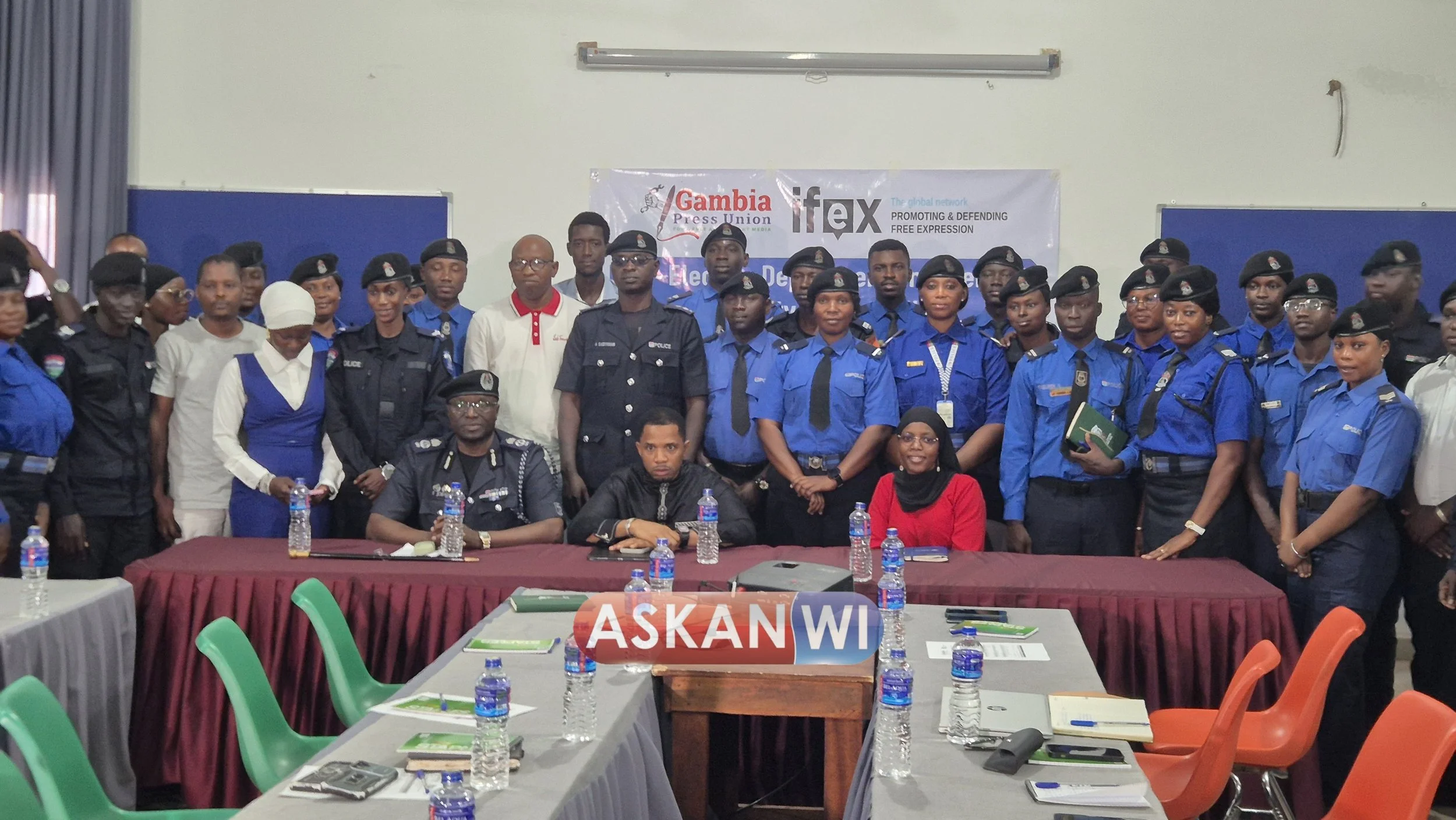
GPU and Police at Engagement © Askanwi Media
By Fatoumata Konteh
The Gambia Press Union (GPU), in collaboration with the global network promoting and defending freedom of expression, IFEX, convened a training and dialogue session for journalists and police officers to strengthen cooperation and promote the safety of journalists ahead of The Gambia’s 5th December 2026 presidential election.
The engagement, held on Wednesday, 14th October 2026, at the National Nutrition Agency (NaNA) in Bakau, sought to enhance police officers' understanding of media rights and freedoms while helping journalists understand the role of the police in maintaining law and order during the electoral process.
The session provided a platform for participants to discuss concerns surrounding the physical safety of journalists, explore ways to prevent harassment and intimidation, and identify measures to foster a peaceful and enabling environment for media practitioners to carry out their professional duties without fear or obstruction.
Participants included police officers, reporters, editors, media managers, and representatives of journalists’ associations.
Addressing the gathering, GPU President Ms Isatou Keita said the engagement was particularly important because journalists and police officers would be operating in the same locations during rallies, public gatherings, and polling activities.
She stressed that effective communication and mutual understanding between the two institutions were essential to preventing unnecessary confrontations during the electoral cycle.
“A journalist with a camera or a notebook is not your opponent. They are doing a job that gives the public the information it needs to vote,” Keita said, urging police officers to respect the lawful work of journalists.
She recalled that engagements organised by the GPU with security forces and political parties ahead of the 2021 elections contributed to a positive environment for journalists, with no reported cases of journalists being arrested or detained by the police before, during, or immediately after the elections.
According to her, only one physical assault on a photojournalist by a political party militant was recorded during the period.
Keita said the experience demonstrated the importance of dialogue and cooperation, adding that the union was seeking to build on those gains ahead of the forthcoming presidential election.
She disclosed that the GPU and IFEX launched a 12-month project in January 2026 focusing on the physical and digital safety of journalists. As part of the initiative, more than 30 journalists had received training in physical and online safety, alongside engagements with political parties, the police, the army, and state and police prosecutors.
However, she expressed concern that journalists and media workers continued to face verbal and physical abuse from political party supporters, political leaders, and, in some cases, security personnel.
She also lamented that many incidents of attacks against journalists remained unresolved, with perpetrators not held accountable.
While calling on the authorities to ensure that journalists could work without intimidation, harassment, unlawful arrest, or obstruction, Keita urged media practitioners to understand the responsibilities of the police during elections, observe safety precautions, and maintain ethical standards in their reporting.
“A free media must also be a credible one,” she said, emphasising the need for journalists to uphold professional ethics, particularly during politically sensitive periods.
She further called for timely access to information from public institutions, arguing that transparency was necessary to counter rumours, reduce mistrust, and strengthen public confidence in the electoral process.
Representing the Inspector General of Police, Commissioner for International Affairs Famara Jobateh conveyed the IGP’s apologies for his absence and reaffirmed the police force’s commitment to protecting journalists during election-related activities.
In a statement delivered on behalf of the IGP, Jobateh said journalists played a critical role in keeping the public informed about candidates, public institutions, and developments within their communities.
He maintained that journalists must be able to perform their duties without intimidation, threats, or unnecessary interference.
“The Gambia Police Force recognises its responsibility to protect journalists as it protects other members of the public,” the statement said.
The police representative noted that officers deployed for election duties were expected to act impartially and professionally, respect the lawful work of media practitioners, and respond appropriately whenever journalists’ safety was threatened.
He added that any restrictions imposed on journalists for public safety reasons must be lawful, necessary, clearly communicated, and applied fairly.
Jobateh also called on journalists to uphold professional and ethical standards, particularly by verifying information and reporting accurately in an election environment where misinformation could heighten political tensions.
He stressed that cooperation between the police and the media must go beyond meetings and public declarations, insisting that the commitments made during the engagement should be reflected in the conduct of officers on the ground and the way journalists interact with security personnel.
“The success of this engagement should ultimately be measured not by the number of presentations delivered, but by the practical improvements it produces before, during, and after the elections,” the statement added.
Meanwhile, Minister of Information, Media, and Broadcasting Services Dr Ismaila Ceesay described the police and the media as two institutions with complementary responsibilities in sustaining democracy.
He said the police had a responsibility to protect democracy, while the media played a vital role in promoting it through independent, responsible, and accurate reporting.
Ceesay commended the GPU and its partners for organising the engagement, noting that the safety of journalists was central to democratic governance, particularly during elections.
He observed that elections were periods of heightened political activity, strong public emotions, and potential tension, making the work of journalists especially important.
According to the minister, a free, pluralistic, and independent media enables citizens to access diverse perspectives, scrutinise the exercise of power, and distinguish facts from rumours.
He emphasised that journalists did not merely report on democracy but also contributed to its growth and effective functioning.
The engagement forms part of ongoing efforts by the GPU and its partners to strengthen relations between journalists and security institutions ahead of the December presidential election.
Participants are expected to use the knowledge gained from the session to promote mutual respect, improve communication, and minimise incidents that could threaten journalists’ safety or undermine press freedom during the electoral period.
