
Media Regulations: Is Information Minister Ceesay Failing to Implement Related TRRC Recommendations?
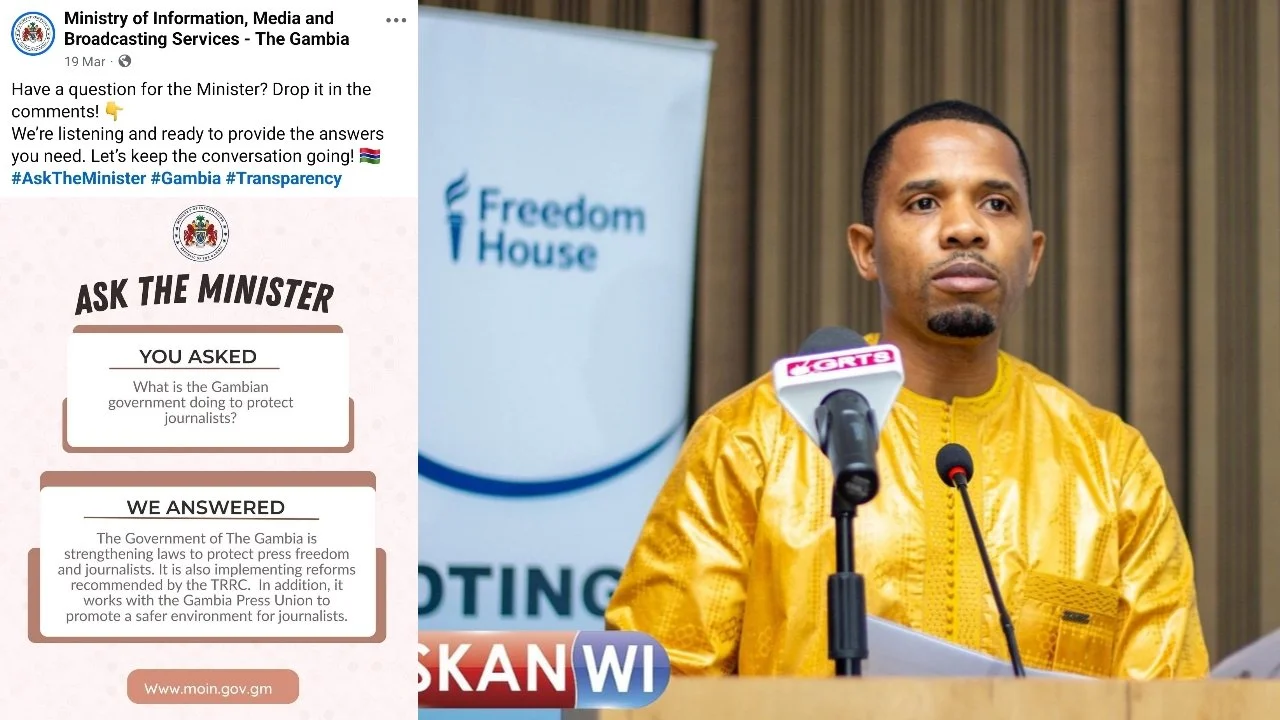
Question and Answer on MoIMBS © Askanwi and MoIMBS Facebook Page
By Yusef Taylor, @FlexDan_YT
The Gambia’s Truth, Reconciliation and Reparations Commission (TRRC) offers numerous lessons for the current administration of President Adama Barrow on how to implement meaningful and impactful change beyond infrastructural development. One of those reforms concerns the much-talked-about Broadcast and Online Contents Regulations 2026.
TRRC Recommendations on Media Reform
The Truth Commission dedicated Theme 7: Attacks on the Media with one key recommendation, 199, calling on the government “to ensure that broadcast content regulation is within the competence of an independent regulatory body applying standards in compliance with international human rights standards.”
Months into its second term, the government accepted this responsibility in its TRRC White Paper, published in May 2022. However, three years later, the National Human Rights Commission’s third monitoring report revealed that “no Broadcast Policy has been developed yet.”
Another TRRC recommendation, 191, states: “There should be a review of domestic laws relating to the media and carry out a comprehensive review of the regime with a view to bringing The Gambia’s laws regulating the media in line with international standards and international best practice. Such a review shall include the National Media and Communication Act 2002, the Newspaper Registration and Broadcasting Act, and the Information and Communication Act 2009.”
The government again expressed its commitment by stating: “The Government accepts the recommendation of the Commission. Domestic laws relating to media freedom and freedom of expression in general, as enshrined in Article 10 of the Universal Declaration of Human Rights, will be reviewed as part of the Government’s overall objective to bring Gambian laws in line with international standards as they pertain to freedom of expression and the media.”
Progress on Legal and Policy Review
According to the NHRC’s third report on the implementation of the TRRC recommendations, as accepted in the Government White Paper, “The Government of The Gambia has conducted a review of laws relating to the media, including the National Media and Communication Act 2002, the Newspaper Registration and Broadcasting Act, and the Information and Communication Act, among others.”
The NHRC notes that “a Media Law Review Committee was established by the Ministry of Information and Communications Infrastructure in January 2018 with support from Article 19 West Africa. The Committee included representatives from the Government, media organisations, civil society, and legal experts.”
More specifically, “it reviewed and made recommendations for revising several media laws to create an enabling environment for freedom of expression and media development in The Gambia. The laws reviewed included the Information and Communications Act 2009 (amended 2013), the Newspapers Registration and Broadcasting Act 1944, the Criminal Code and subsequent amendments, the Indemnity (Amendment) Act 2001, the Official Secrets Act 1922, the Gambia Radio and Television Services Corporation Act 2004, and the Telegraphy Act 2005.”
Question and Answer on MoIMBS © Askanwi and MoIMBS Facebook Page
Emerging Concerns
Back in March 2026, the Ministry of Information issued an infographic claiming that the government is “strengthening laws to protect press freedom and journalists. It is also implementing reforms recommended by the TRRC. In addition, it works with the Gambia Press Union to promote a safer environment for journalists.”
Instead of implementing the TRRC recommendations as claimed, the Ministry of Information appears to be undermining the gains made. Dr Ismaila Ceesay’s recent introduction of the Broadcasting and Online Content Regulations 2026 has revealed a deep division with the media and directly contradicts the TRRC recommendations accepted by the government.
This was mentioned in the Gambia Press Union position paper issued in response to the regulation.
During the media-boycotted consultation process and in subsequent media appearances, Minister Ceesay advanced the argument that online media did not exist when earlier regulations governing television and radio were introduced. However, this narrative is misleading. The previous government consistently used regulations to restrict and punish freedom of expression online.
According to the TRRC, “the Information and Communication Act 2009 was passed to regulate information, communication, and technologies.” The Act was amended in 2013 to introduce harsh penalties and further restrict freedom of expression on online platforms. The Commission noted that spreading false information on the internet, caricatures, and posts deemed derogatory could “carry a 15-year prison term or a fine of three million Dalasis (D3,000,000), or both.”
Furthermore, the TRRC highlighted that “Sections 46, 51, 52, 52A, 59, 178, 179, 181, 181A and 184 of the Criminal Code, Cap 10 Laws of The Gambia, imposed additional restrictions on freedom of expression.” These provisions, the Commission observed, led journalists to express concerns that such laws significantly hindered their ability to perform their duties, including disseminating information to the public.
Implications for Press Freedom
Given the continuity in government, and the current administration’s commitment to ensuring that content regulation falls under an independent institution, the present approach raises serious concerns. Rather than advancing reforms, the Information Minister appears to be worsening the press freedom environment by promoting regulations that risk ushering in a form of state-controlled media—similar to the model seen with the Gambia Radio and Television Services (GRTS).
The claim that state regulation of media content represents a natural progression is therefore unconvincing. In practice, direct state control over media content is more commonly associated with authoritarian or totalitarian systems.
There is a clear distinction between regulating technical aspects—such as broadcast frequencies, minimum quotas for Gambian music, and oversight of Internet Service Providers—and regulating editorial content. Crossing that line risks concentrating excessive power in the hands of the state.
Conclusion
At that point, the concern is no longer about regulation, but about control—and the consequences of that shift remain uncertain.
