
NCCE Calls on Influencers to Champion Truth Ahead of Elections
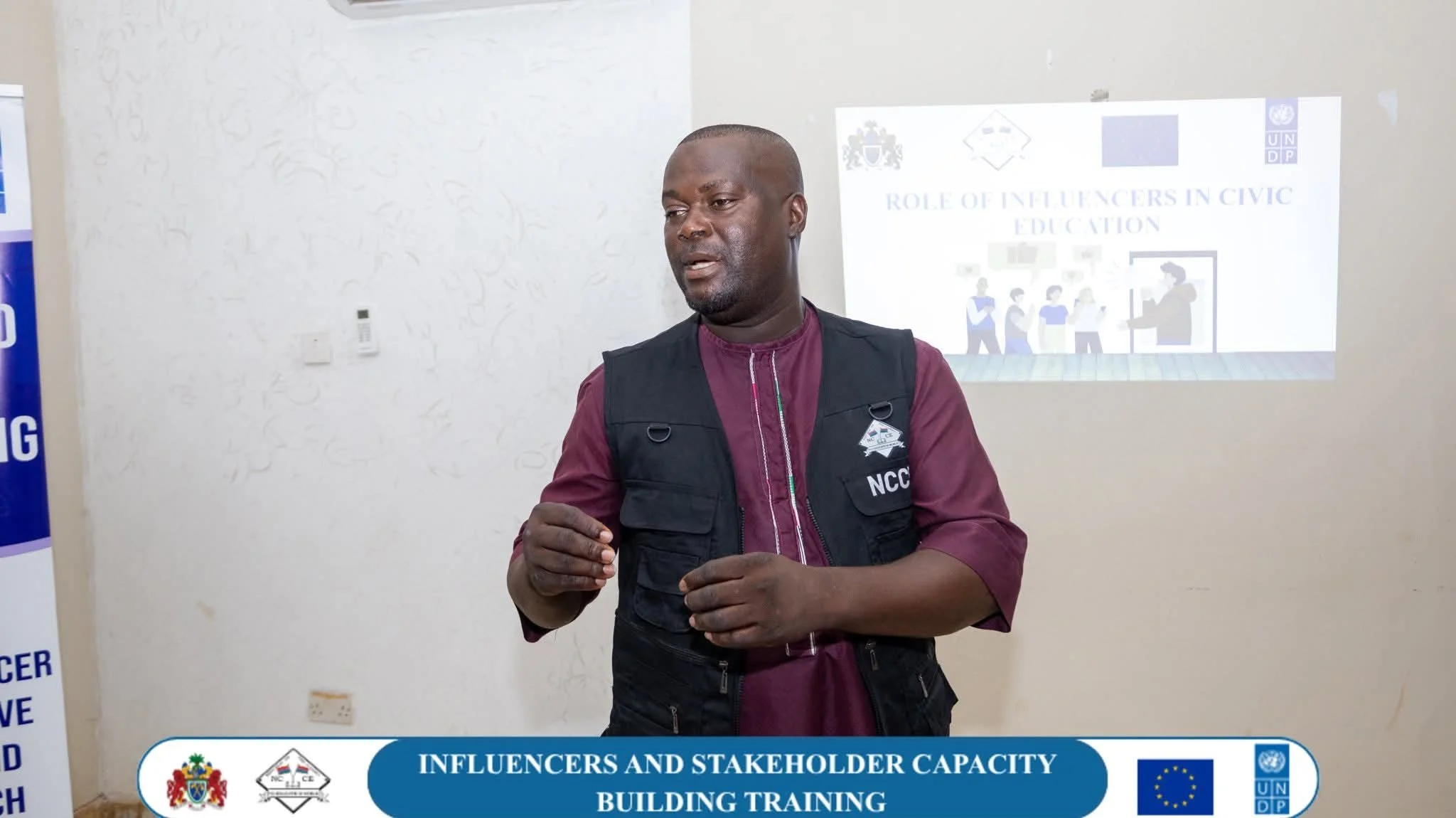
NCCE Mr Ansumana Ceesay © NCCE
By Fatoumata Jaiteh,
The National Council for Civic Education (NCCE), with support from the EU-UNDP GREAT Project Initiative, has called on influencers and community leaders to become champions of truth as the country prepares for elections.
The call was made during a capacity-building training for influencers and stakeholders held at the Governor's Office in Brikama on Thursday, 9th July 2026, under the theme "Strengthening Influencer Networks for Inclusive Civic Engagement and Sustainable Outreach”.
Addressing participants, Mr. Ansumana Ceesay, Programmes Manager at the NCCE, described misinformation as one of The Gambia's greatest threats, warning that false information and hate speech could undermine peaceful elections if left unchecked. He urged influencers, religious leaders, youth groups, women's leaders, civil society organisations and political representatives to be mindful of the information they share with the public, noting that many citizens trust influential voices more than official institutions.
Ceesay stressed that civic education remains the foundation of democracy because it empowers citizens to understand their rights and responsibilities while encouraging peaceful political participation. He also reminded participants that political differences should not breed hostility, emphasising that the Constitution guarantees every citizen the freedom to support a political party of their choice.
The programme forms part of the NCCE's broader efforts to prepare influential community actors ahead of the electoral period by equipping them with the practical knowledge and skills needed to disseminate accurate civic and electoral information, encourage responsible citizen participation, and effectively counter misinformation, disinformation and hate speech within their respective communities.
Ceesay reminded participants that although they represented different political parties, organisations and communities, the objective of the training was to deliberate on issues that serve the national interest.
"This programme is not about challenging one another because of political or organisational differences. It is about discussing issues for the good of the country," he said.
He explained that the nationwide training began in Basse and will conclude in the Kanifing Municipality, highlighting the NCCE's commitment to ensuring that stakeholders across the country receive the same level of civic education and capacity building.
During his presentation on the role of influencers in civic education, the facilitator described civic education as the backbone of democratic governance, stressing that it empowers citizens with knowledge of their constitutional rights and responsibilities.
He noted that influencers occupy a unique position in society because many citizens place considerable trust in their opinions, sometimes even more than they trust official institutions.
The session also explored political tolerance and democratic participation. Ceesay reminded participants that The Gambia now has 24 registered political parties and that citizens are constitutionally guaranteed the freedom to associate with and support any political party of their choice.
"We all support different political parties, but that should never make us hate one another. The Constitution guarantees freedom of association, and that is what democracy is about," he said.
Addressing concerns about the relationship between religion and politics, the presenter challenged the common perception that the two should never intersect. He explained that religious institutions also have a role to play in encouraging civic responsibility and democratic participation.
He observed that discussions on leadership, governance and responsible citizenship can appropriately take place in churches and mosques because electing leaders is a civic responsibility that affects every citizen, regardless of religious affiliation.
Participants actively contributed to the discussions, sharing their perspectives on responsible political engagement and national unity.
Representing the Alliance for Patriotic Reorientation and Construction (APRC), Mr Alieu Touray urged Gambians to approach politics with maturity and patriotism.
"You were not born into any political party, and when we die, we will not go to any political party. Let us put The Gambia first," he said.
Another participant encouraged greater youth participation in politics, arguing that young people must become active contributors to the country's democratic processes rather than remaining passive observers.
"If young people do not get involved in politics, they will be led by people they do not want," the participant remarked.
The final session of the training focused on combating misinformation, disinformation and hate speech, an issue participants acknowledged as increasingly important as the country approaches another electoral cycle.
Facilitators explained that election periods often witness a surge in false information, manipulated content, inflammatory rhetoric and politically motivated propaganda, much of which spreads rapidly through social media and informal communication networks. Such misinformation can mislead voters, deepen political divisions, incite hostility and erode public confidence in democratic institutions.
Participants were therefore encouraged to verify information before sharing it, rely on credible and authoritative sources, reject messages intended to provoke hatred or violence, and use their influence to promote peaceful dialogue and informed public discourse.
