
Omar Camara’s Late Arrival Foils Police Prosecutor’s Arrest Warrant Application
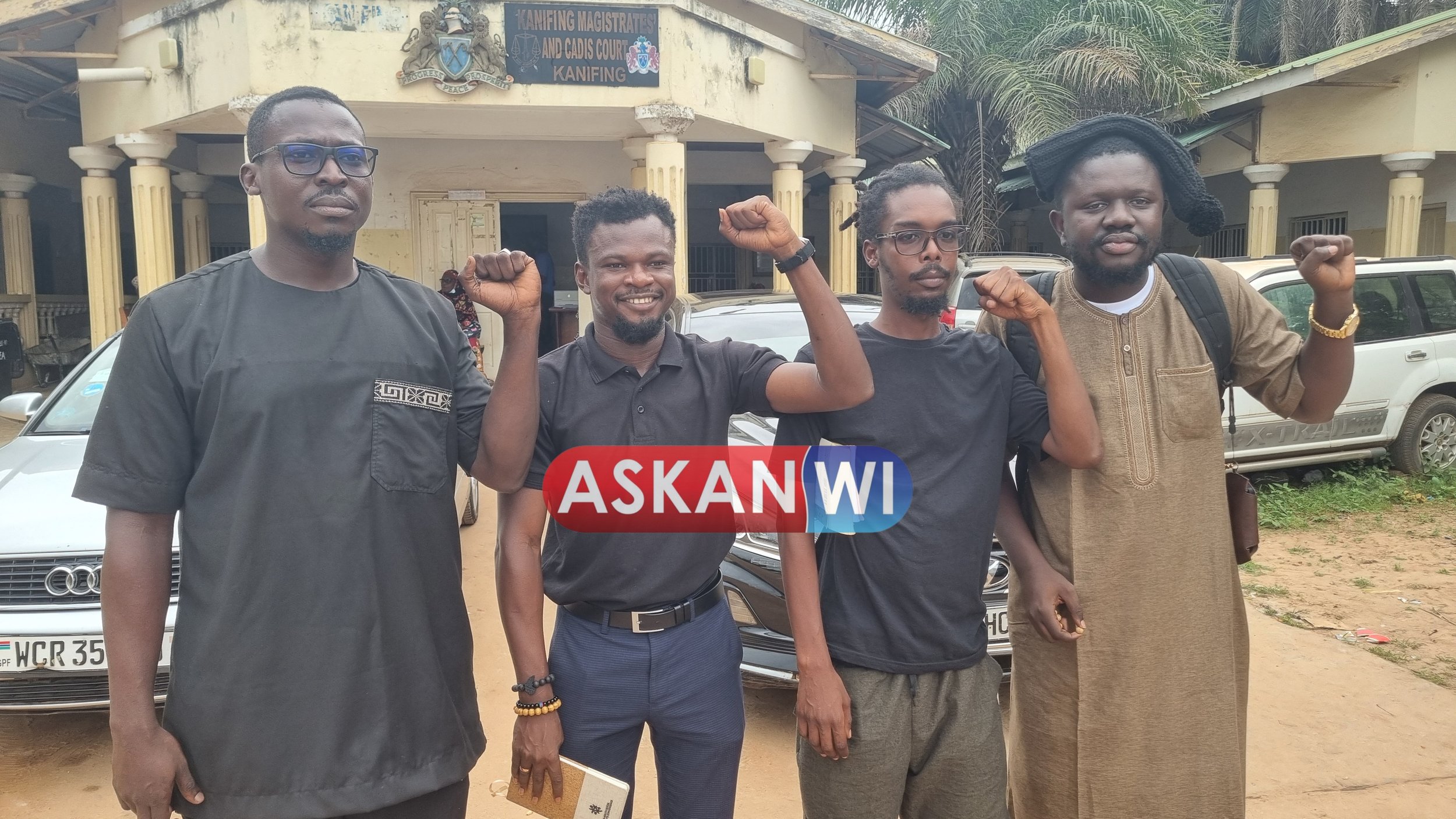
Kemo Fatty, Omar Camara, Alieu Bah and Gallas Ceesay at Court © Askanwi
By Fatoumata Jaiteh
Police Prosecutor Commissioner Sanneh's application for a bench warrant to arrest anti-corruption advocate Omar Camara was foiled after his late arrival before the end of the court proceeding. Commissioner Sanneh has been on a mission to re-arrest Gambian protestors.
Last week police announced their failed attempt to submit an application to the Kanifing Magistrate Court for a bench warrant for the arrest of 23 other protestors in a separate trial. Just a week later, Commissioner Sanneh’s latest application to arrest another protestor was dashed, another blow.
The trial involving members of Gambians Against Looted Assets (GALA) resumed at the Kanifing Magistrates’ Court on Monday, 16th February 2026, at the Kanifing Magistrate’s Court, with proceedings marked by a brief application for a bench warrant and a legal tussle over the scope of re-examination.
Presiding over the matter was Magistrate Sallah Mbye. The prosecution team was led by Commissioner Sanneh, assisted by Trawally, while Lawyer L.S. Camara represented the accused persons Alieu Bah, Kemo Fatty, and Omar Camara.
The charges stem from an alleged unauthorised press conference and demonstration staged outside the offices of the National Audit Office (NAO) in mid-September 2025 by GALA members. GALA is a civic movement that emerged in the wake of growing public frustration over alleged corruption and the recovery of public funds. Their members and other concerned Gambians have conducted several demonstrations demanding transparency and accountability over the handling of former president Jammeh’s assets.
When the case was called, only Kemo Fatty and Alieu Bah were present in the dock while Omar Camara was absent.
Commissioner Sanneh immediately drew the court’s attention to the absence, noting that this was “the second or third time that the case has been called and the accused is late, and it seems deliberate.” He added that "we can’t be here and you sit at home with no tangible reason,” Sanneh submitted, seeking leave to apply for a bench warrant for Omar Camara’s arrest.
In response, defence counsel L.S. Camara argued that lateness was not habitual by the accused.
“This isn’t a norm,” he said, adding that on the last adjourned date, a reason had been given that the accused had suffered a vehicle breakdown on his way to court.
He further told the court that if his client failed to appear before the end of proceedings, “I will not defend an application for a bench warrant.”
Magistrate Mbye then ruled that the accused would be given the benefit of the doubt, noting that he may be on his way to court. “If at the end of the proceedings, the accused is absent,” she stated, “the court will do its ruling on the matter.”
Eventually, Mr Camara arrived in the dock before the end of proceedings, limiting the prosecution’s application.
Moving to the fourth prosecution witness, Commissioner Ousman Colley (PW4), a Deputy Superintendent stationed at Kairaba Police Station, then took the stand.
Colley testified that he was part of an investigative panel tasked with interviewing three GALA members who allegedly protested outside the offices of the NAO in September 2025.
While he was not physically present at the protest scene, he told the court that he was informed that the protesters were initially approached by Superintendent Dawda Jallow and asked to disperse, but “they refused.” A second intervention team led by ASP Lamin Bojang also requested that the demonstrators disperse, but again “they refused,” he said.
Colley explained that the reason for the arrest was that “they did not get a permit from the Inspector General of Police.” Consequently, they were arrested and brought to Kairaba Police Station, where they were interviewed and later charged.
Under cross-examination, L.S. Camara asked Colley whether he could recall the other members of the investigative panel. The witness responded, "The panel was headed by Demba J. Bah, now Superintendent of Police; myself; and Sergeant Musa Darboe.”
Defence counsel then put it to the witness that he was not present at the protest and therefore did not personally witness the arrests.
“You were not on the ground on this day, and since you were not there, you do not know who arrested the accused persons, and you do not know why they were arrested unless you were told,” Camara stated.
Colley answered in the affirmative.
During re-examination, Commissioner Sanneh asked the witness, “During your interview, did the accused produce any permit?”
At that point, L.S. Camara objected, arguing that the issue of a permit had already been canvassed during evidence in chief. “The issue of whether they have a permit or not should have been under the evidence in chief; it was an attempt to reopen their case.”
Camara further argued that no ambiguity had arisen during cross-examination to justify the question. He cited Section 192(2) of the Evidence Act, which limits re-examination strictly to matters arising out of cross-examination. Under that provision, re-examination is meant to clarify ambiguities or explain issues raised during cross-examination; it cannot be used to introduce new evidence or strengthen a party’s case beyond what was initially presented.
In response, the prosecution relied on Section 3 of the same Act, arguing that there was ambiguity between the witness’s evidence-in-chief and his responses under cross-examination.
“We believe that there is ambiguity during cross-examination and evidence in chief. Two answers were given, and there is an ambiguity,” the prosecution submitted, insisting that the question was genuine and should be allowed. “The objection raised by counsel should be thrown in the bin,” argued Commissioner Sanneh.
L.S. Camara countered that Section 3, which sets out general principles regarding the application of the Act, is subject to specific provisions and does not override them. “Section 3 is very clear,” he said. “It is subject to specific provisions, and general rules do not override specific provisions.”
He also emphasised that relevance alone does not make a question admissible.
In her ruling on the matter, Magistrate Mbye held that there was no ambiguity in the witness’s testimony. “Both statements were clear, and there is no doubt,” she said, disallowing the prosecution’s question to proceed.
