
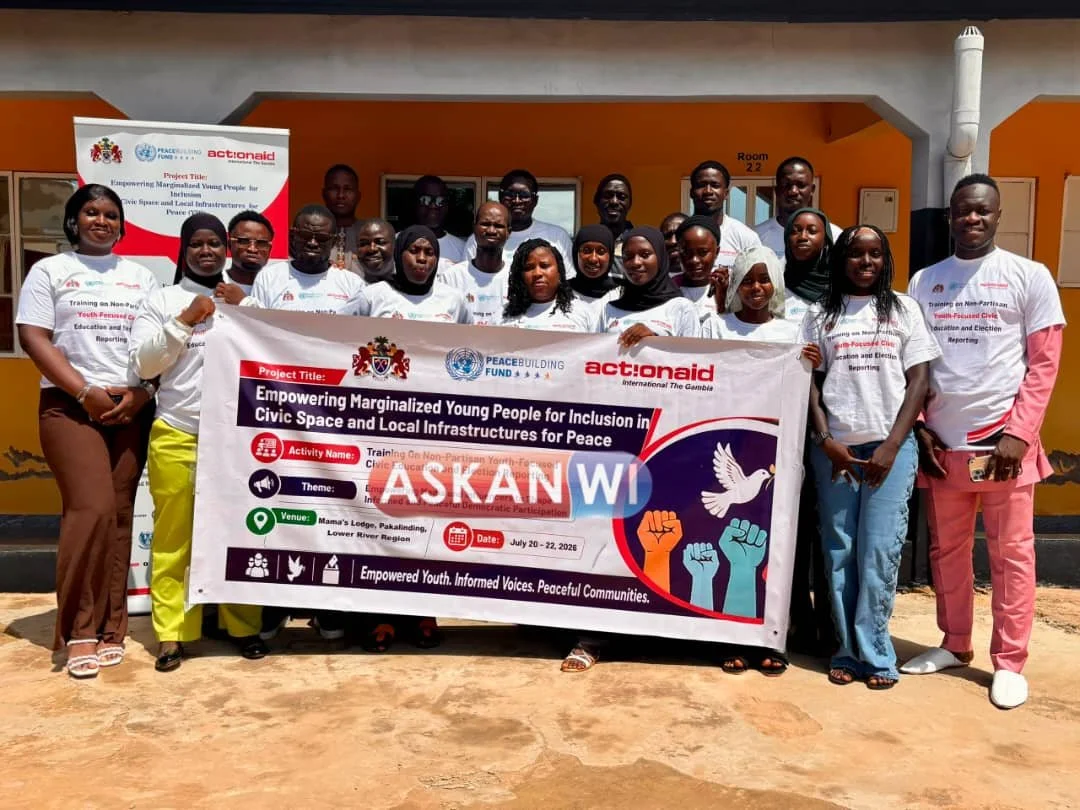
Actionaid International Media Training © Askanwi
By Haddy Ceesay
With political rhetoric expected to dominate campaigns ahead of The Gambia's December elections, the Managing Director of the Media Academy for Journalism and Communication (MAJaC), Sang Mendy, has challenged journalists to rethink how they cover the race.
Addressing journalists and social media influencers during a training, Mr. Mendy said election reporting should move beyond reproducing politicians' statements and instead scrutinise policies, campaign promises, and issues that directly affect citizens.
He also cautioned journalists against becoming conduits for mis-information, dis-information, mal-information, and hate speech, describing hate speech as “a cancer for every society”.
Instead of merely amplifying political rhetoric, he urged the media to prioritise issue-based reporting. “Election reporting is beyond ‘Barrow says,’ ‘Darboe says,’ or ‘Talib says.’ It should be issue-based,” he said.
Mr Mendy made the remarks during a training organised by ActionAid The Gambia in Soma, Lower River Region (LRR), from 21st to 23rd July 2026. Held under the theme, “Empowering Media and Influencers to Shape Informed and Peaceful Democratic Participation,” the training brought together journalists and social media influencers to strengthen ethical, non-partisan, and youth-focused election reporting ahead of The Gambia's upcoming elections.
He urged journalists to critically examine the claims made by political actors rather than simply reporting them, while warning against publishing content that could fuel misinformation or inflame political tensions.
His warning echoes the findings of the National Human Rights Commission (NHRC), whose July 2025 report, a follow-up to its 2024 Study on the Prevalence of Hate Speech in The Gambia, found that hate speech remains widespread and continues to threaten social cohesion.
The Commission said both studies confirmed the persistence of hate speech and underscored the need for stronger collaboration to address it. The 2025 report identified politically motivated hate speech as the most prevalent form, with “most of the respondents believing that hate speech is mostly perpetrated by politicians, followed by media-based hate speech”.
According to the NHRC, the study “employed a mixed-method design, which combined both quantitative and qualitative approaches to determine changes in hate speech trends identified by the previous study and build on the findings of the 2024 Study”.
Mr Mendy further advised journalists to carefully assess statements made during political rallies before publishing them, particularly where such remarks could incite political tensions, tribal divisions, or violence.
Speaking at the opening ceremony, Senior Programme Officer at the National Council for Civic Education (NCCE), Muhammed Bah, described the media as central to civic education and democratic accountability.
“The role of the media in civic education is indispensable. It is not only a messenger, it is a bridge between citizens and institutions, a platform where voices are amplified, and a tool through which governance becomes transparent and participatory,” he said.
Mr Bah noted that at a time when misinformation has the potential to divide communities, responsible journalism and civic education remain essential pillars of peacebuilding and democratic resilience. He added that through responsible reporting and inclusive storytelling, journalists help citizens better understand governance processes, strengthen democratic participation, and promote accountability.
The concerns raised during the training mirror warnings from other election stakeholders. During the Independent Electoral Commission's (IEC) Stakeholders Forum held in July at the Sir Dawda Kairaba Jawara International Conference Centre, NCCE’s Yusupha Bojang said “the political climate of the country sometimes is very worrying. You will see a lot of back and forth, bickering, and hate speech is becoming very prevalent”.
He urged political parties to take responsibility for the conduct of their supporters noting that “when we see our supporters crossing certain lines, let's caution them, call them back. But if we leave them, it is not going to be helpful.”
With the NHRC study noting that most of their respondents believing that hate speech is mostly perpetrated by politicians and the media, the United for Nation, Integrity, Transformation and Equality (UNITE) leader Talib Ahmed Bensouda has indicated that his party is developing a code of conduct to discipline supporters who use inappropriate language during an interview with Dialectic Space Podcast. If the code of conduct is into effect, people find violating will face punishment, Talib highlighted.
