
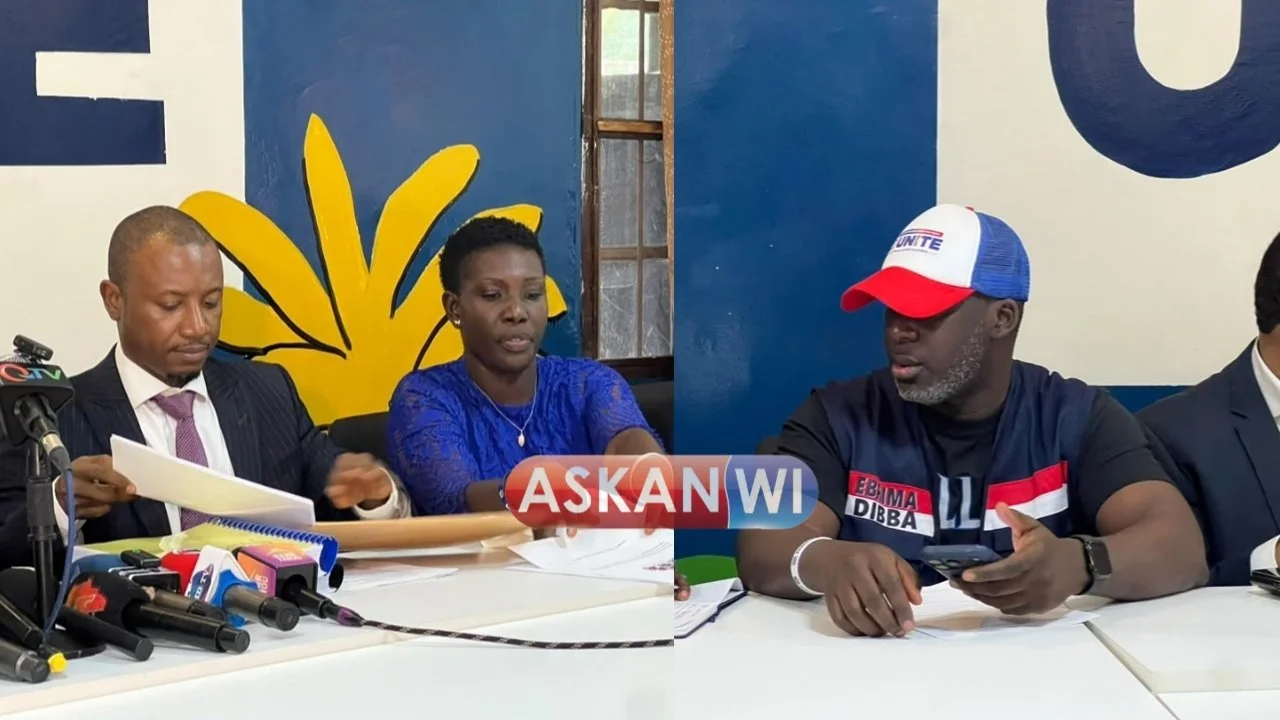
UNITE Aziz Bensouda (left) & Ebrima Dibba (right) © Askanwi Media
By Fatoumata Konteh
UNITE has warned that the 2026 presidential election may not proceed if its presidential candidate, KMC Mayor Talib Ahmed Bensouda, is rejected by the Independent Electoral Commission (IEC) following concerns surrounding the government’s recently published White Paper on the Commission of Inquiry into Local Government Councils.
Speaking at a press conference held at the UNITE Headquarters on 3rd November 2026, National President Ebrima Dibba warned that if Bensouda is prevented from contesting the election, President Adama Barrow will also not stand for the polls.
The warning was reinforced by Assan Martin, a lawyer and spokesperson for Coalition 2026, who said the party would mobilise people onto the streets if the IEC rejects Bensouda’s nomination.
Martin warned that such a decision would not be accepted and could lead to public protests, adding that the election would not hold under those circumstances.
The press conference, led by UNITE Legal Secretary Abdul Aziz Bensouda, focused largely on the legal implications of the Commission of Inquiry report and the government’s White Paper, which was published on 29th October 2026.
UNITE argued that the White Paper cannot be used as a legal basis to disqualify Bensouda from contesting the 5th December 2026 presidential election. The party maintained that under Section 62(2) of the Constitution, a presidential candidate can only be disqualified on the basis of specific adverse findings relating to corruption, negligence, misconduct or improper behaviour.
According to Abdul Aziz Bensouda, the adverse finding against Talib Ahmed Bensouda does not establish any of the four constitutional grounds for disqualification.
He maintained that the Commission’s finding, which stated that Bensouda exercised political and executive influence in a manner capable of contributing to irregular financial commitments and expenditure, did not amount to a finding of personal liability for corruption or misconduct.
The legal secretary further argued that the White Paper represents the government’s response and recommendations to the Commission’s report and cannot independently create grounds for disqualification.
He also questioned the IEC’s authority to interpret the Commission’s findings, arguing that the electoral body is responsible for receiving and examining nomination documents rather than determining criminal or personal liability.
UNITE disclosed that it had written to President Adama Barrow, copying the IEC, seeking clarification on the government’s position before November 7.
The party also raised concerns over the timing of the government’s planned inauguration of a road in Abuko, which is scheduled for the same day as its presidential nomination. It described the decision as politically provocative, particularly given the proximity of the inauguration venue to the location of its planned post-nomination rally.
UNITE called on the government to reschedule the inauguration, warning that holding both events on the same day could create unnecessary tension.
The party also alleged that the Commission’s report had been altered after its submission to the President on 11th May and raised concerns about the report’s alleged use of artificial intelligence. Abdul Aziz Bensouda clarified that his AI-related allegation concerned the Commission’s report, not the government’s White Paper, and said the matter would be pursued separately.
UNITE said it would make its correspondence with the President and relevant Commission documents available to the public and the media.
The press conference comes amid growing political tension ahead of the 2026 presidential election, with Bensouda’s eligibility and the interpretation of the Commission of Inquiry findings emerging as major issues in the nomination process.
