
WAVE and ICTJ Engages Youth and Media on Transitional Justice.
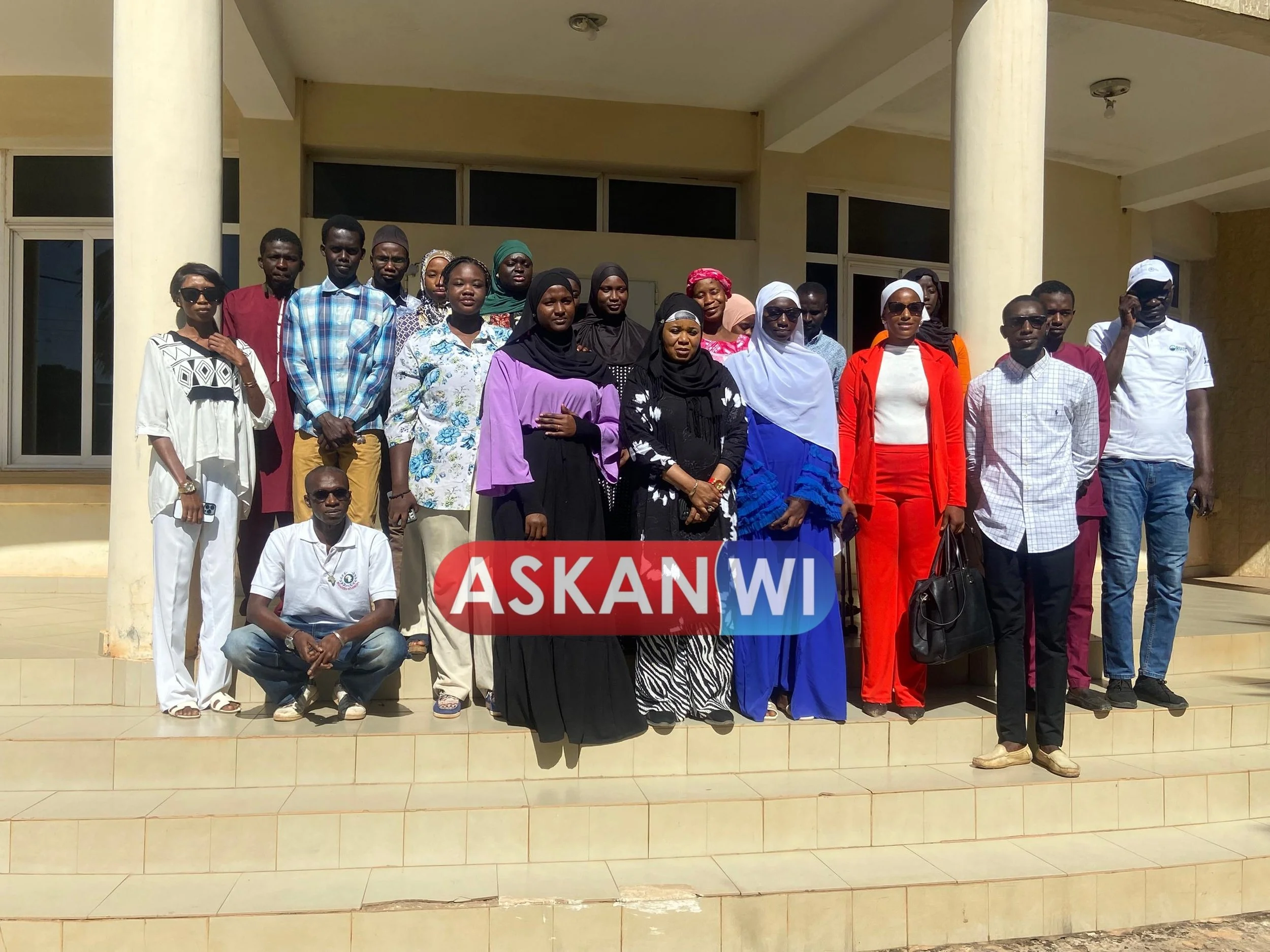
Group Photo © Askanwi
By Haddy Ceesay
The harrowing testimonies of survivors of the November 11th, 2000 incident and alleged witch-hunt victims under the former regime of ex-president Yahya Jammeh left many participants emotional during a two-day youth and media engagement on transitional justice and social cohesion. The event, organised by the Women’s Association for Victims Empowerment (WAVE), was held on Thursday 27th and Friday 28th, 2025, at the NaNA Conference Center in Bakau.
The training aimed to equip youth and journalists with knowledge on transitional justice, strengthen their role in peacebuilding, and provide media professionals with tools and ethical guidelines for reporting on victims. Many survivors whose rights were violated during the former regime renewed their call for reparations and justice.
“Justice must be real, not abstract.” — Essa Sanneh, WAVE-Gambia.
During the opening ceremony, Essa Sanneh, Assistant at WAVE-Gambia, emphasised the importance of youth and media in advancing the transitional justice process.
“The TRRC gave us a roadmap and a promise of ‘never again.’ But this promise will only be fulfilled if it lives in our communities, our schools, our public discourse, and in the everyday actions of citizens,” he said.
“Youth, who represent the majority of our population, must be empowered to lead this transformation. The media, as the amplifier of truth and accountability, must be equipped to tell these stories responsibly and inclusively.”
He added that the two-day forum serves as a call to action to build “a Gambia where peace is sustained, justice is real, and the voices of youth and survivors help shape our collective future.”
ICTJ Representative Highlights Legal and Moral Responsibilities
Representing the International Center for Transitional Justice (ICTJ), Samba Jallow delivered remarks on behalf of the Head of Program. He underscored that transitional justice is not merely a legal process but a moral and civic duty.
He noted that the engagement aligns with the TRRC Final Report, the Government White Paper on its implementation, and the National Development Plan (2022–2027), which prioritises youth empowerment.
“Transitional justice connects the pain of yesterday with the promise of tomorrow. Justice must be people-driven, not just policy-driven,” he said.
He reminded participants that The Gambia is bound by several regional and international frameworks—such as UN Security Council Resolutions 2250 and 2419 on Youth, Peace and Security, the African Youth Charter, and the AU Transitional Justice Policy—that recognise the importance of youth participation in peace-building.
Addressing the media, he said, “You are the storytellers of our time, the keepers of public memory, and the facilitators of national conversation. With power comes a duty — to uphold integrity, resist misinformation, and prioritise empathy.”
He encouraged youth to use the platform purposefully, describing them as “architects of the present” with the responsibility to contribute to national healing and reform.
GPU Calls for Strengthened Media Professionalism
Sheriff Saidykan, vice president of the Gambia Press Union (GPU), highlighted the essential role of the media in protecting victims and promoting accountability.
“Victims of the former regime faced torture, sexual violence, and other grave human rights abuses. Transitional justice reforms require a higher degree of professional development, and the media must rise to this responsibility,” he stated.
Saidykan urged journalists to fully utilise the training to improve responsible reporting and contribute to national reconciliation. He also expressed appreciation to WAVE and ICTJ for their collaboration and continuous commitment to strengthening media capacity.
