
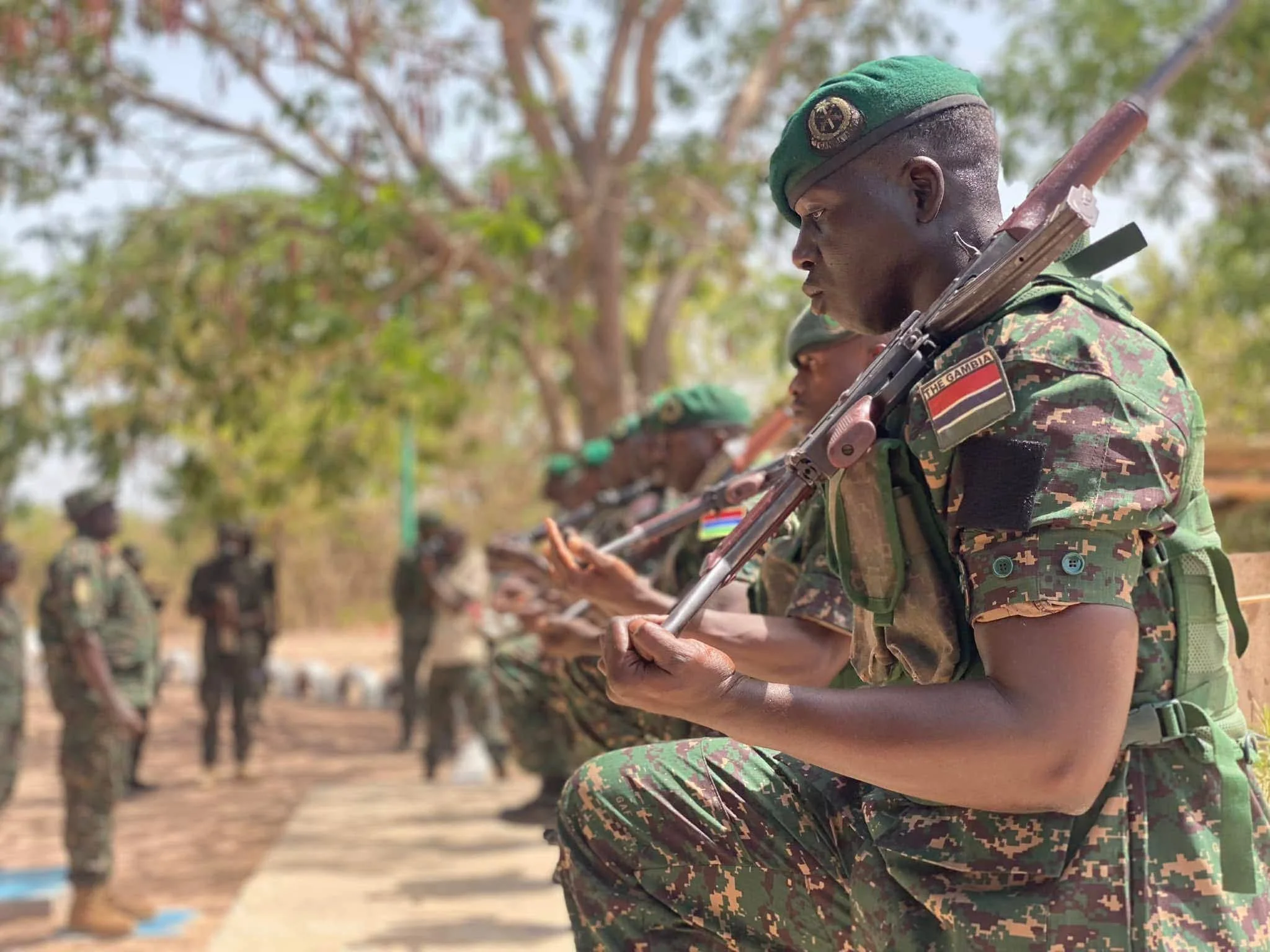
Gambia Armed Forces (GAF)
When Does ECOMIG Go Home? The Exit Strategy Question The Gambia Hasn’t Answered
By David Kujabi,
I read the Honourable Minister of Information's recent defence of ECOMIG's continued presence in The Gambia with the seriousness it deserves, and I want to engage with it in the same spirit, not to dismiss the argument, but to press on the parts of it that a mature security debate cannot skip past.
Dr Ceesay says Gambian institutions still command Gambian security. He is correct. The Gambia Armed Forces, the State Intelligence Services, the Gambia Police Force and the Immigration Department are Gambian-headed. They operate under Gambian law. No one disputes this.
But this concedes very little. Nobody serious argues that ECOMIG has formally seized command of our institutions. The real question is different: what has nine years of leaning on a foreign force done to those institutions, to public confidence in them, and to the officers who serve in them alongside a better-resourced foreign contingent?
Dr Ceesay frames ECOMIG as "partnership, cooperation and complementarity", not substitution. The evidence does not support that framing.
ECOWAS's own analysts have found that ECOMIG increasingly functions as a protection force for the government of the day, not as an engine of reform. Beyond the 2020 defence and security strategy, The Gambia has made no other major progress in rightsizing its forces. That verdict comes from people close to the mission itself, not from critics.
Nine years is long enough to ask why the reforms ECOMIG's mandate was meant to enable, the White Paper on the TRRC's security recommendations, the rightsizing of the GAF, and professionalisation remain undelivered. A propped-up institution has less pressure to fix itself. That is not a flaw peculiar to Gambians; it happens wherever a crutch stays in place after the emergency that justified it passes. ECOMIG's continued presence has probably delayed reform as much as it protected the transition that made reform possible.
Dr Ceesay's central comparison of NATO forces in Germany and US forces in Japan also does not hold. Those arrangements sit inside mutual defence treaties that each country's own parliament ratified between two fully sovereign, fully capable states jointly facing a named external threat. Germany's and Japan's own armed forces are not propped up by their allies; NATO and the United States never deployed those forces because Bonn's or Tokyo's military could not be trusted after a domestic political rupture.
ECOMIG's mandate looks nothing like that. ECOWAS has renewed it on a rolling, largely annual basis since 2017, each time attaching conditions like a new constitution, implementation of the White Paper, and rightsizing the forces – conditions that The Gambia has not yet fully met. In June 2025, the ECOWAS Authority extended ECOMIG for a further 24 months and, in the same decision, called it "the final extension". It ordered the ECOWAS Commission to build an exit strategy, including a drawdown and liquidation plan. No one drafts a liquidation plan for a military alliance. That is the language of an intervention winding down, not a partnership between equals. Reaching for Bonn and Tokyo to describe Banjul flatters the arrangement, and it now contradicts what ECOWAS itself is saying.
Ceesay's piece leaves out some really fundamental questions that need looking into under this subject.
The mandate and its end date. ECOWAS has already called the current extension final and ordered a drawdown plan. The Gambia's own 2025 review of its Security Sector Reform process, produced by the Office of National Security, lists "implementation of a comprehensive ECOMIG exit strategy" among the milestones the government has still not delivered, alongside integrating SSR into the national budget and setting up the promised trust fund.
ECOMIG has also long relied heavily on one contributor: research published in 2021 found Senegal supplied roughly three-quarters of ECOMIG's troops, 750 of about 1,000 then deployed, with Nigeria and Ghana making up the rest. The political will for an exit exists. What is missing is a published, conditions-based plan the public can hold the government to.
ECOMIG's original 2017 mandate explicitly included providing security for the president and key state institutions. A government that keeps extending that arrangement, mandate after mandate, for nine years, tells us something about how much confidence it places in the security architecture it commands. Nearly a decade into an SSR process, it is fair to ask what it means for the Commander-in-Chief's own security to have rested, even partially, on a foreign force for any part of that period. This is not a sovereignty question; command remains formally Gambian, and Dr Ceesay is right about that. It is a confidence question, and it deserves an answer.
I agree with Dr Ceesay that The Gambia needs regional cooperation. No small state can face terrorism, trafficking, arms smuggling or maritime crime alone, and SSR was never meant to produce isolation. But there is a real line between partnership and dependency. A partner builds a national institution's capacity to do its own job. A substitute does the job because the institution still cannot. Nine years of Gambian officers serving alongside better-resourced, better-equipped foreign contingents, while officials call them the custodians of national security, sends a mixed signal. Left unexamined, that signal can harden into a belief that ours is a permanently junior security service in its own country. Even though no study yet quantifies this. That does not make it unreasonable to ask.
One more point deserves fair acknowledgement, even though it also sits outside Dr Ceesay's post: deterrence. A regional force in-country plausibly raises the cost of any move against a constitutional government, and Gambians themselves are genuinely split on ECOMIG's presence, not united against it; Afrobarometer's research confirms this. Deterrence and reform stagnation are not opposites. Both can be true at once. ECOMIG can have helped keep the peace and, at the same time, removed some of the urgency to build a security sector that would not need that peace kept for it by someone else.
None of this argues for ECOMIG to leave tomorrow. It argues for calling the arrangement what it is: a stabilisation and coup-deterrent presence whose long life has coincided with real stagnation in reforming our own security sector, not a peer alliance that settles the debate by existing. Nine years after Jammeh left, the honest question is not whether Gambians formally command their institutions. It is when, and under what benchmarks, we stop needing someone else to help us hold them.
ECOWAS has already called this the final extension and ordered a drawdown plan. The Gambian government owes its citizens the plan itself, published with clear benchmarks, on a timeline the public can track. Make ECOMIG's eventual departure proof that the transition it came to protect succeeded, not proof that we could not stand on our own.
