
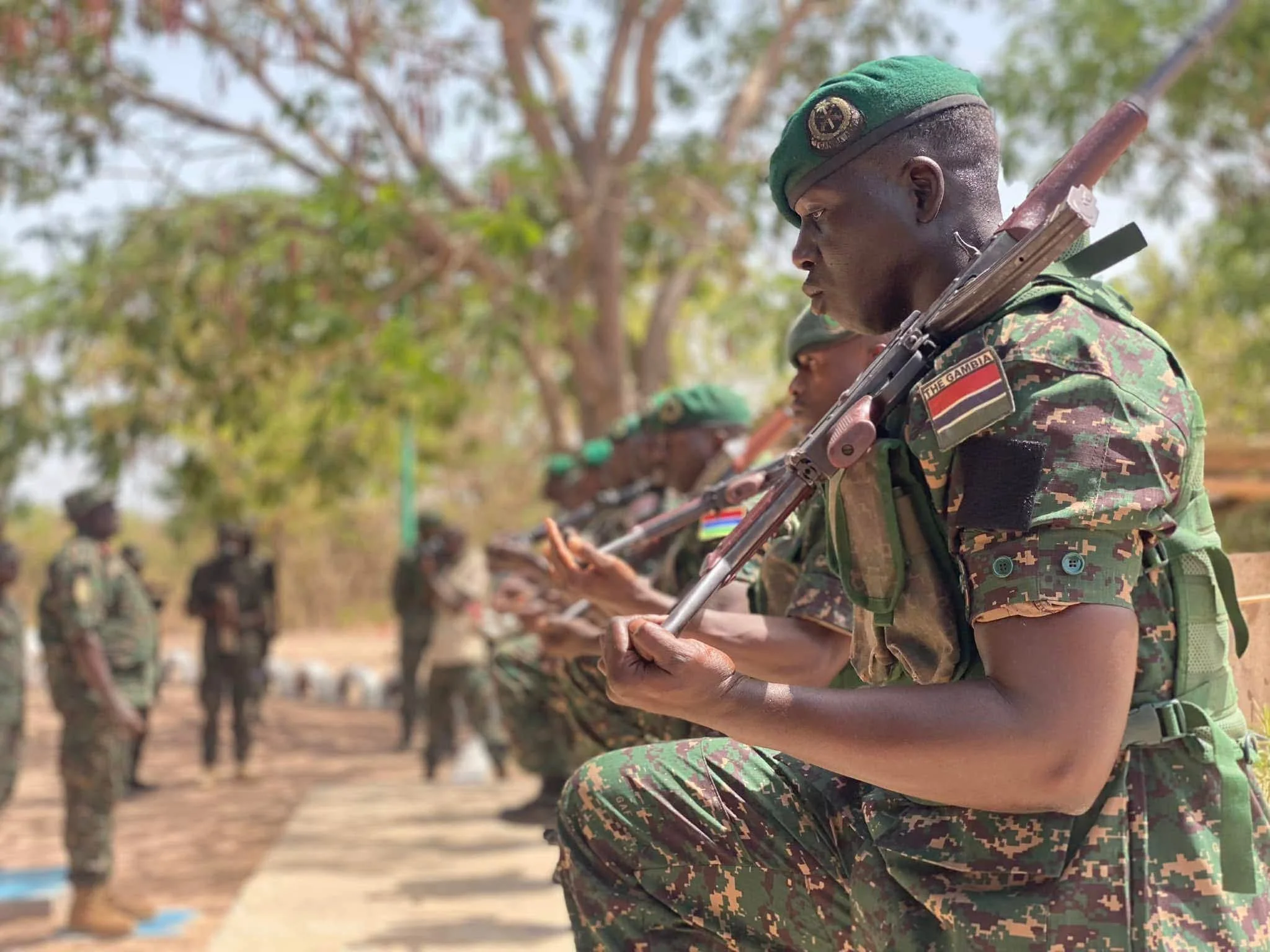
Gambia Armed Forces
By Alagie Barrow,
Upon logging into Facebook this morning, I came across an article by Ismaila Ceesay on the issue of ECOMIG, and my ears perked up. I read it because the subject matters to me. I must say, Ismaila did not disappoint me. Few Barrow mandarins contradict their former selves as shamelessly as Ismaila Ceesay. Gambia government officials are quite skilled at inventing their own arguments and then heroically arguing against them. I am not entirely sure whether that is what Ismaila did in this piece, but the crux of his argument was that “there is a misleading narrative that because a limited number of ECOMIG personnel remain in The Gambia, Gambians somehow no longer control their own national security.” Notice how he uses the phrase “limited number” to try to program our brains. You have to give it to the man: he is trying hard.
What I have not seen is anyone making the argument Ismaila claims to be rebutting. He did not quote anyone or cite any statement. He mentions a narrative, then proceeds to dismantle the argument he wants to shift our attention toward. But for the sake of argument, let us assume that this narrative does, in fact, exist. Ismaila tells us that the “assertion is simply incorrect and risks reducing a serious national security matter to political propaganda”. Fair enough. But before accepting the new Ismaila’s lecture, it is worth revisiting what the old Ismaila said before the government office made him discover new truths.
OLD ISMAILA CEESAY
Back then, Ismaila had warned that “ECOMIG will not prevent long-term security risks if the President does not win the trust of the army.”
In another commentary about ECOMIG, Ismaila was paraphrased as follows:
The population wonders why this ECOWAS mission is still present in the country. Dr CESSAY considers that the question beyond the role of ECOMIG is to know who really benefits from their presence. He believes that ECOMIG should not stay in The Gambia for too long, as it could have the opposite effect. A recent poll showed that the majority of the population wants them to leave. On the other hand, all indications are that the current President wants to stay in power, and the ECOMIG forces are a support for him. Dr CEESAY stressed that the 2021 presidential elections will be very competitive, as they will be the first elections after the departure of Yahya JAMMEH. There may be risks of electoral tensions, and the presence of ECOMIG could contribute to amplifying them.
In an interview with The Standard Newspaper, Ismaila Ceesay was quoted as saying:
What I was trying to say is what I observed as an expert on security issues from my extensive reading of the literature and also from observing some empirical data in security issues on the African continent The army had played a certain role under dictatorship. The whole concept of security has also changed since after the Cold War. Now, I am a researcher, and when we do research, we collect data and speak with the relevant people. And I see a trend that you cannot rely on external forces for the longer term. ECOMIG was supposed to come as a stabilisation force to ensure that this transition from authoritarianism to democracy is safeguarded and delivered with no destruction. That was the purpose of Ecomig. I saw a trend where there was a lack of trust between the army and the president. The army were feeling alienated, and my point of view was that yes, Ecomig is here, but in the long term, if you want stability in The Gambia, you must gain the trust of your army because they will be the ones ready to die defending this country, so gain their trust. Go visit them and have a word with them; that will give them some confidence. That was what I was saying. I wasn’t speaking to incite violence; I was just speaking as an expert.
Security expert because you read the literature? Kon mu yormbah di… anyway, Ayeh diya… Moving on, let us compare the old Security Expert with the new one.
THE NEW ISMAILA
According to the new Ismaila:
The facts are clear: The Gambia’s national security institutions remain Gambian-led, Gambian-commanded and subject to Gambian authority and laws.
You see what he did there? Who, exactly, has argued that The Gambia’s national security institutions are formally controlled by foreigners? That is not the argument on the table. The real issue is more damning: Adama Barrow’s personal security is widely understood to depend on Senegalese forces. Ismaila avoids that question, substitutes it for a safer one, and then congratulates himself for answering it. Then he puts on his security expert hat and lectures us:
In today’s interconnected world, security threats do not respect national borders. Terrorism, organised crime, human trafficking, drug trafficking and other forms of transnational crime require countries to work together. Cooperation with ECOWAS partners strengthens The Gambia’s capacity to confront these threats while preserving our sovereignty and national decision-making.
Okay, Ismaila. We agree with you. Security threats do not respect borders. Regional cooperation matters. No serious person disputes that. But that is a diversion, not an answer to the vexing question! The issue is not regional cooperation. The issue is that the most powerful person in The Gambia relies on foreign troops for protection despite the fact that we have our own security forces. Could that be because, as you yourself argued earlier, the President does not fully trust the Gambian security forces? If Gambians lead and command their own security institutions, why does the man who heads them rely on foreign soldiers to guard him? That is not political propaganda. It is a legitimate security concern. No nation should outsource its leader’s security to outsiders for ten years and counting.
Ismaila then offers this comparison:
There are clear international examples of this principle. NATO forces have long been stationed in Germany, yet Germany remains a sovereign state whose national security institutions and policies are determined by its own government. Similarly, the presence of American forces in Japan does not mean that the United States controls Japan’s national security. Japan remains a sovereign country with its own government, laws, and security institutions. The same principle applies to The Gambia.
Alright, Ismaila, let us not get too fancy with the expertise claim.
NATO forces are not guarding the Chancellor of Germany. American forces are certainly not guarding the Prime Minister of Japan or his family. As a security expert, I am sure you understand that NATO’s mandate is vastly different from ECOMIG’s. The same applies to the American military presence in Japan. You cannot take examples of foreign military bases established under specific historical, strategic, and treaty arrangements and then use them to justify a situation in which foreign troops are effectively tied to the security of a sitting head of state. Those are not the same thing. No nation, worthy of its sovereignty, will entrust the security of its leader to foreign forces. You will not go to any country where all is truly well and find that the head of state's security is entrusted to foreign troops. That is not a sign of confidence. It is deep-seated distrust. Interestingly, that is precisely the point the old Ismaila Ceesay understood very well before the new Ismaila Ceesay decided to pretend otherwise by choosing political spinelessness over intellectual consistency!
