
Politics of Character Assassination Over Policy: Should the Media Become the Megaphone?
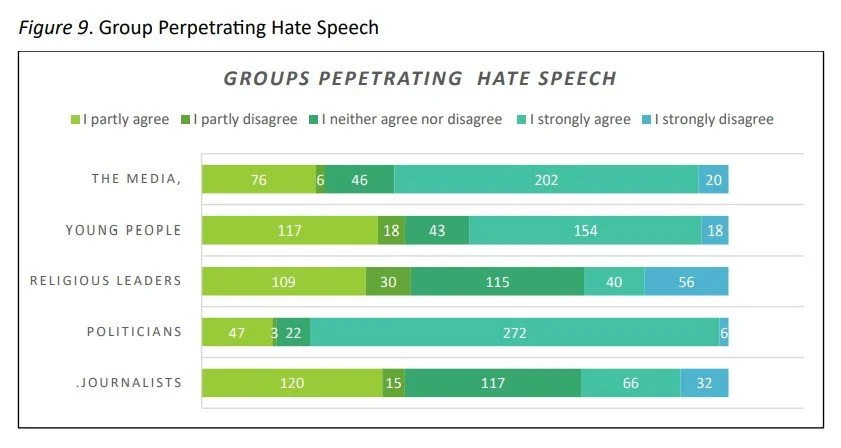
Groups Perpetrating Hate Speech © NHRC Gambia 2025 Report
By Edward Dalliah, Jr.
With almost two months to go before the 2026 presidential election, The Gambia’s political environment is becoming increasingly active, with political parties and politicians holding meetings and rallies to engage their supporters ahead of the November presidential campaign.
At many of these gatherings, the media is present to document what politicians say and share it with the public. But what happens when political discourse moves beyond policy discussions and into hate speech, tribalism, discrimination, and personal attacks?
This is an important question for journalists and media organisations to consider. In some political meetings, politicians make statements that contain elements of hate speech, tribal or discriminatory remarks, and character assassination, conduct that the newly revised Cherno Jallow Charter of Ethics for Journalists and Media Operators cautions journalists against amplifying.
Yet, despite these ethical concerns, such remarks are often published by media houses, particularly online platforms, sometimes with little context or scrutiny. In doing so, the media can unintentionally give offensive statements a much larger audience than they would otherwise have had.
According to the National Human Rights Commission’s 2025 Follow-up Study on the Report of Hate Speech in The Gambia, “most of the respondents [the Commission interviewed] believed that hate speech is mostly perpetrated by politicians, followed by media-based-hate speech”.
This finding should concern the media. The responsibility of journalism is not simply to repeat what public figures say. It is also to scrutinise, contextualise and hold duty-bearers accountable. The Commission’s findings further identified “political rallies and public gatherings as the main vehicles for hate speech, followed by social media and religious gatherings”.
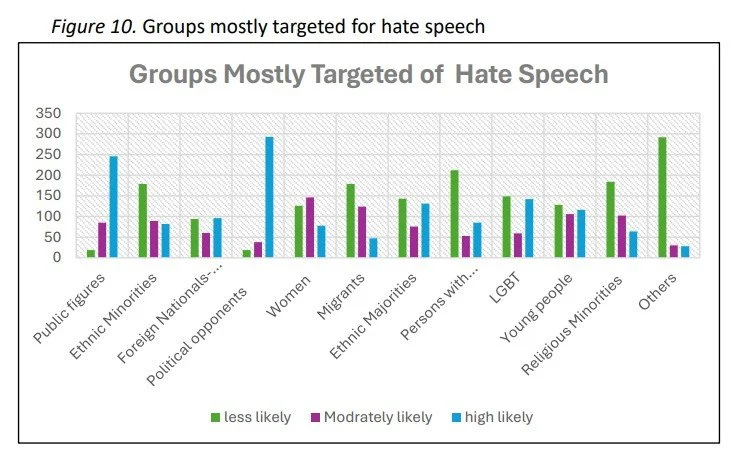
Groups Targeted for Hate Speech © NHRC Gambia 2025 Report
This creates a difficult but important responsibility for the media. Political rallies are newsworthy, and journalists have a legitimate role in covering them. However, the fact that something is said at a political rally does not automatically mean that it should be reproduced in a way that amplifies it.
Part 9 of the revised Ethics for Journalists states that journalists should avoid amplifying hate speech and other derogatory remarks but should instead flag and expose them.
The distinction is important. There is a difference between reporting that hate speech was made and turning the hate speech itself into the headline, social media clip or viral content.
Journalists can inform the public without becoming vehicles for the further spread of harmful rhetoric. Hate speech should not become entertainment. Neither should character assassination replace meaningful political discussion about policies, programmes, leadership records and issues affecting citizens.
This places a significant responsibility on journalists and media practitioners to safeguard the integrity of journalism and uphold professional ethics, particularly during an election period when political rhetoric can become increasingly heated.
If a political meeting becomes dominated by hate speech, tribal remarks or character assassination, journalists should ask themselves: What is the public interest in reproducing these words? What purpose does publishing them serve? And are we informing the public or simply amplifying the rhetoric?
The answer should guide how the material is reported. The media does not have to become a megaphone for every statement made by a politician. Journalism is not merely about recording what was said; it is also about exercising professional judgement over how information is presented to the public.
Therefore, as The Gambia approaches the 2026 presidential election, journalists must remember the important role they play in a democratic society. Their responsibility is to inform the public, scrutinise those seeking power and serve the public interest, while ensuring that the platforms entrusted to them are not used to unnecessarily amplify hate, discrimination or personal attacks.
