
The 2027 Budget: A Government on Life Support, Not a Nation on the Move

2025 to 2027 Budget Overview © Askanwi Media after MoFEA
By a Concerned Public Finance Analyst
The true test of any national budget is simple: does it solve the biggest problems facing ordinary people?
Does it create jobs for unemployed youths? Does it lower the cost of living? Does it provide reliable electricity? Does it invest in agriculture, education, healthcare and productive sectors that can grow the economy?
A careful reading of the Barrow Administration's 2027 Budget Estimates suggests the answer is largely no.
Instead of presenting a bold roadmap for tackling The Gambia's chronic economic and social challenges, the 2027 Budget appears primarily designed to keep the machinery of government running, sustain an expanding bureaucratic structure, and finance rising recurrent obligations. Far from being a development-driven budget, it increasingly resembles an operational budget designed to put government institutions on life support while ordinary Gambians are asked to wait another year for meaningful transformation.
The numbers tell the story.
Government expenditure is projected to increase by more than 12.5 percent in 2027. Personnel costs rise from approximately D10.29 billion in 2026 to D11.21 billion in 2027. Subsidies and transfers increase from D7.66 billion to D8.31 billion. Debt service grows from D13.46 billion to D16.17 billion. Total Government Local Fund expenditure reaches approximately D48.6 billion. These figures reveal a government that is becoming more expensive to maintain, not necessarily more effective in delivering results.
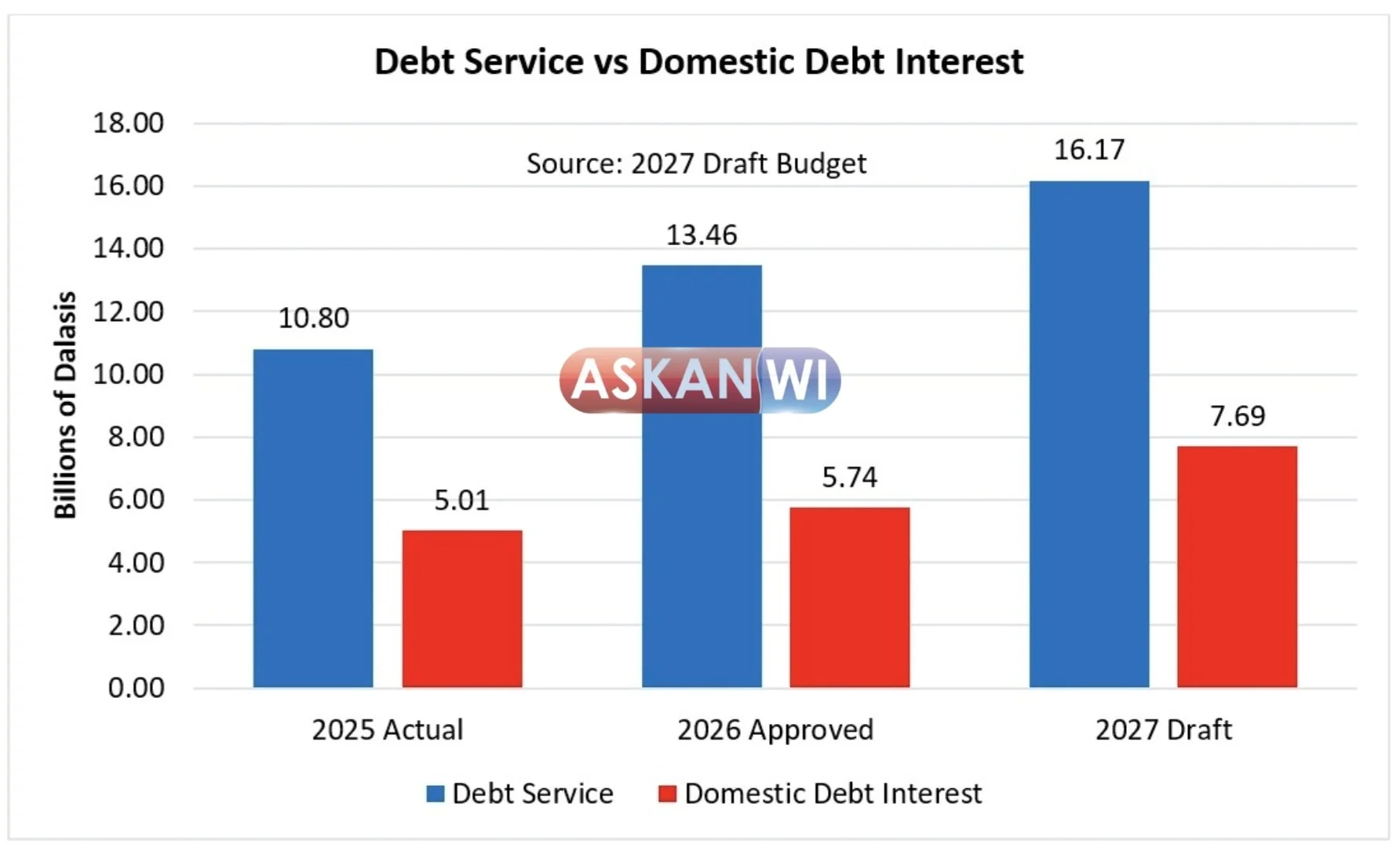
Debt Service from 2025 to 2027 © Askanwi Media
Most alarming is the explosion in debt servicing.
The country will spend more than D16 billion simply paying debts and interest in 2027. According to the government's own budget framework, debt service will consume about one-third of Government Local Fund expenditures. Every dalasi spent servicing debt is a dalasi unavailable for youth employment, electricity generation, agricultural modernization, healthcare expansion or education improvement.
This raises a fundamental question.
How can a government claim fiscal sustainability when debt repayments have become one of the largest items in the national budget?
The situation becomes even more troubling when viewed in historical context. Public debt has reportedly risen from roughly D44 billion less than a decade ago to around D140 billion today. In nominal terms, The Gambia has accumulated more public debt under the current administration than was accumulated during the combined eras of Sir Dawda Jawara and Yahya Jammeh. Whether one supports or opposes the current government politically, this is a trend that should concern every Gambian.
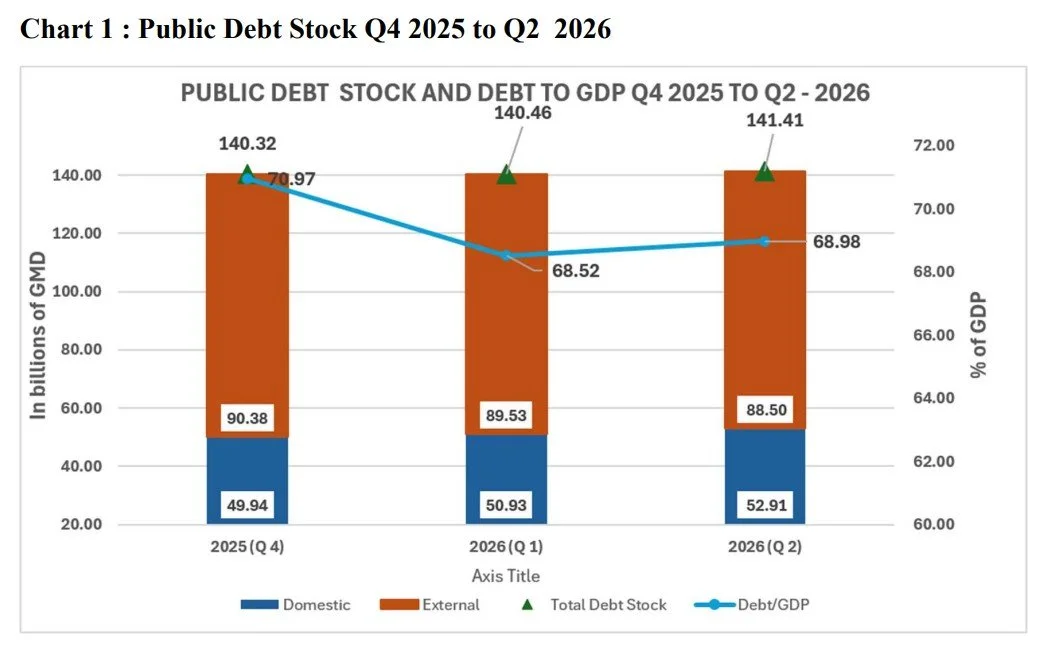
The Gambia’s Total Public Debt Stock © MoFEA 2026 Q2 Public Debt Bulletin
The irony is striking.
The same government that regularly speaks about fiscal discipline continues to expand spending commitments while debt obligations rise year after year.
Yet the greatest weakness of the 2027 Budget may not be spending itself.
It is the continued reliance on highly optimistic assumptions about external financing.
Government plans to spend D23.47 billion on development projects in 2027. Of this amount, D15.97 billion, or approximately 68 percent, is expected to come from grants. Government Local Funds account for only D5.28 billion while loans contribute D2.21 billion. In other words, more than two-thirds of the country's development agenda depends on money that is outside government's direct control.
That dependence would be less worrying if history supported such optimism.
But history tells a very different story.
Between 2020 and 2025, government budgeted nearly D79.3 billion in grants but received only D19.8 billion. That means grant realization averaged just 24.9 percent. In some years performance was dramatically worse. In 2021, the government budgeted D12.01 billion in grants but received only D796 million, a realization rate of just 6.6 percent. Even the best-performing year achieved only 41.1 percent of projected grant receipts.

Actual vs Approved Grants 2017 to 2024 © Askanwi after MoFEA
The implication is unavoidable.
For six consecutive years, governments have budgeted grants as though they were guaranteed revenue. The money has rarely arrived at the levels projected.
Yet instead of becoming more cautious, the 2027 Budget assumes grant receipts of D19.54 billion, more than four times the highest level of actual grants received during the audited review period.
This is not prudent budgeting. It is budgeting on hope.
When expected grants fail to arrive, government is left with hard choices. Projects stall. Contractors go unpaid. Development programs are delayed. Domestic borrowing rises. Interest costs increase. Future budgets become even more constrained.
The government's own data reveal another uncomfortable reality. Development expenditure execution has been collapsing rather than improving. Actual development spending fell from 23.9 percent of budget in 2021 to only 10.2 percent by 2025. In practical terms, nearly 90 percent of approved development spending in 2025 was never implemented.
This should spark a national debate.
If development projects are not being implemented, why does government continue presenting increasingly larger development budgets?
A budget should not be judged by promises announced at the National Assembly. It should be judged by projects completed in communities.
For many Gambians, daily realities remain unchanged.
Youth unemployment remains high. Electricity remains unreliable. Businesses continue to struggle with energy costs. The cost of food continues to strain household budgets. Corruption allegations continue to dominate public discourse. Yet the 2027 Budget offers little evidence of a fundamental shift in national priorities.
Perhaps the most revealing comparison is the allocation to youth development.
The Ministry of Youth and Sports receives approximately D146.7 million in 2027. Government fuel expenditures exceed D400 million. Government travel costs approach D700 million. Debt service exceeds D16 billion.
What message does this send to the country's young people?
That servicing debt, funding travel and maintaining government operations matter more than creating jobs and opportunities for the generation that represents the future of the nation.
The government's defenders will point to the proposed 30 percent salary increase for civil servants as evidence that the budget supports working families.
Civil servants deserve fair wages. There is no dispute about that. The problem is sustainability.
A responsible salary policy must be supported by reliable revenues, productivity improvements and realistic fiscal planning. Announcing substantial pay increases while simultaneously relying on grant projections that historically fail to materialize raises legitimate concerns about future financing pressures. If the underlying fiscal assumptions prove inaccurate, today's promises could become tomorrow's borrowing requirements.
At its core, the 2027 Budget reflects a deeper governance challenge.
Government continues to treat symptoms rather than causes.
Instead of reducing the cost of government, it expands recurrent expenditure.
Instead of aggressively tackling procurement leakages, it increases operational spending.
Instead of restructuring underperforming institutions, it finances them.
Instead of reducing dependency on external financing, it deepens it.
Instead of prioritizing productive investment, it allocates ever-growing resources to administration and debt repayment.
A different path is possible.
A credible alternative would start by rationalizing government structures, reducing duplication across ministries and agencies, digitizing procurement, expanding e-government services, strengthening payroll controls, improving public financial accountability, and redirecting savings toward sectors that generate growth and jobs. It would invest heavily in energy reliability, skills development, agriculture, technology, manufacturing and entrepreneurship.
Most importantly, it would budget based on money that is likely to arrive, not money that policymakers hope will arrive.
The ultimate question facing Gambians is not whether government spending is increasing. It clearly is.
The real question is whether that spending is making life better for ordinary citizens.
After nearly a decade of rising expenditure, rising public debt and continued dependence on foreign grants and loans, many Gambians are entitled to ask a simple question:
If government is spending more than ever before, why do so many national problems remain unsolved?
Until that question is convincingly answered, the 2027 Budget will be remembered less as a blueprint for national transformation and more as a plan to sustain an increasingly expensive state while the country waits for development that exists largely on paper.
