
Billions of the Books Cover Photo © Askanwi Media
By Edward Dalliah, Jr.
Every year, the National Assembly approves billions of dalasi for development projects expected to be financed by international partners. But when the government later reports how the national budget was actually financed and spent, much of that external funding disappears from the figures presented to Parliament, often recorded as zero.
A ten-year review of national budget documents by Askanwi has uncovered persistent gaps in the reporting of ‘self-accounting projects’, raising serious questions about whether government accounts present a complete picture of public expenditure. The gaps also limit the ability of Parliament and the National Audit Office (NAO) to effectively scrutinise billions of dalasi linked to development projects implemented by Ministries, Agencies and Departments.
The problem is particularly evident in the Ministry of Agriculture, one of the country's major recipients of development assistance from international partners. During President Adama Barrow’s two terms in office, from 2017 to 2026, Parliament approved D24.81 billion for the ministry. Of this, a total of D19.78 billion was expected to come from external financing, while D5.04 billion was expected to come from Government Local Funds (GLF).
However, a comparison of approved allocations with actual receipts reported in subsequent budget documents shows that the GLF component is generally reflected, while expected external financing is often recorded as zero in most cases.
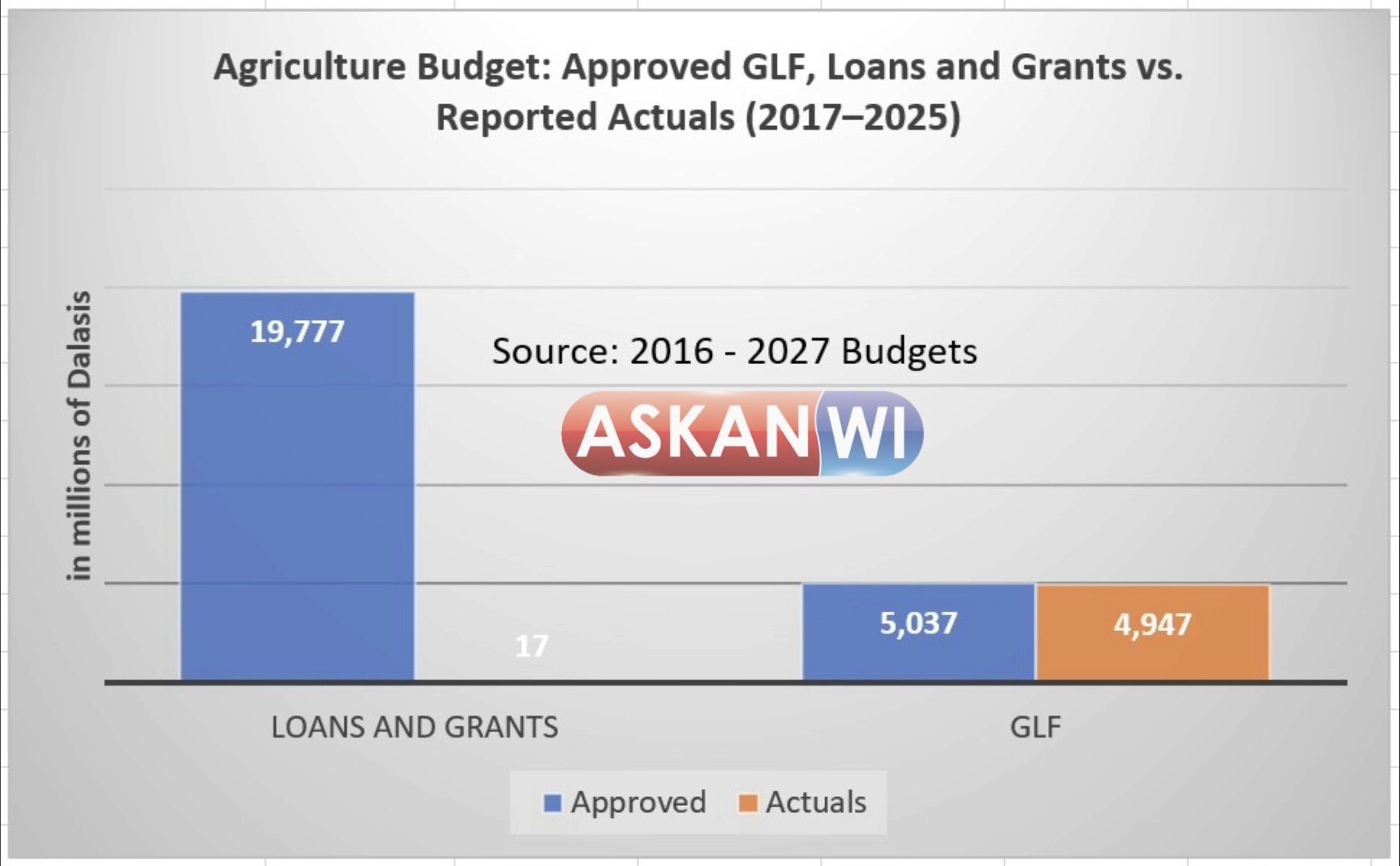
Agriculture GLF, Loans & Grants Approved vs Actual Funding © After MoFEA by Askanwi Media
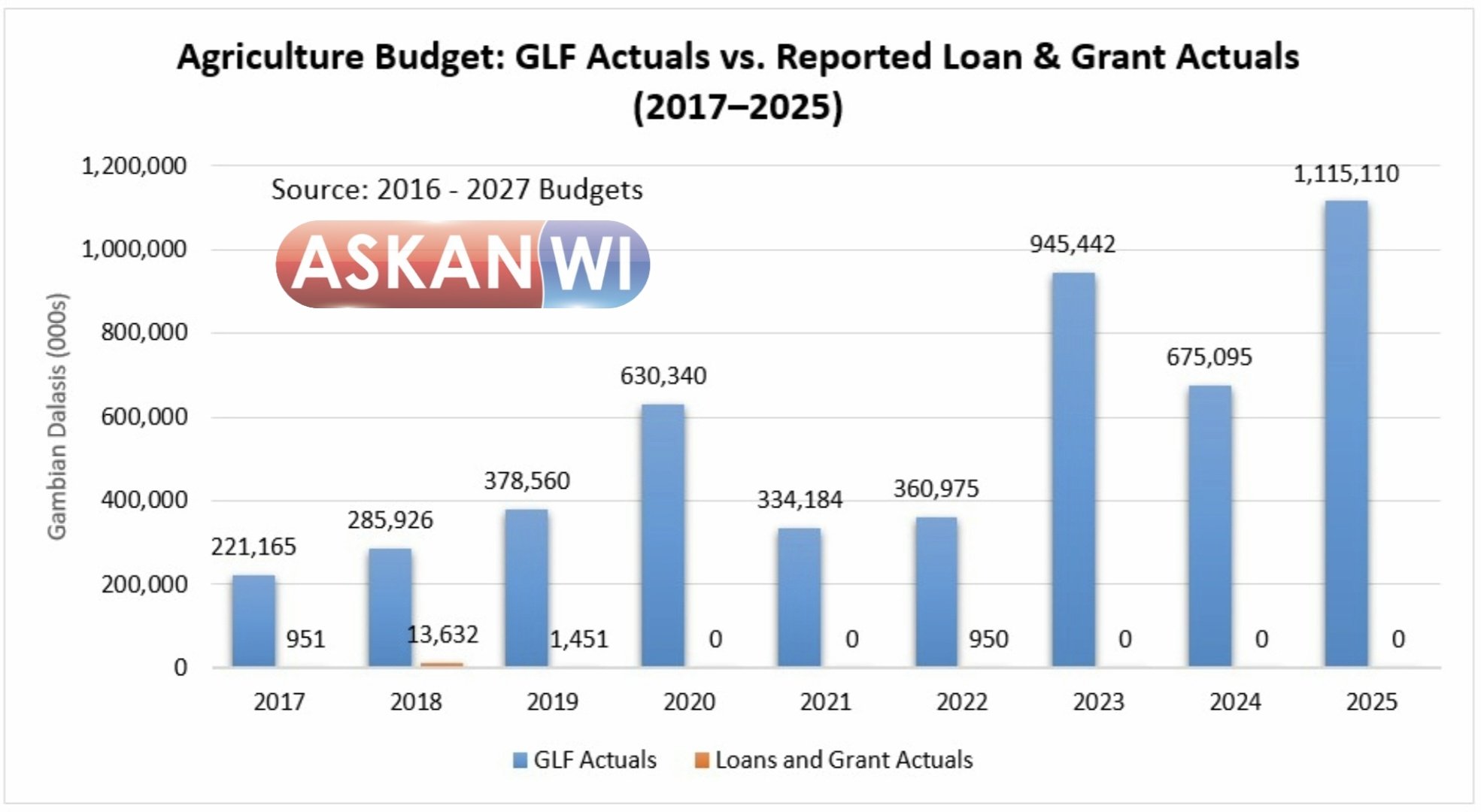
Agriculture Yearly Funding from 2017 to 2025 © After MoFEA by Askanwi Media
A decade of reporting gaps
As seen on the chart, the above only in four years out of the nine year did the budget capture disbursements of loans and grants; the rest of the years all have zero, indicating the reporting gap on external monies in the national budget.
This trend has continued for a decade, leaving the parliament, NAO and the public in the dark about how much funding is disbursed by partners for the country’s development.
Similarly, our findings align with a report by the Centre for Budget and Macroeconomic Transparency (CBMT), which examined eight major Agriculture development projects between 2020 and 2023.
The report found that “D6.69 billion was approved for the eight projects, [but] only D172.96 million was reflected as actual funding received in the national budget reports, equivalent to 2.58% of the approved amount.” The projects included the ROOTS Project, Gambia Inclusive and Resilient Agricultural Value Chain Project (GIRAV), Rice Value Chain IDB Project and Small Ruminant Project.
All of these projects need independent oversight on their implementation; however, the lack of proper reporting has made it difficult for it to happen. Lawmakers who normally approve these allocations are left in the dark, as is the government’s Accountant General.
To make matters worse, the NAO, whose part of its mandate is to audit the government accounts, is also left in the dark.
Auditor General identifies missing project accounts
The 2025 version, which is the most recent one, pointed out in the Accountant General’s commentary on the government’s financial statements that “projects funded and administered entirely by external agencies but representing development expenditure [of government] are required to submit certified quarterly summary accounts to the Accountant General’s Department to be included in the Government accounts.”
However, this requirement “was not met by Self-Accounting Projects” as of 2025, meaning “their accounts were not incorporated into the Government’s financial statements,” according to the audit report.
The accompanying Management Letter provides further details highlighting that the Accounting Procedure Manual 7.7.5 “states that Self-Accounting Projects shall submit quarterly Account Statements to the Accountant General’s Department to be incorporated into the main Government Account.”
However, during the auditing process, the document noted that auditors “have requested the quarterly plan, cash books, and bank reconciliation statements of the Self-Accounting Projects, but discussions with officials at AGD revealed that the self-accounting projects managers are not submitting their quarterly account statements and cash books.”
Therefore, they warned that “failure to submit these records increased the risk of understating account balances in the financial statements, potentially leading to inaccurate financial reporting.”
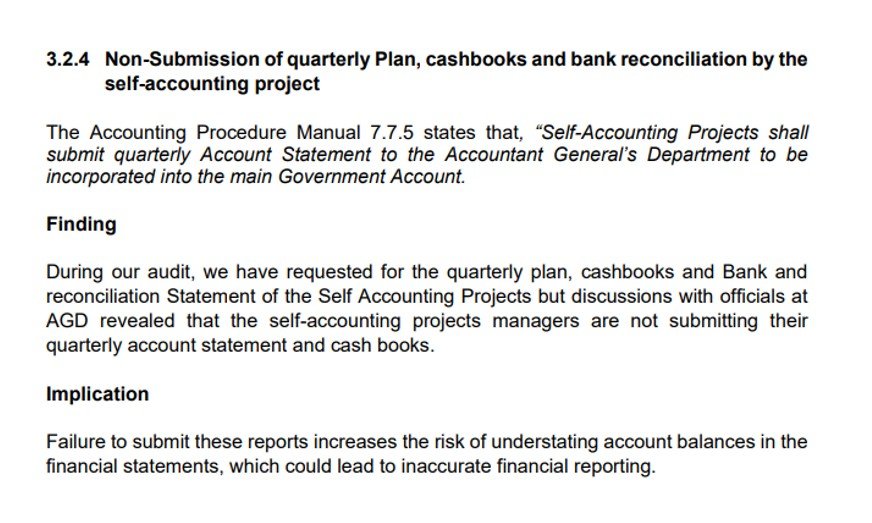
Screenshot of the 2025 Final Management Letter
These findings reveal the systemic gap the country is battling with on its government's accounts, making it impossible for both the NOA and Parliament to perform their oversight functions fully in accordance with the laws.
Finance Minister acknowledges D8.61 billion in unreported disbursements
The issue extends beyond Agriculture. During parliamentary proceedings on Wednesday, 28th October 2026, Minority Leader and NAM for Brikama North, Hon. Alhagie S. Darbo, asked Finance Minister Hon. Seedy Keita to explain the disparity between allocations approved for seven major energy development projects between 2020 and 2023 and the amounts reported as disbursed.
According to the minister’s response, the projects had an “estimated funding projection of D11.6 billion, against which only D2.2 million was reflected in the national budget reports.” He explained that “the actual disbursements were not captured because the projects were not enrolled in the Integrated Financial Management Information System (IFMIS).”
However, he further explained that the Directorate of Aid Coordination “maintained separate records of the actual disbursement received; based on these records, the ministry has accounted for approximately D8.61 billion in actual disbursement received during the period compared to the 2.2 million reflected in the approved budget.”
“The variance does not indicate that funds were not received; rather, it resulted from a reporting and system limitation as the projects were not enrolled in the IFMIS and consequently their actual disbursement could not be captured in the final national budget reports,” Finance Minister Keita told lawmakers.
His response reveals that donor-funded projects do receive disbursements and are recorded by the Aid Department Coordination; however, most of it will not appear in national budget reports for parliamentary oversight.
Officials from the Ministry of Finance’s Budget and Directorate of Aid Coordination told Askanwi that donor disbursements are captured in the government’s Aid Bulletin, which is normally published under the Directorate of Aid Coordination on the Ministry of Finance website.
Our reporter reviewed bulletins covering 2017 to the second quarter of 2025. However, the reporting format makes it difficult to compare donor disbursements directly with allocations in the national budget. The figures are largely presented in US dollars, rather than consistently converted into dalasi using the exchange rates applicable when funds were received.
The bulletins also acknowledge limitations in “accessing data in The Gambia is a challenge; thus, data from some UN agencies were not captured in this bulletin.” This raises further questions about the completeness of the information on the bulletins.

Infographic comparing the 2027 Approved for Agriculture vs Actual funding for Agriculture for 9 years © Askanwi
For financial journalists and budget enthusiasts, the result is that we are effectively driving blindly when it comes to the funding of the nation’s Agriculture sector, and this continues to impede accountability in a key component of the economy.
To put everything into context, Parliament recently approved the 2027 Budget, which allocated almost D7 billion to Agriculture. However, only D1.7 billion is expected to come from the government, while international partners are expected to provide the majority—D5.2 billion.
In comparison, the government’s reported receipts indicate that only D4.9 billion was spent from Government Local Funds and international partners over the nine-year period from 2017 to 2025.
This means that the current Parliament has approved plans for the government to spend more on Agriculture through loans and grants than it reportedly managed to spend from all funding sources between 2017 and 2025.
Our findings also highlight how heavily dependent the Agriculture sector appears to have become on international partners. The funds are certainly coming; we see evidence of projects through luxury vehicles bearing their names. However, what we do not see is a complete account of the actual funds spent on these projects reflected in the national budget.
All these findings point to a persistent reporting gap between the funds approved by Parliament and its disbursements. While the Ministry of Finance maintains separate records of donor disbursements through Aid Coordination, the failure to consistently reflect these funds in national budget reports leaves Parliament and the public without a complete picture.
More worrying is the continued exclusion of these funds in the auditing process of the government’s accounts. Ultimately, the question is not simply how much government approves for ‘self-accounting projects,’ but how much is actually received, spent and transparently reported.
