
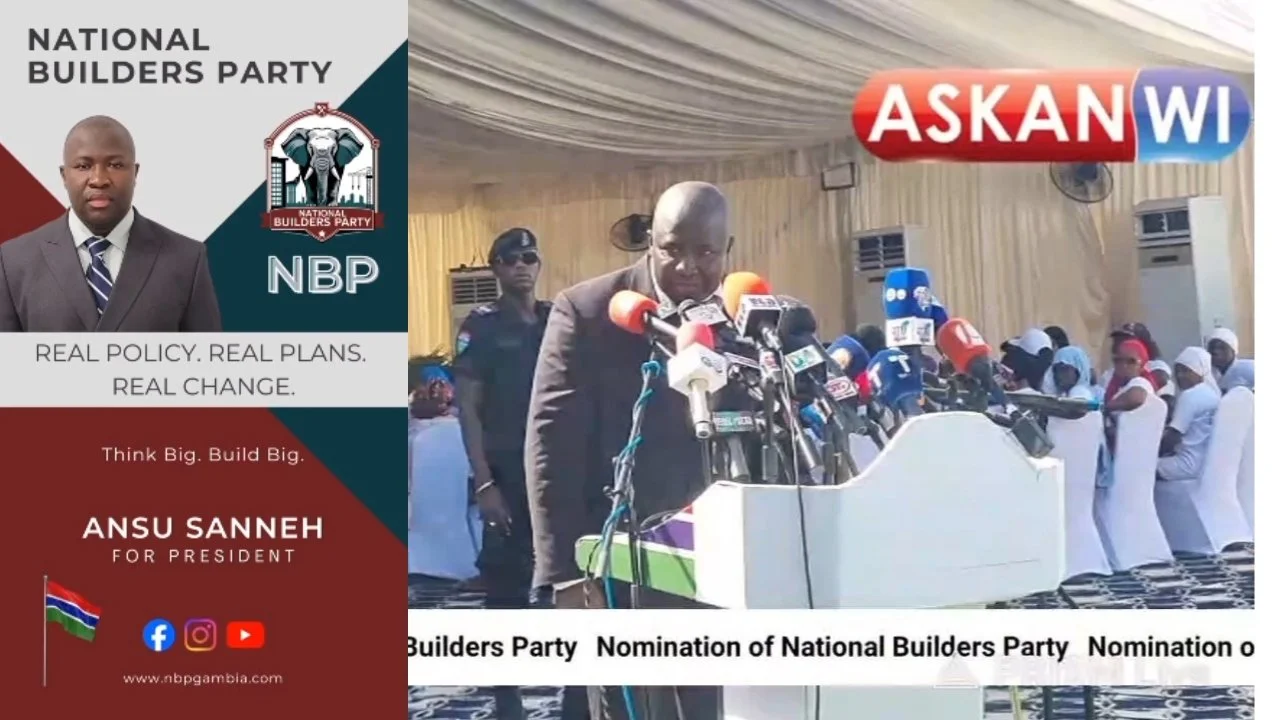
Ansu Sanneh of the National Builders Party YouTube and at the Nomination © Askanwi Media
By Edward Francis Dalliah,
The Independent Electoral Commission (IEC) announced on the final day of presidential nominations that Ansu Sanneh of the National Builders Party (NBP) had been cleared to contest the 5 December 2026 Presidential Election.
However, just a day after being certified by the IEC, multiple media outlets reported that Mr Sanneh had withdrawn from the race and would instead be backing UNITE's Talib Bensouda.
But our feature publication by Askanwi has raised questions about whether Mr Sanneh should have been approved by the IEC in the first place.
While Mr Sanneh's widely reported lack of a valid voter's card may have attracted criticism, there is another, more explicitly stated constitutional requirement that could have presented a significant obstacle to his candidacy.
According to Section 62(1)(c) of the 1997 Constitution, one of the requirements for qualification as a presidential candidate is that an aspirant must have "been ordinarily resident in The Gambia for the five years immediately preceding the election".
FactCheck: What Did Mr Sanneh Say About His Return to The Gambia?
Askanwi's research uncovered a video published on the National Builders Party's YouTube channel just three months ago, featuring a speech by Mr Sanneh in which he spoke about his return to The Gambia.
In his own words:
"Today, I speak to you with a heart full of gratitude, humility, determination and an overwhelming sense of responsibility. I am home after 17 years in the United States. I've returned to the country that raised me."
He further stated:
"I arrived in The Gambia more than a month ago, and I acknowledge that I should have spoken to you sooner. Circumstances beyond my control made it take longer than I wanted."
He also emphasised:
"17 years is a long time to be away from home."
Watch the video below and hear Mr Sanneh explain his return to The Gambia in his own words.
The video was published on the National Builders Party's YouTube channel on 29 July 2026. Based on the timeline provided in his own statement, Mr Sanneh appears to have returned to The Gambia around June 2026.
Appearing before the Independent Electoral Commission for his nomination, on 5th November 2026, Mr Sanneh told the IEC Chairman that he came back in the country in June 2026.
This triggered our reporter to ask him a question when he faced the media, citing Section 62(1)(c) of the 1997 Constitution. However, in response, Sanneh said he was under the impression that the constitutional provision had been amended, reducing the residency requirement from five years to six months.
Our research did not unearth any amendment reducing the ordinary resident period from 5 years to 6 months preceding the election.
If his statements are taken at face value, this raises a fundamental question: How could Mr Sanneh have satisfied the constitutional requirement of being ordinarily resident in The Gambia for the five years immediately preceding the 2026 Presidential Election?
His own account of returning after 17 years in the United States appears to raise serious questions about whether he met this constitutional qualification. Moreover, his confirmation to the IEC that he returned in June 2026
Editors' Note
Askanwi recognises that the constitutional residence requirement is a potentially contentious issue. Some argue that it ensures presidential candidates maintain a genuine connection with the citizens and the country, while others contend that it has been used to exclude Gambians in the diaspora from participating in the country's highest political office.
While these arguments deserve consideration, Askanwi's focus in this publication is narrower: whether Mr Sanneh fulfilled the constitutional requirement of ordinary residence for the five years immediately preceding the election.
The central issue is not whether the requirement should exist but whether it was properly applied in assessing Mr Sanneh's eligibility to contest the presidency.
