
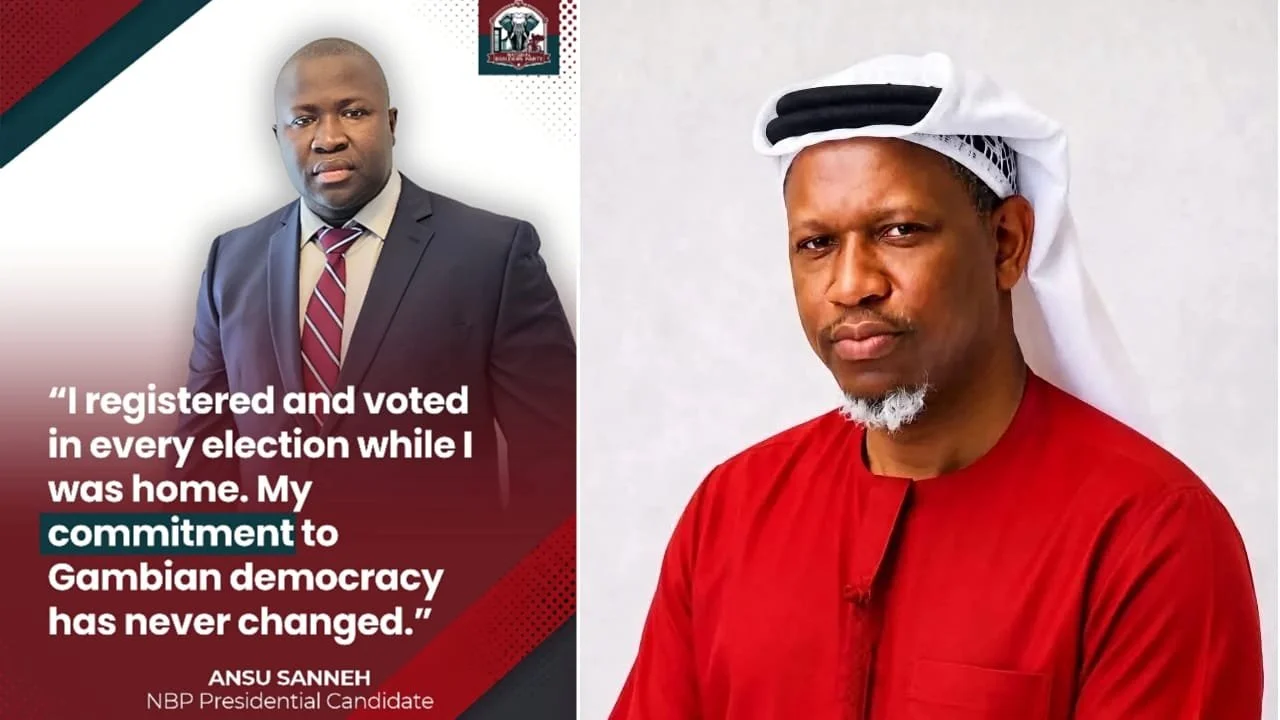
Ansu Sanneh left and Prince Ebrahim Sanyang right
By Askanwi Media
According to reports across multiple media platforms, Prince Ebrahim Sanyang, an independent presidential aspirant, declined to submit his nomination papers to the Independent Electoral Commission (IEC) after the Commission reportedly failed to trace his voter registration records.
However, his concerns appear to have been called into question by the IEC's decision to approve Ansu Sanneh of the National Builders Party (NBP), despite Sanneh openly admitting that he did not have a voter's card and had not registered.
Although Sanneh subsequently withdrew from the race to support the UNITE candidate, Talib Bensouda, he had already informed the IEC during his nomination appearance that he was not registered to vote. Despite this admission, the Commission approved his nomination.
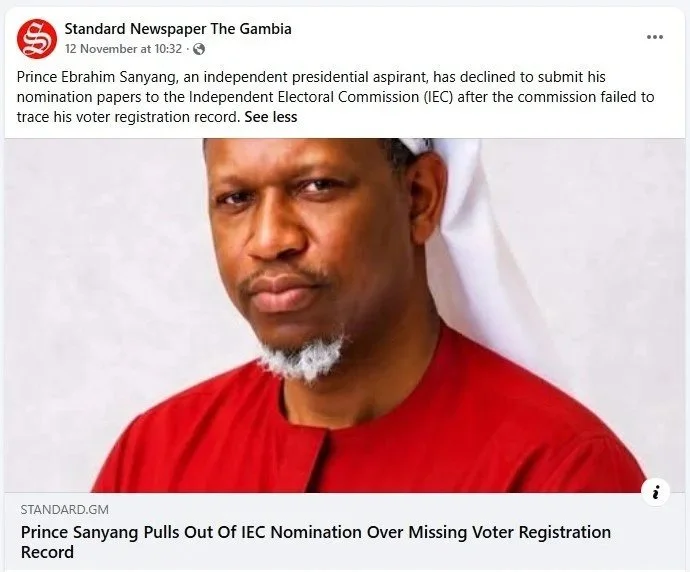
Front page story on the Standard Newspaper
FactCheck: According to Sanyang, his legal team wrote to the Commission on 10 November 2026, requesting the verification and restoration of his voter registration records. However, the IEC's presidential nomination schedule indicated that Sanyang was expected to submit his nomination documents on 11 November 2026, following Fabakary Jammeh's scheduled appearance.
Sanyang ultimately did not submit his nomination documents. His lawyers, Sheriff Kumba and Co., subsequently wrote to the Commission, making it clear that their client's decision should not be interpreted as a withdrawal from the race or an abandonment of his political rights.
“Our client's decision is taken solely by reason of the inability to trace his voter registration record. It does not constitute a waiver or abandonment of any of his rights, all of which are expressly reserved.”
According to a report by The Standard Newspaper, IEC Chairperson Joseph Colley explained that Sanyang registered in 2016, but the Commission's current database no longer contains records from that year. He stated that the available database covers registrations from 2021 to 2026.
The case becomes particularly interesting when compared with the interaction between IEC Chairperson Colley and Ansu Sanneh during the latter's nomination appearance.
When questioned about his voter registration status, Sanneh was asked by the IEC Chairperson whether he had a voter's card, adding that having one was optional.
Sanneh responded: “Not yet. I might register if you have a registration process somewhere down the line.”
The IEC Chairperson then pressed him further, asking: “Are you registered? Do you have a voter's card?”
To which Sanneh replied: “No, I haven't registered.”
Despite this exchange, Sanneh's nomination was approved by the IEC.
This interaction raises an important question: Is having a voter's card or being registered to vote a mandatory requirement for someone seeking to contest the presidency?
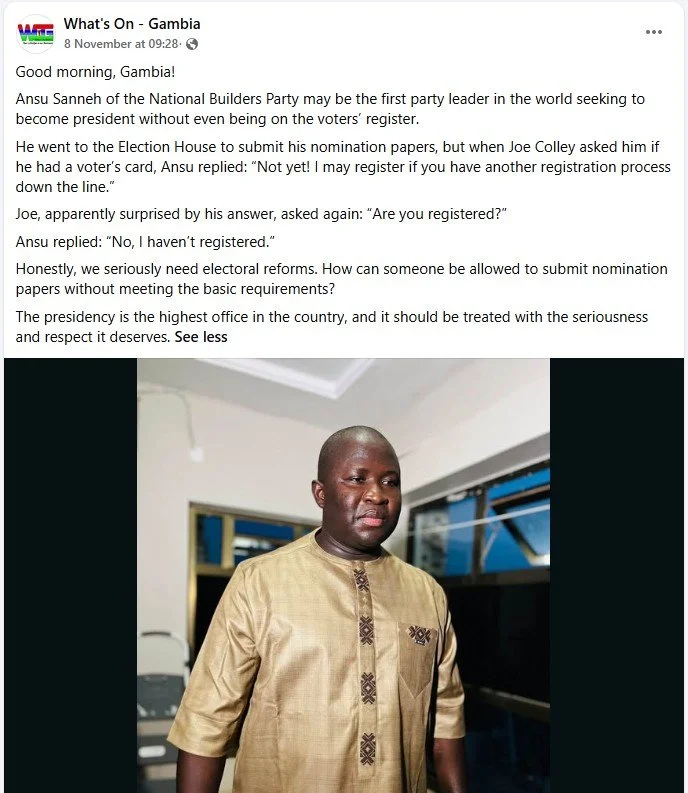
What’s On Gambia Post on Ansu Sanneh Voters Card © What’s On Gambia
Our research suggests that the absence of a voter's card does not, in itself, disqualify a presidential aspirant under the relevant electoral provisions. The requirement to be a registered voter under Section 47 applies expressly to those supporting a presidential nomination, rather than necessarily to the aspirant.
Sanneh's qualification, despite openly admitting that he had never registered to vote, therefore raises questions about the basis on which Sanyang's concerns prevented him from proceeding with his nomination.
Given that Sanyang had a legal team representing him, it is surprising that he did not proceed with the nomination process while the issue of his registration records was being addressed.
Conclusion
The claim that Sanyang declined to submit his nomination papers because the IEC could not trace his voter registration records requires further clarification. To date Sanyang hasn’t provided any evidence that he obtained a voters card back in 2021 or during the 2026 Supplementary Voter Registration process.
Regardless, the argument that the absence of a voter's card automatically prevented him from qualifying is difficult to reconcile with the IEC's treatment of Ansu Sanneh.
Sanneh was approved despite admitting that he had neither registered to vote nor obtained a voter's card.
