
Finance Minister: Gambia Fails to Hit 2025 Non-Tax Revenue Target by 42%
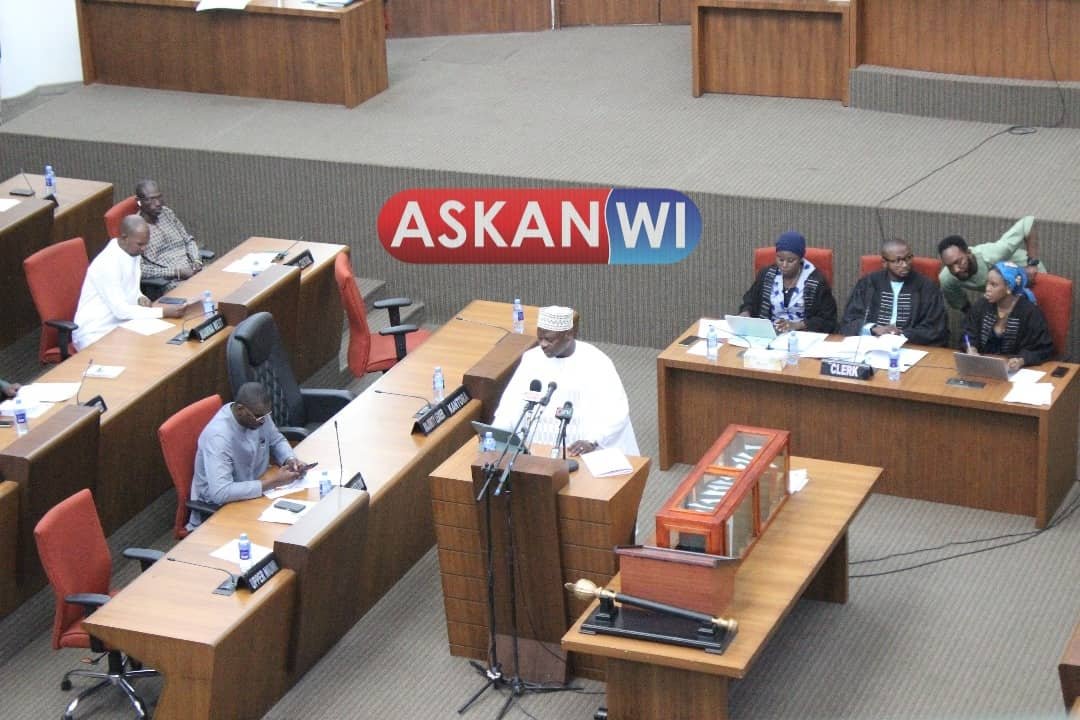
Finance Minister Seedy Keita in Parliament © Askanwi
By Edward Francis Dalliah, Jr.
The Gambia’s finance minister, Hon. Seedy Keita, informed Parliament that the government under-collected by over D3.3 billion in non-tax revenue in 2025, representing over 42% of the overall non-tax revenue target.
After requesting a last-minute postponement of his scheduled parliamentary budget update initially set for 2nd March 2026, Finance Minister Keita appeared before lawmakers on 9th March 2026 to provide an update on the government’s budget implementation for 2025.
According to the finance minister, “total non-tax revenue recorded D4.65 billion in 2025, up from D2.90 billion in the previous year, reflecting a 60% increase.” However, “despite these performances, overall non-tax revenue fell short of its D7.96 billion target in the approved budget by 42%”.
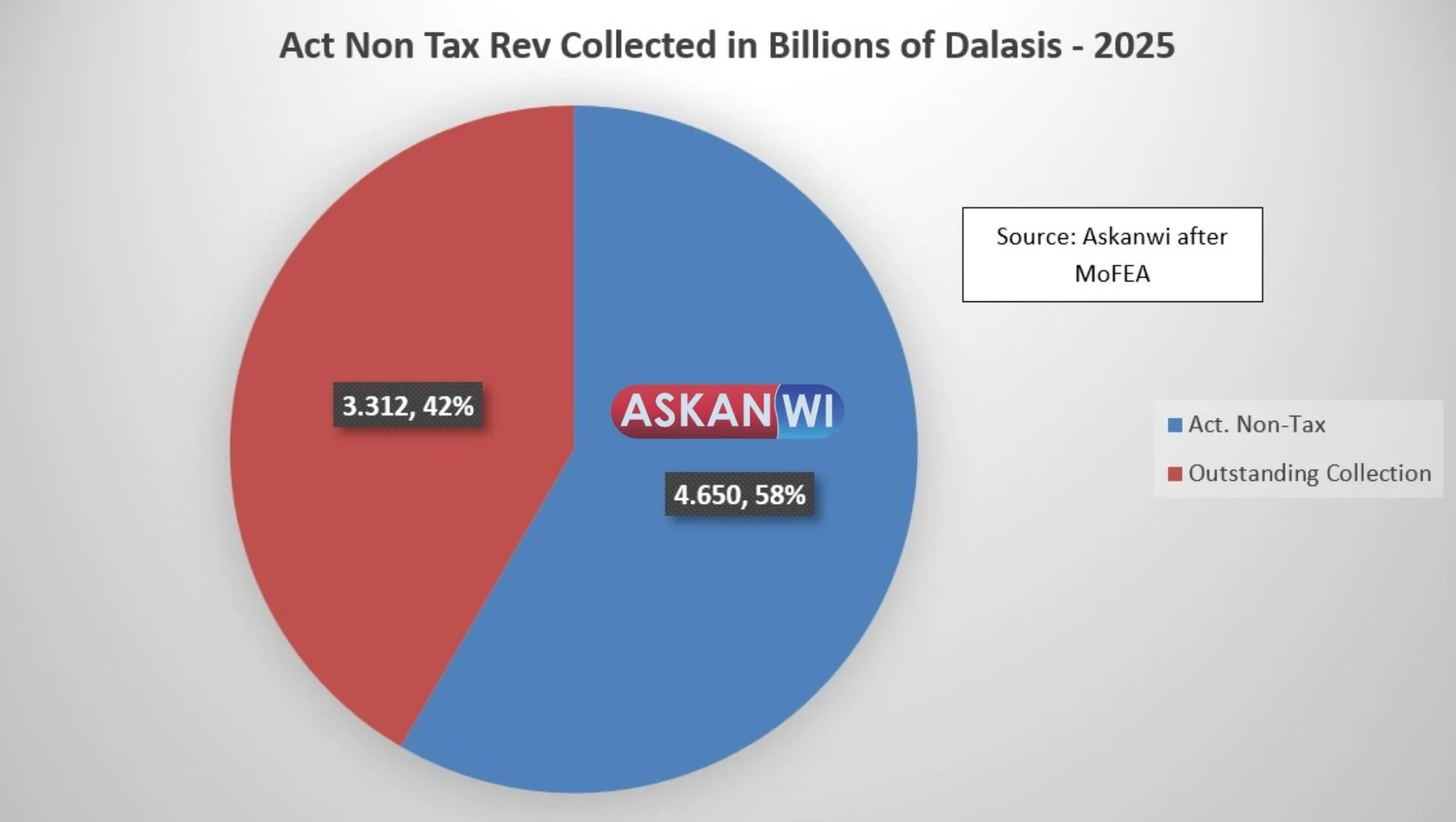
Actual Revenue Collected vs Outstanding Amount 2025 © Askanwi
This latest shortfall appears to reflect a broader pattern, as our analysis of government budgets between 2017 and 2025 by our reporter shows that non-tax revenue exceeded approved targets only three times over the past nine years.
Our budget analysis reveals that the strongest non-tax revenue collection occurred in 2022, when the government targeted collecting D2.2 billion but ended up collecting a record D7 billion. Since then, non-tax revenue collected never exceeded D5 billion in a year, highlighting a worrying regression from three years back.
Our review of the Barrow administration’s non-tax revenue performance in his first and second terms highlights that overall non-tax revenue collection has been quite strong. As shown in the charts below, over the last nine years, D24.6 billion was collected in non-tax revenue after D26.27 billion was approved for collection. This translates to a 94% non-tax revenue collection rate.
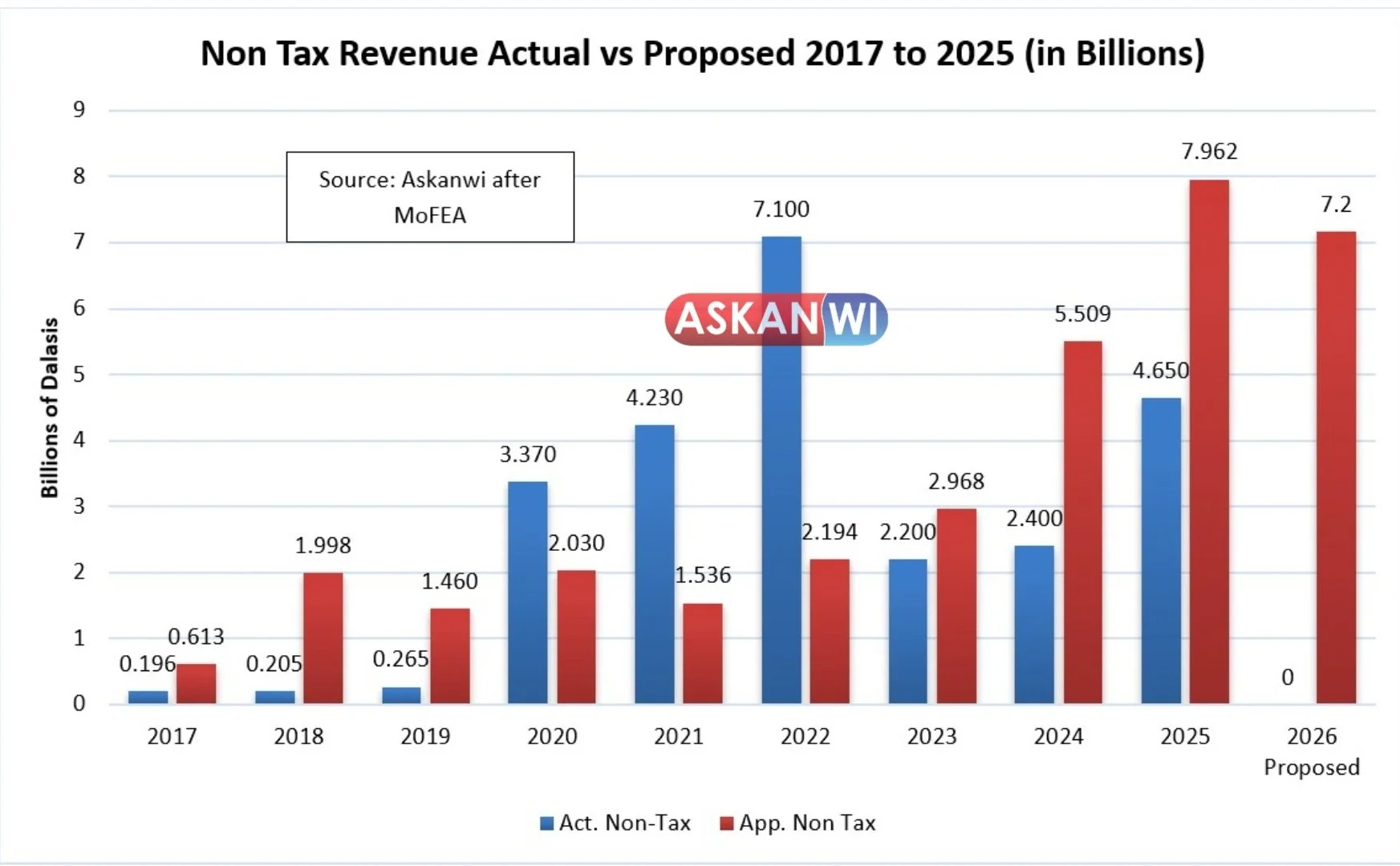
Actual Revenue Collected vs Outstanding Amount from 2017 to 2025 © Askanwi
In the first term of the Barrow administration, the government managed to exceed its non-tax revenue target by raking in D8.26 billion after approving D7.6 billion from 2017 to 2021. This translates to 108% of the non-tax revenue target in President Barrow’s first term.
In contrast, this trend appears to be reversing, with only D16.35 billion collected after D18.63 billion was approved for collection in non-tax revenue from 2022 to 2025. This translates to 88% of the non-tax revenue target in President Barrow’s second term in office so far.
To improve the country’s non-tax revenue base and reduce the government’s dependence on taxes, an introspection of the successes achieved from 2020 to 2022, when targets were almost doubled, could reveal the policies that drove those over-collections.
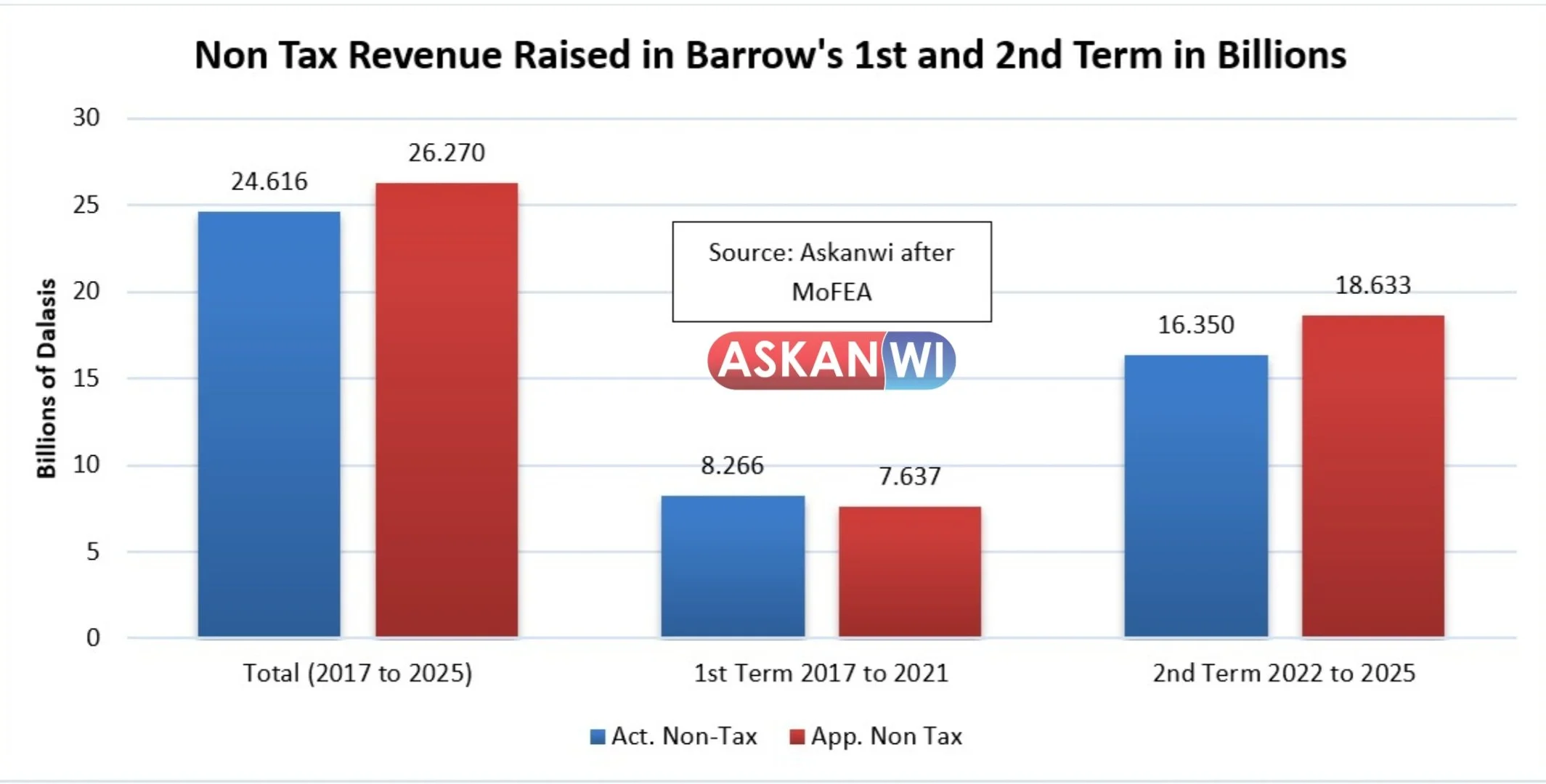
Actual Revenue Collected vs Outstanding Amount Barrow's 1st and 2nd terms © Askanwi
Economists like Nyang Njie argue that the country is not fully utilising its non-tax revenue potential. In a Facebook publication in April 2025, he highlighted that “non-tax revenue remains a critically underutilised component of The Gambia’s fiscal framework, representing only about 10 – 11% of total revenue and grants in recent budgets.”
He added that strengthening non-tax revenue collection could “reduce reliance on volatile donor funding, which historically financed about 27% of the national budget between 2018 and 2023, while aligning [the country] with global best practices for sustainable fiscal management”.
Non-tax revenue typically comes from government fees and service charges, dividends from state institutions, administrative fines, penalties, forfeitures, and other non-tax-related payments. However, weak enforcement and limited reforms continue to constrain collections. For example, fines imposed by the National Environment Agency for illegal littering in streets, public places, and highways are rarely enforced or paid.
Until stronger reforms and enforcement mechanisms are introduced, non-tax revenue will likely remain an underutilised component of The Gambia’s fiscal system.
