
The Gambia’s Maternal Mortality on the Rise, Contrary to the Health and Information Ministry’s Claims

Dr Ismaila Ceesay and Dr Ahmadou Samateh and False Claims © Askanwi
By Yusef Taylor and Edward F. Dalliah Jr.
Three claims from Cabinet Ministers Dr Ceesay and Dr Samateh that The Gambia’s Maternal Mortality Rate (MMR) is on a steady decline have been debunked after the health minister corrected data he submitted to Parliament. Askanwi Media's investigation into the government’s claims of a sustained decline in the MMR in late 2025 has resulted in a parliamentary inquiry after our request for information was ignored completely.
In late 2025, the Ministry of Information, Media and Broadcasting Services (MoIMBS) issued a Facebook post claiming that the MMR had declined by 38% after President Adama Barrow came into office. This triggered our investigation, which reveals that the minister of health's latest claims and correction that the MMR had declined from 2019 to 2025 are inaccurate and misleading. Instead, our calculations using the MoH’s corrected figures revealed that the MMR increased over the last six years.
Responding to parliamentary questions, health minister Dr Ahmadou Samateh boasted that “the 2019–2020 statistic for Gambia was 289 per 100,000 live births; that is the standard we’ve been using. And in 2025, we had 128 (maternal deaths) per 100,000 live births, so the Gambia has been able to have more than a 50% reduction of maternal mortality these past years."
The data presented by the health minister was quickly debunked by US-based Dr Amadou Barrow, who meticulously clarified that basic mathematical errors rendered the data presented as incorrect. Dr Barrow’s clarification forced the MoH to issue a press release on 18th March 2026, correcting the MMR data presented to Parliament.
This investigation interrogates the country’s MMR data presented by the health minister and the claims amplified by the MoIMBS. The maternal mortality rate is a measure of the number of maternal deaths per 100,000 live births. Our research reveals that maternal mortality relates to the number of mothers that have died during pregnancy. It does not take into consideration the number of babies that die during pregnancy.
The chart below depicts the data presented by the Minister of Health in Parliament and the subsequent correction.
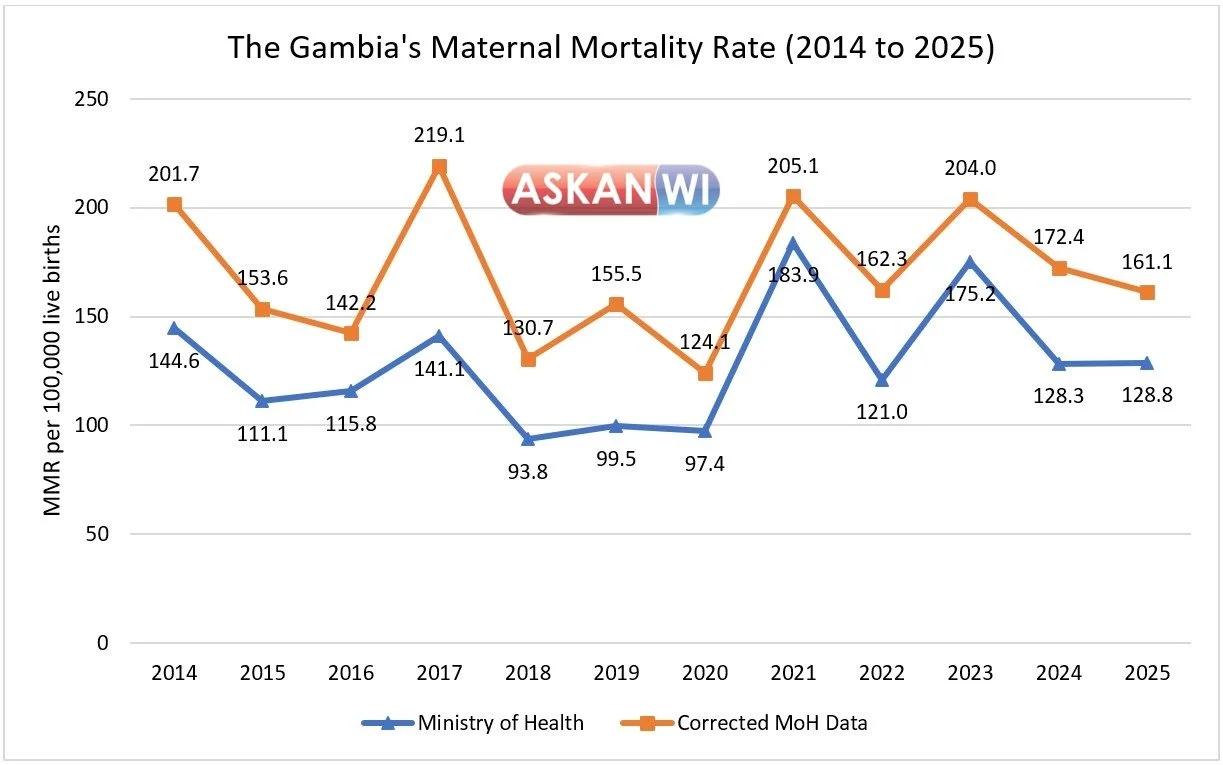
Data presented by the MoH in Parliament and the corrected data © Askanwi
Under-Reporting the MMR and Amplifying False Success
But this is not the first time the Ministry of Health (MoH) has been found wanting for presenting incorrect MMR data. Our investigation unearthed a study conducted by researchers from the Medical Research Council The Gambia at the London School of Hygiene and Tropical Medicine in collaboration with the MoH and The Gambia Bureau of Statistics. The study “revealed that the number of women who died from pregnancy-related causes in The Gambia in 2012 was twice what it was thought to be”.
By its own admission, the 2023 joint study concluded that "the prevailing pregnancy-related mortality for the country was robustly estimated at 861 deaths per 100,000 live births, as opposed to 433 deaths per 100,000 live births adopted in the government's national health policy and planning documents.”
The fact that the report was published in 2023 highlights how long it can take to detect such errors. In addition to this, wrong data can have a significantly lasting effect if used as a reference in national documents. This was exactly the case in The Gambia.
This gross under-reporting raises serious doubts over the credibility of official MMR figures stated in the government’s national health policy and planning documents. Given the MoH’s involvement in the study, they are well aware that the country’s MMR was grossly underreported.
Looking at the figures, Askanwi observed that this practice of under-reporting allows the government to boast of huge successes in its quest to eradicate MM in the country. Askanwi observed two claims highlighting significant progress in addressing MM issued by the MoIMBS.
Back in September 2025, MoIMBS published a Facebook post claiming that the “total percentage decline in maternal mortality per 100,000 live births from 2014 to 2024 was 33%". This was followed by another more impressive claim in November 2025, stating that “there has been a 38% reduction in maternal health mortality from 2017 to date, according to Gambia's Ministry of Health.”
These claims by the MoIMBS, attributed to the MoH, prompted Askanwi to submit a request for information letter to the MoH in October 2025. After waiting for months without any response, Askanwi decided to escalate our inquiry through a parliamentary question.
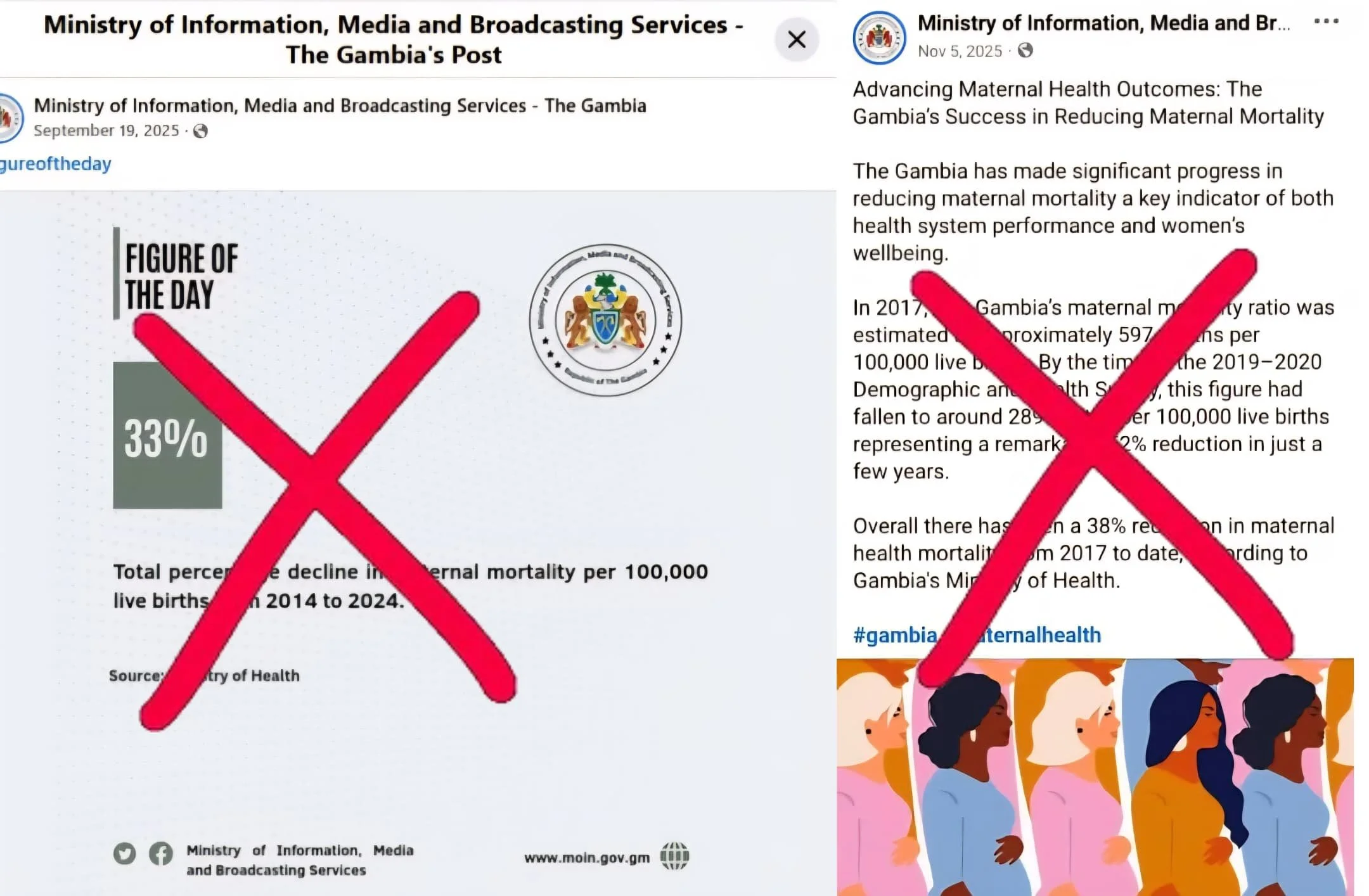
False social media claims from the MoIMBS referencing the MoH
Parliamentary Inquiry Results in Misinformation and Corrections
Although our request for information was completely ignored, the MoH could not avoid our parliamentary question asked by Hon. Omar Jammeh of Janjanburreh, who requested data on the country’s MMR from 2014 to 2025.
In response, Minister Samateh told Parliamentarians on 11th March 2026 that there were “130 maternal mortalities from our health facilities’ statistics out of 80,720 live births. This translates to 129 deaths per 100,000 live births [in 2025].”
His response should have provided clarity but failed to do so and instead became the latest episode of misinformation on the country’s MMR. Our reporters immediately observed that the minister's data was incorrect after a Gambian, US-based epidemiologist, Dr Amadou Barrow, issued a clarification.
Using simple mathematics, Dr Barrow proved that 130 maternal deaths out of 80,720 live births translates to 161.1 deaths per 100,000 live births and not 129 deaths per 100,000 live births as claimed by Minister Samateh. According to Dr Barrow, the gap “represents a 25% discrepancy, far beyond typical rounding”.
Just days after Dr Barrow’s clarification, the MoH issued a statement mirroring his calculations and correcting the data presented to Parliament. The corrected data only starts from 2019 instead of starting from 2014 as presented in Parliament. Our calculations and chart shown above present a more complete picture by starting from 2014 to ensure a like-for-like comparison.
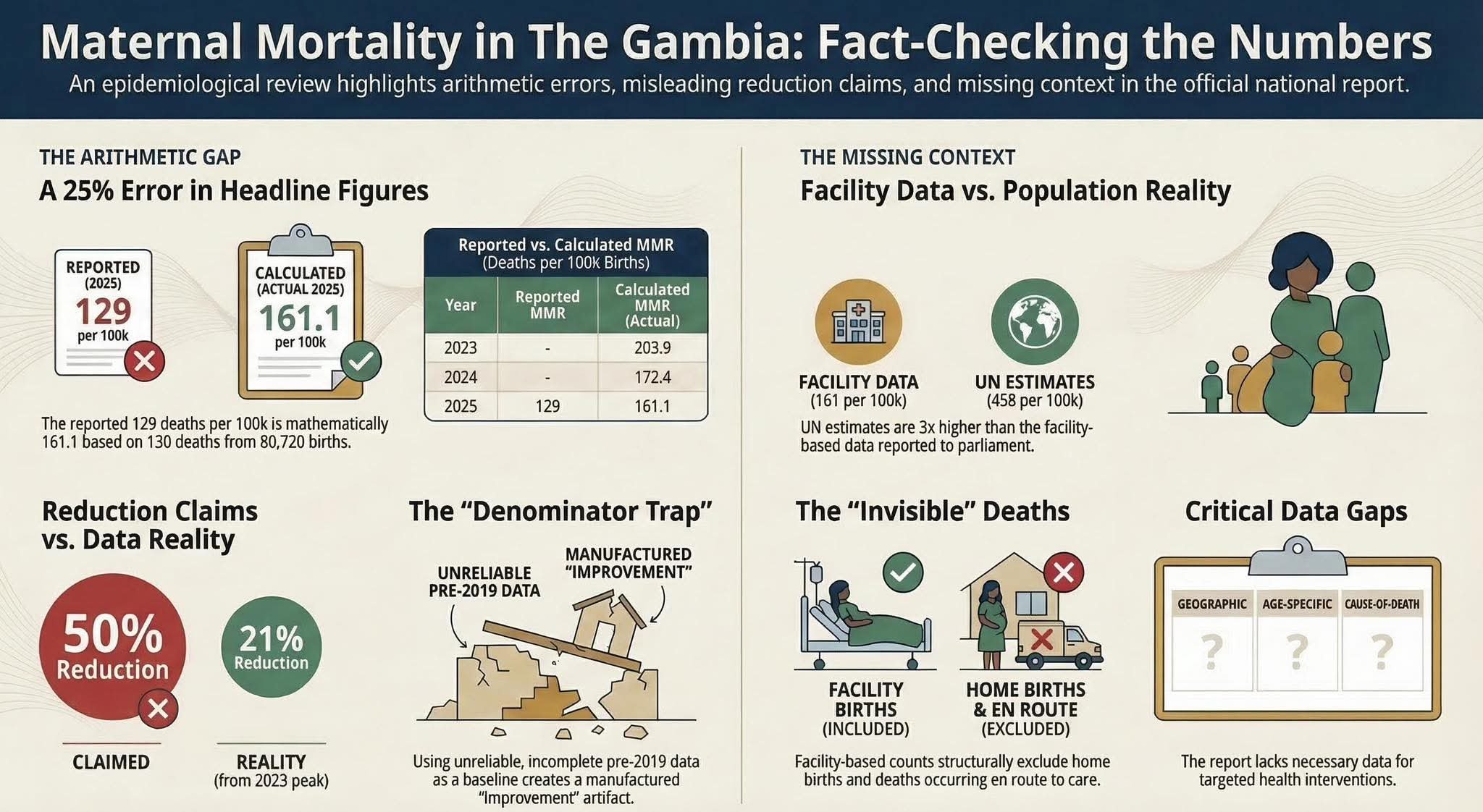
Infographic on Maternal Mortality © Dr Amadou Barrow
Health and Information Ministry False MMR Claims
Given the new data presented by the MoH, all three claims from the MoH and the MoIMBS were now in doubt. Askanwi recalculated the progress and presented the data to experts for their insight. As shown in the table below, the calculated progress made using the MoH’s corrected data is much less than that claimed by the two ministries.
US-based epidemiologist Ms Sally Manneh explained that “the government’s narrative appears overstated and not fully supported by the corrected figures provided. While there is evidence of some reduction in maternal mortality over time, the actual declines of approximately 15% from 2014 to 2024 and 21% from 2017 to 2024 are significantly lower than the claimed 33% and 38%.”

Claims vs Recalculated FactCheck © Askanwi
Speaking on the health minister's latest claim that the MMR declined by 44%, Ms Manneh noted that this “is not supported and appears to be inconsistent with the observed trend". In fact, Ms Manneh observes that the MMR has increased over the last six years. Referencing the MoH’s corrected data, she observed that “the maternal mortality ratio was approximately 155.5 in 2019 — but rose again to 161.1 by 2025, indicating an overall increase rather than a sustained decline”.
Askanwi calculated that the MMR increased by 5.6 deaths over the last six years, which translates to an increase in the MMR of 3.6%.
“Even when considering short-term fluctuations, the data does not demonstrate a reduction of that magnitude, suggesting either a misinterpretation of the figures or the use of an alternative, unclarified methodology,” said Ms Manneh.
Looking at the data trends, she noted that it “is not consistently downward, with notable fluctuations and increases in certain years. This suggests that the reported improvements may be influenced by selective interpretation of data or methodological inconsistencies rather than sustained, system-wide progress, underscoring the need for more transparent, standardised, and comprehensive reporting to accurately reflect maternal health outcomes.”
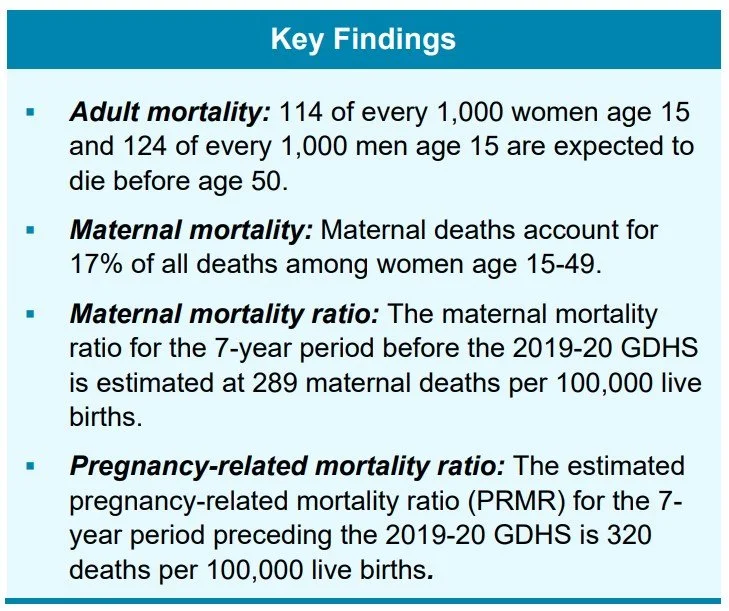
Key Findings from 2019-2020 DHS Survey © MoH
Health Minister’s Selective Data Mismatch Misleading
Askanwi managed to get a copy of the 2019-2020 DHS Survey to understand the benchmark referenced by the health minister. Our research observed that the minister of health utilised data from the DHS Survey and the MMR dataset from his parliamentary submission to conclude that the MMR had declined by over 50% (later corrected to 44%).
As suggested by Ms Manneh, this appears to be a case of misrepresentation of data due to a mismatch. After the minister submitted that the MMR was 155.5 deaths per 100,000 live births in 2019 and 124.1 deaths per 100,000 live births in 2020, this data was ignored in his calculation in favour of the higher 289 deaths per 100,000 live births from the DHS Survey.
This selective approach by the MoH allows them to boast that the MMR declined by 128 maternal deaths from 2019 to 2025, translating to 44%. However, this compares apples and oranges because it would have been more appropriate to compare data in the same data set.
Askanwi’s calculation above shows that the MMR increased by 5.6 maternal deaths from 2019 to 2025, which translates to an increase of 3.6% in the MMR in this same period.
Had the MoH compared data from one DHS Survey to another, assuming they used similar methodology, then his comparison would have been sufficient. However, after our review and expert advice, it’s clear that the claims by the MoH and the MoIMBS are both inaccurate and misleading.
“This factcheck investigation was fully self-funded by Askanwi Media.
We are preparing a follow-up that will compare the government’s maternal mortality data with other publicly available sources.
Support us to continue producing impactful investigations and holding power accountable. Donate here: https://www.gofundme.com/f/support-askanwi-reliable-news-for-the-gambia”
