
Jammeh’s U.S. Mansion Funds Are Ready But Victims May Get Far Less
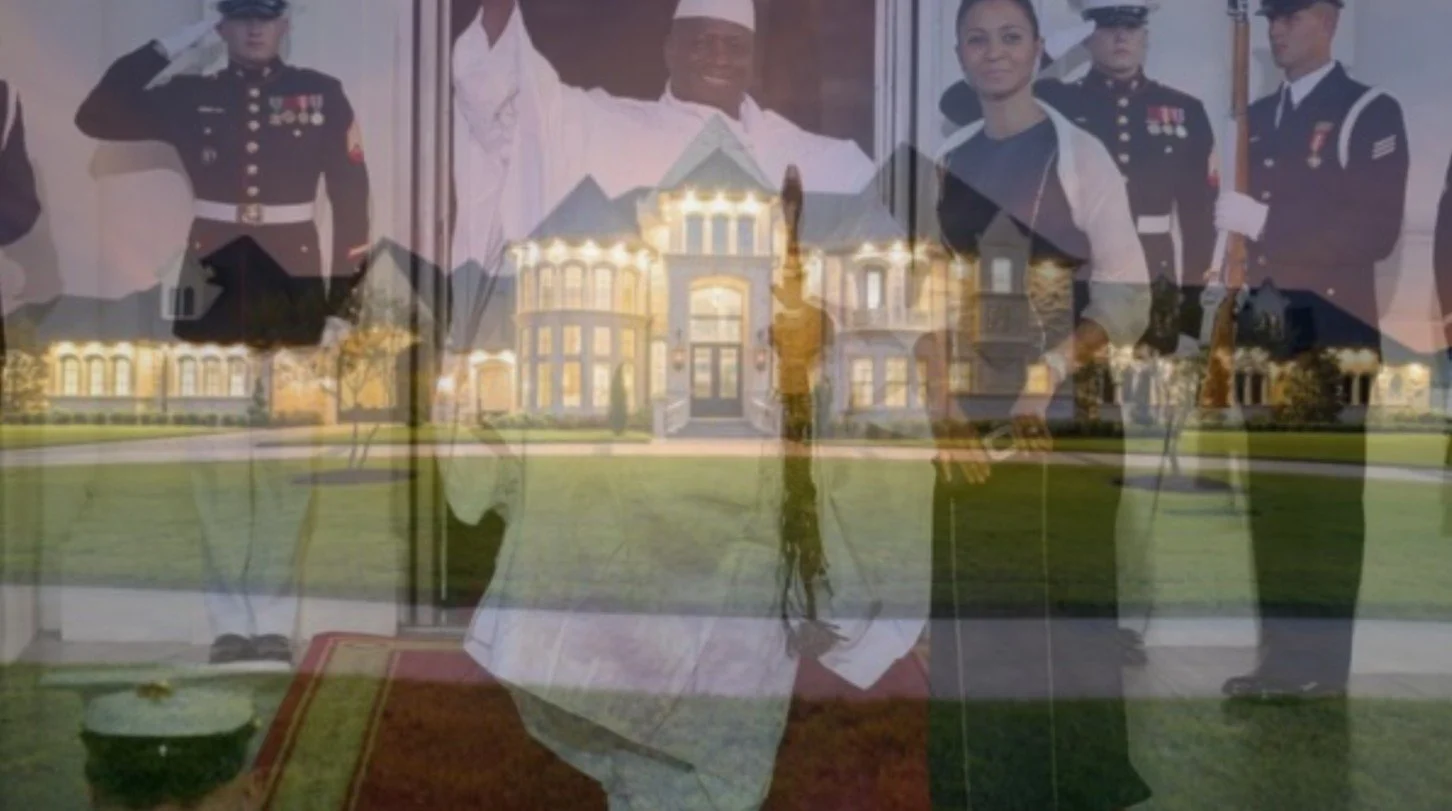
Former President Jammeh
By Yusef Taylor, @FlexDan_YT
Millions of dalasis allocated to compensate victims of President Jammeh’s abuses have yet to reach them, even as some die from treatable health conditions. At the same time, the fate of money generated from the sale of Mr. Jammeh’s assets remain shrouded in mystery, including the multi-million dollar U.S. mansion.
The United States has requested documents from the Gambia Government for the transfer of money from the sale of the mansion former president Yahya Jammeh bought for $3.4 million in Potomac, an upscale Washington D.C. suburb in Maryland.
The U.S. had seized the property in 2022 following a formal request from the Gambia government. Washington had agreed to the forfeiture on condition that the Gambian authorities freeze the assets of Muhammed Bazzi, a close associate of Mr. Jammeh. The government complied with the U.S. demands by freezing Mr. Bazzi’s assets and eventually banning him from entering the country, a source familiar with the matter told Malagen.
It was a convergence of interests for both countries, said our source, who requested anonymity because he is not cleared to speak on the matter. Moving against Mr. Bazzi was a crucial part of the post-Jammeh clean-up while the U.S. viewed him as a financier of Hezbollah, a Lebanese militant group sanctioned by the U.S.
Mr. Bazzi, who served as Gambia’s honorary consul to his home country Lebanon under President Jammeh, operated at least 15 companies in the Gambia in 16 years of his stay. All of them had business dealings with the government, and some enjoyed exclusive government contracts through “illegal directives” from Mr. Jammeh, causing losses amounting to millions of dollars to the Gambian state, according to findings of the Janneh Commission.
Mr. Bazzi was arrested in Romania in 2023 and extradited to the United States, where he pleaded guilty to attempting to transfer nearly $830,000 in funds that had been frozen by U.S. authorities.
It is not clear whether those funds are connected to Mr. Bazzi operations in The Gambia, but Mr. Jammeh’s are not in doubt.
But although Mr. Jammeh paid $3.4 million for the U.S. mansion fifteen years ago, the amount to be transferred by the U.S. could fall short by around $1 million, even though the property’s market value has likely appreciated over time. Neither the U.S. nor Gambian authorities have provided an explanation for why the sum to be transferred falls short of the original purchase price.
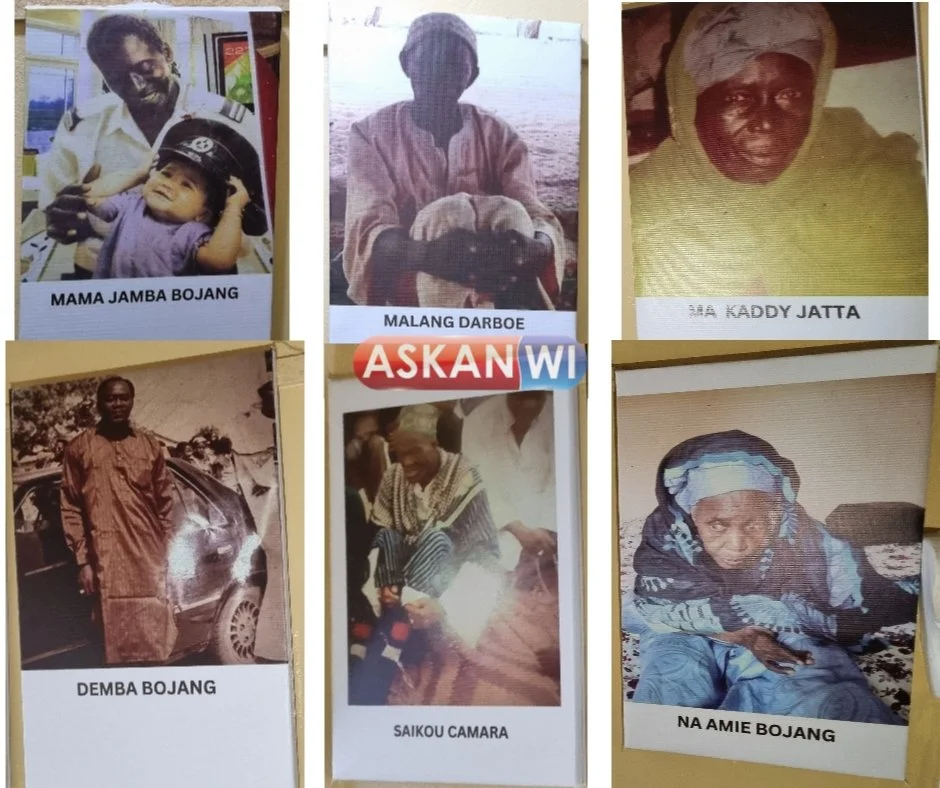
Victims who died without receiving reparations © Askanwi
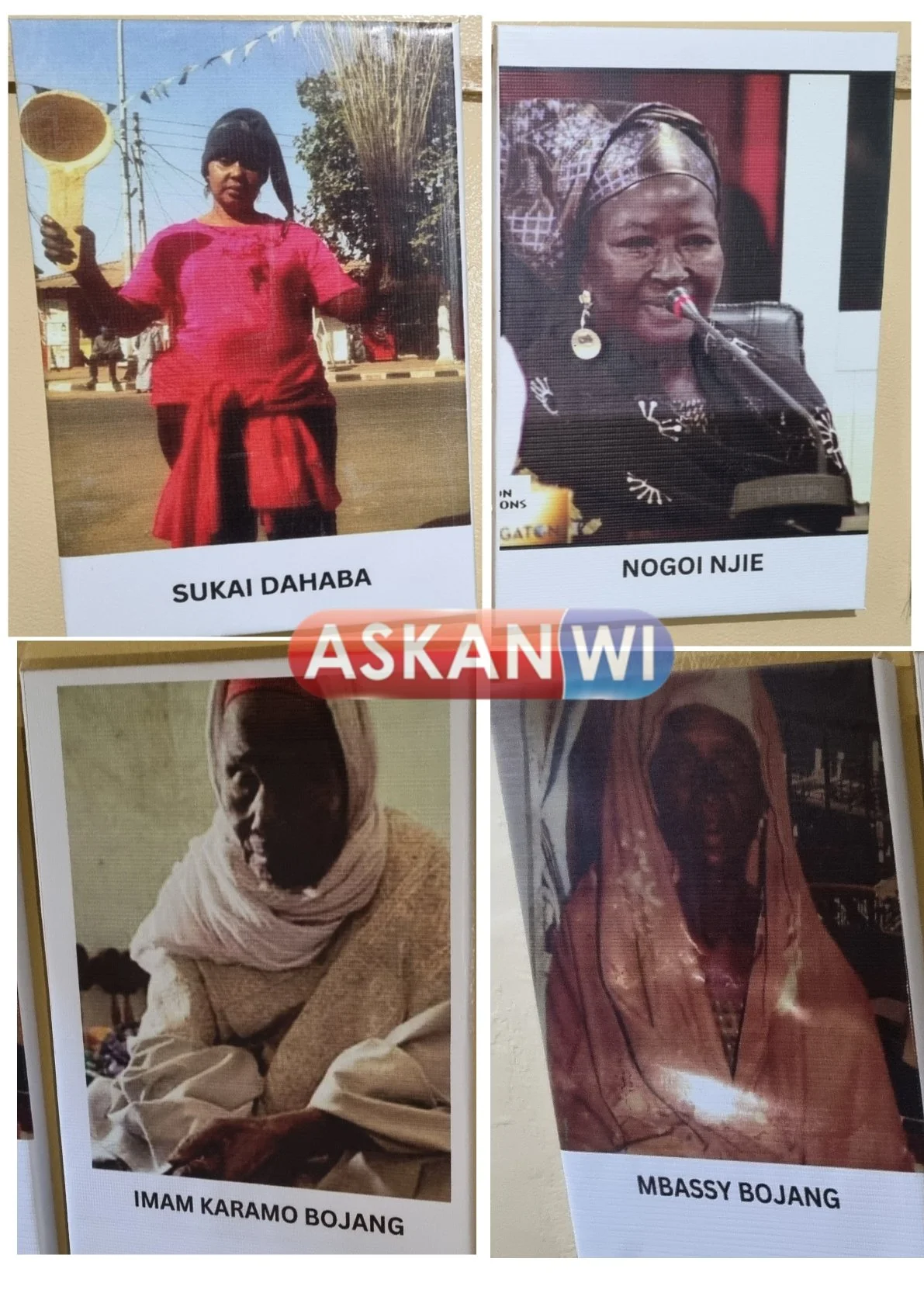
Sukai Dahaba, Nogoi Njie and other victims died without receiving reparations © Askanwi
According to the Victims Reparations Act, compensation for victims would come from the sale of the former president’s assets. But the mystery surrounding Mr Jammeh’s mansion is just one of many unanswered questions about reparations. Millions of dalasis have been budgeted for reparations in the past few years but never spent to compensate victims.
The government claims to have generated about D1.4 billion from the sale of Mr Jammeh’s assets, but details about the money – how much was eventually raised, where it is, and how it has been used – remain unclear.
The funds were kept at a dedicated account at the Central Bank, several government officials, including the accountant general and finance minister, told the National Assembly inquiry. “By Sept. 17, 2025, the account’s balance had fallen to zero,” Central Bank Governor Buah Saidy said at a recent appearance.
“We are keenly following the National Assembly’s enquiry and any subsequent processes dealing with the sale of the assets of the former president, because these are lawful sources of monies for the Reparations Fund,” said Ms Ida Persson, a special adviser to the ministry of justice.
Dying Without Reparations
Four years after the Truth, Reconciliation and Reparations Commission concluded its two-year investigation into abuses during the former president’s two-decade rule, victims are still awaiting the compensations promised to them. Many have died, some from treatable conditions, and others are struggling with failing health and the cost of educating their children.
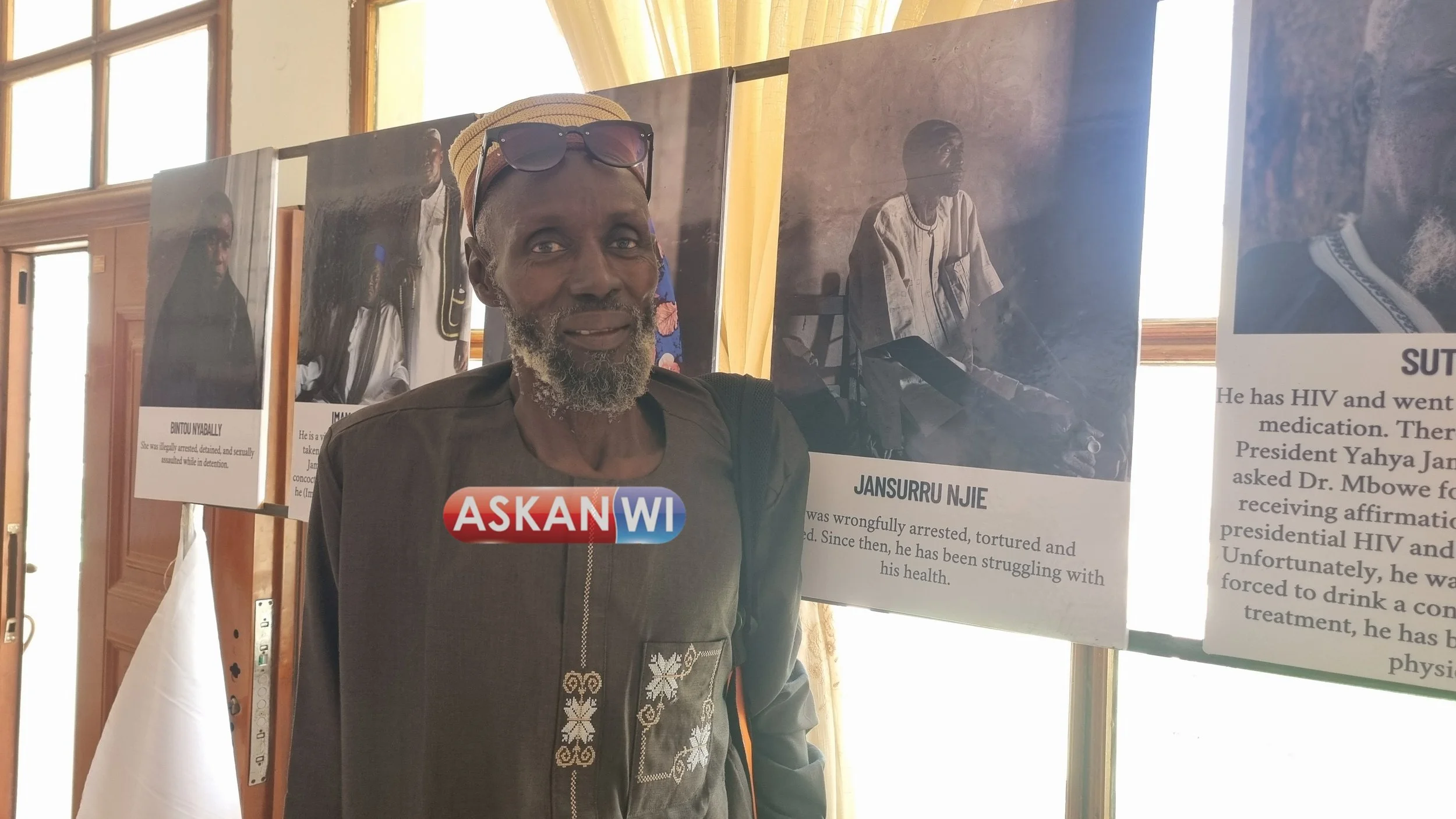
Mr Jansurru Njie - Victim © Askanwi
One victim, Jansurru Njie, said the torture he endured in detention has left him struggling to stand or walk long distances, and making it difficult for him to maintain closeness with his wives. He receives some support from the Victims Center for treatment.
Mr. Njie said he plans to use the funds he expects to receive as compensation to undergo health treatment and regain the ability to support his family.
Malagen has however confirmed that the only funds so far disbursed to compensate victims was D51 million: a D50million contribution from Senegal and D1 million contribution from the diaspora.
Senegal’s grant came from the sale of rosewood linked to Mr. Jammeh, illegally logged in Casamance and later sold under a 50-50 revenue-sharing deal between the two countries.
How The Gambia spent its portion remains unclear, and the government has failed to honour its pledge to contribute D50 million to match Senegal’s.
A Malagen analysis of government budgets found that D245 million was allocated for reparations between 2021 and 2024.
The lowest allocation was made last year, when the parliament approved D30 million: D20 million for victims compensation and D10 million for the operational cost of the Reparations Commission, which the government set up earlier this year.
Justice Minister Dawda Jallow in September told parliament that only part of the last year’s funds – D5.3 million of D10 million for operations and D17.5 million of D20 million for the Reparations Fund – had actually been disbursed.
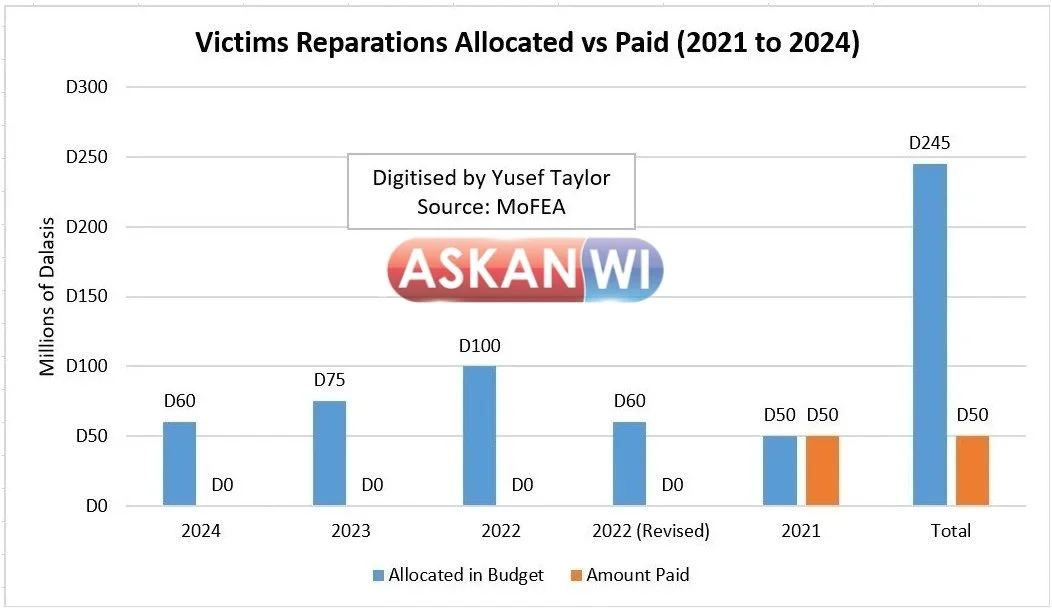
Budget Research showing Approved and Actual Expenditures © Askanwi
But no reparations were paid from these disbursements and Mr. Jallow said payments have been delayed because the Commission was completing its “foundational work”.
“They know the urgency concerned,” Mr. Jallow said, referring to the Reparations Commission. “But they are working on their criteria. They need to be careful how they assess and how they pay.”
At least 174 individuals registered as victims of Yahya Jammeh’s human rights abuses have died, according to data from the Gambia Center for Victims of Human Rights Violations. It is not clear how many of those died after the truth commission.
In the Kombo North village of Jambur alone, at least five victims of the 2009 witch-hunting exercise have died since the truth commission wrapped up, according to Abdoulie Bojang, a native of the village. One of them, Alieu Mbye, left behind a wife and child, who eventually dropped out of school.
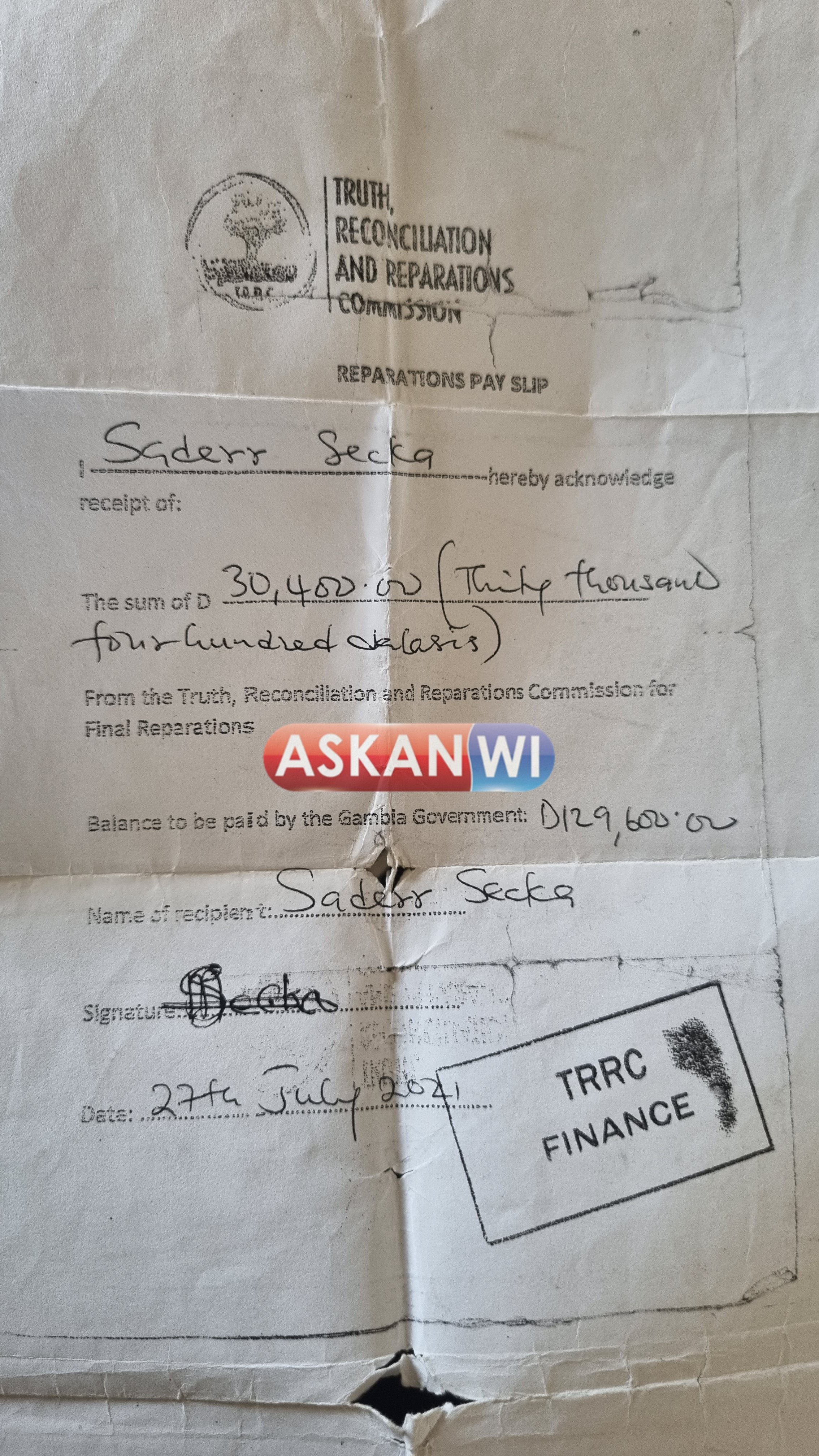
Victim Reparations Slip © Askanwi
For the victims, the establishment of a Reparations Commission is a crucial step to bring them closer to long-awaited financial relief. Although old questions about political will and whether meaningful compensation will be delivered have resurfaced, the government believes that the money from the sale of President Jammeh’s U.S. mansion will offer crucial financial support to the reparations process.
“They’ve confirmed that the reparations fund has been established and requested contact details for the fund signatories,” Ms. Persson, referring to the United States Government, adding: “hoping for some good news by December.”
When asked why the U.S. intends to transfer only $2.5 million when President Jammeh paid $3.5 for the property, Ms. Persson said: “This process is just beginning. There is yet to be formal communication about this. This formal communication is necessary to hear directly from the U.S. Department of Statement on the final sale amount and any deductions made.”
Ms. Persson said that all the funds would go directly into the fund for victim reparations, though it remains unclear whether all of the money will be used exclusively for compensating victims or also for other expenditures related to the reparations process.
The U.S. Embassy in Banjul has not responded to several requests for comments.
Approximately D168.8 million in financial compensation to victims remains outstanding, according to a 2021 TRRC estimate. This excludes a total of D32 million determined as compensation for the 54 West African migrants killed in The Gambia in 2005. The families are now demanding $1 million for each person killed.
Of the D50 million contributed by Senegal, D13 million was used for interim reparations, such as overseas medical treatment of some victims. The remaining D37 million was used as financial compensation, according to the TRRC. Up to 198 people have received full financial compensation from that amount, representing those who suffered less severe violations.
Some of the remaining 758 victims received only a partial payment. They represent those who suffered severe violations, such as torture and sexual violence, and are entitled to get D50,000 or more. Families who lost loved ones or suffered enforced disappearance may receive up to D600,000.
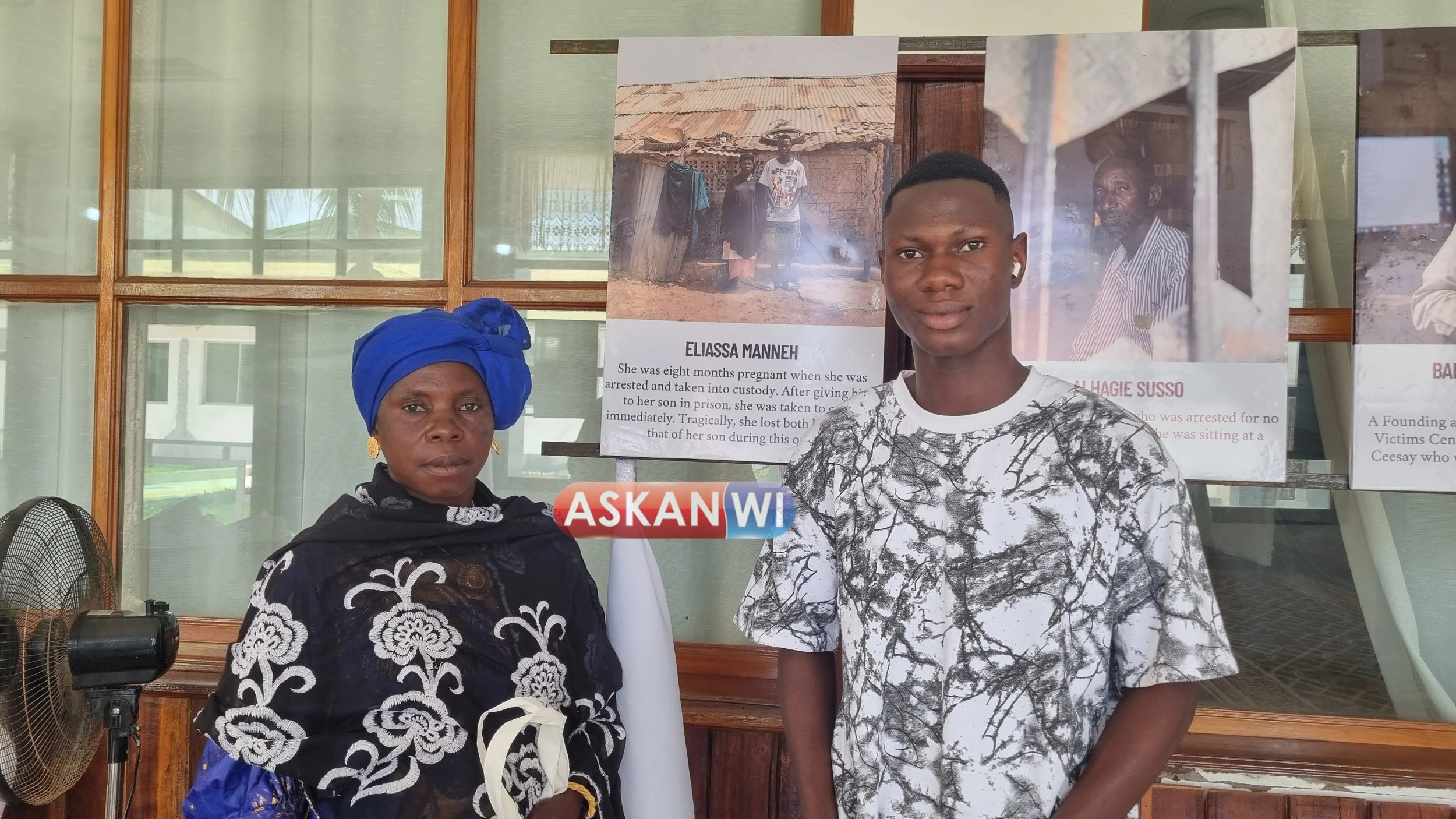
Ms Manneh and Son © Askanwi
Some victims say they have yet to receive any compensation. Among them is Eliassa Manneh, who was arrested while seven months pregnant. That child, Saibeh, stood quietly beside her as she recalled her ordeal.
Ms. Manneh said she went in search of her son, who had been involved in the clashes between supporters of the ruling APRC and the opposition UDP. When the police found her, they accused her of being part of the unrest. She spent the night on a wooden plank in a cell before she was transferred to the Janjanbureh prisons, where she spent two weeks in detention before being released on bail.
When she was finally taken to the hospital, doctors told her that her baby was not properly positioned in the womb. She was admitted for treatment and later gave birth.
But even after giving birth, her ordeal did not end. “They took me back to court with my newborn baby,” she said. During one hearing, the infant fainted. “That he survived,” she added softly, “is only thanks to Allah.”
“This story was produced through a collaboration between Malagen and Askanwi and is being jointly published by the two organisations.
This story was produced with funding from NED, which played no role in the editorial decision-making”
