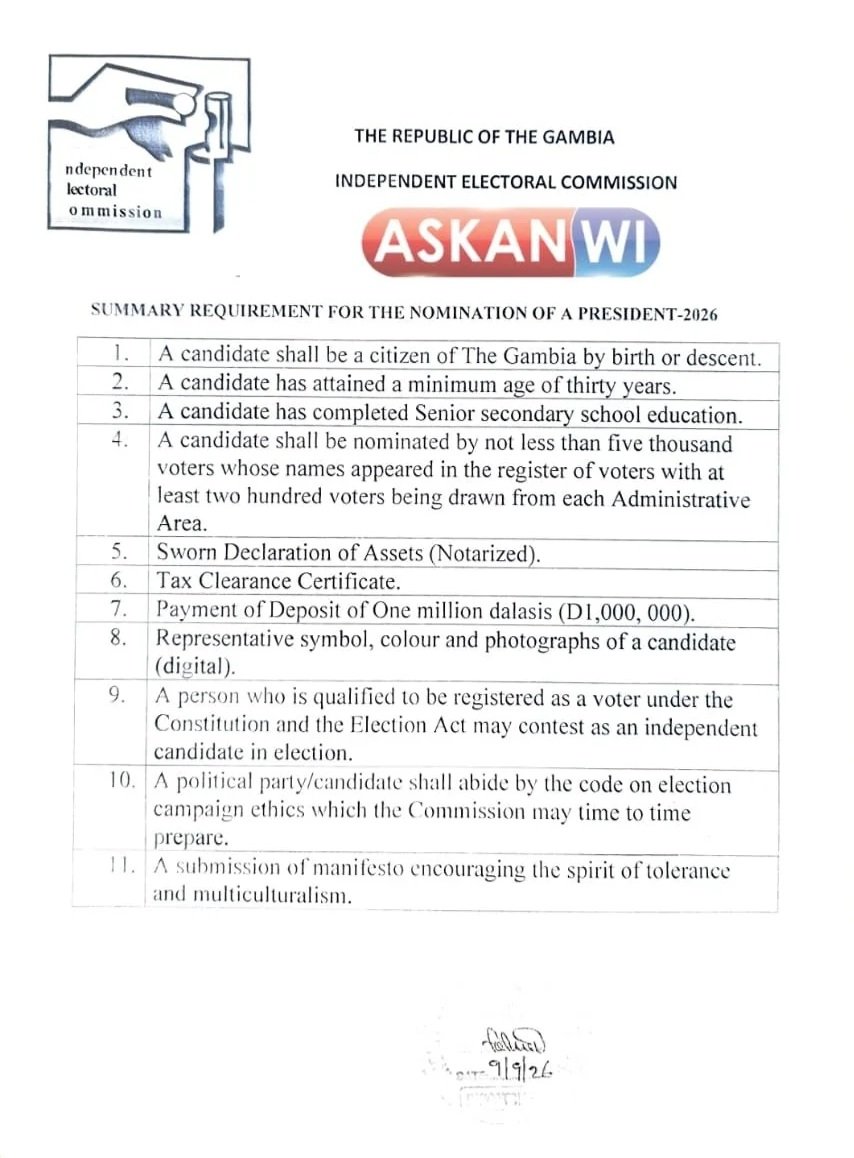
Nominations Infographic 2026 © Askanwi Media
By Askanwi Media
The Independent Electoral Commission (IEC) announced last week that 25 nomination forms had been collected during its October 2026 stakeholder engagement.
One week later, the Commission released a nomination schedule indicating that 27 presidential aspirants are expected to undergo the nomination process between 3 and 14 November 2026.
For comparison, 26 aspirants were initially listed on the nomination schedule ahead of the 2021 Presidential Elections. However, only 24 turned up for the nomination process. Two aspirants, Bakary Bunja Darboe of Gambia For All (GFA) and Dr Bai Biran Jagne of the All People's Party (APP), cancelled their nominations or did not participate.
At the end of the 2021 nomination process, only six aspirants were cleared by the IEC to contest the election, meaning that 18 of those who participated failed to qualify. When the two who did not participate are included, 20 of the 26 initially scheduled aspirants did not make it onto the final ballot.
The six candidates who qualified in 2021 were Adama Barrow (NPP), Ousainou A.N.M. Darboe (UDP), Mamma Kandeh (GDC), Halifa Sallah (PDOIS), Abdoulie Ebrima Jammeh (NUP) and Essa Mbye Faal (Independent).
Who is returning, and who is missing?
Interestingly, PDOIS' Hon. Halifa Sallah, GDC's Mamma Kandeh and independent candidate Essa Mbye Faal, all of whom qualified to contest the 2021 Presidential Elections, are missing from the 2026 nomination schedule.
Of the 27 aspirants scheduled for nomination in 2026, 12 are representing political parties or political groups, while the remaining 15 are listed as independent aspirants.
Women remain significantly underrepresented, with only two female aspirants appearing on the schedule: Awa Bah and Fatou Sowe-Jaiteh. In 2021, Marie Sock was the only female aspirant.
Some notable names missing from the list include former female Vice Presidents Madam Isatou Njie-Saidy Jallow-Tambajang and Dr Isatou Touray, both of whom have been expected to contest the upcoming elections.
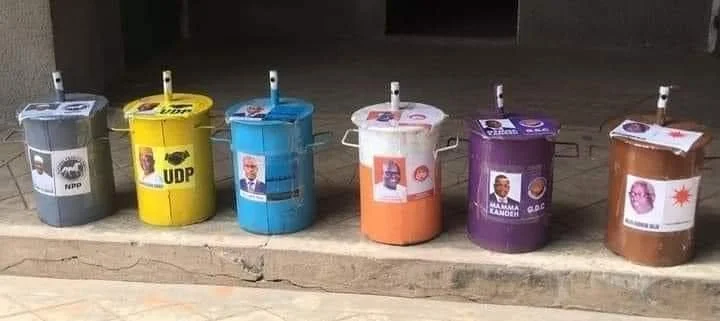
Presidential Candidates for 2021 Elections © Omar Wally
Team Gambia and the PDOIS Question
When our reporter observed that PDOIS' Team Gambia was missing from the nomination schedule, an inquiry with party supporter Kexx Sanneh revealed that Fatou Sowe-Jaiteh collected the nomination form on behalf of Team Gambia.
This means that whoever emerges as Team Gambia's flag bearer is expected to contest using Fatou Sowe-Jaiteh's nomination booking.
Interestingly, National Unity Party (NUP) leader Lamin J. Darbo, who is also associated with Team Gambia, appears separately on the nomination schedule. This could potentially allow him to contest independently of the eventual selection of Team Gambia's flag bearer.
Talib Bensouda and Bakary K. Badjie Among Notable Names
UNITE Party leader Talib Ahmed Bensouda also appears on the schedule as a UNITE presidential aspirant rather than as an independent candidate representing Coalition 2026.
Another notable name on the list is Hon. Bakary K. Badjie, an independent parliamentarian representing Foni Bintang Karenai, signalling his intention to contest for the country's highest political office.
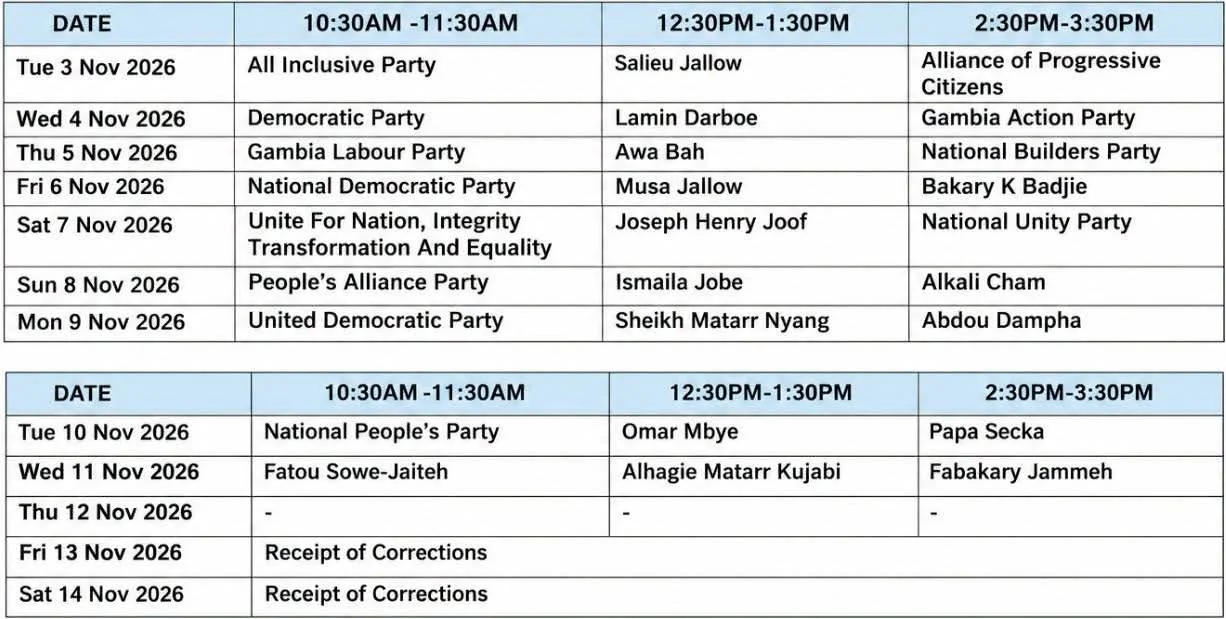
IEC Nomination Schedule © Kerr Fatou
Returning Aspirant from 2021
Joseph Henry Joof, who appeared on the 2021 nomination schedule but failed to qualify, is again listed among the 2026 presidential aspirants.
Interestingly, among the six candidates who qualified in 2021, the political parties represented on the current nomination schedule include the UDP, NPP and NUP.
IEC Introduces Two Days for Corrections
The final two days of the nomination schedule, 13 and 14 November, have been allocated for the receipt of corrections.
The IEC appears to be making provisions to address concerns that emerged during the 2021 nomination process, when some aspirants had their nominations rejected on the final day without being afforded an opportunity to correct identified deficiencies.
Following the rejection of their nominations in 2021, some aspirants took the matter to court. However, the limited time available before the elections meant that the legal proceedings were overtaken by the actual conduct of the elections. The court's eventual ruling came after the elections and could not provide a remedy capable of forcing a fresh election or overturning the results.
The two-day correction window is therefore intended to provide aspirants with an opportunity to address deficiencies in their nomination documents ahead of the 2026 Presidential Elections.
The 5,000 Voter Nomination Requirement
Another important aspect of the nomination process is the IEC's system for managing voter nominations. The Commission has announced that it operates a system in which voter nominations are assigned to aspirants on a first-come, first-served basis.
This means that once a voter's nomination has been accepted for one aspirant, that voter's name is blocked from being used to support another aspirant.
Consequently, the IEC has urged aspirants to collect more than the mandatory 5,000 voter nominations to improve their chances of meeting the required threshold.
Aspirants who submit only the minimum 5,000 nominations risk falling short if some of their nominations are subsequently blocked because those voters have already been assigned to other aspirants or are struck out during the verification process.
What Does It Take to Qualify?
Each aspirant is required to pay a nomination fee of D1 million, in addition to fulfilling the other constitutional and electoral requirements established by the IEC.
Below are some of the additional requirements that aspirants must satisfy to successfully complete the nomination process and be officially recognised as presidential candidates.
Only aspirants who successfully complete the process and are cleared by the IEC will have their names placed on the ballot for the 5 December 2026 Presidential Elections.