
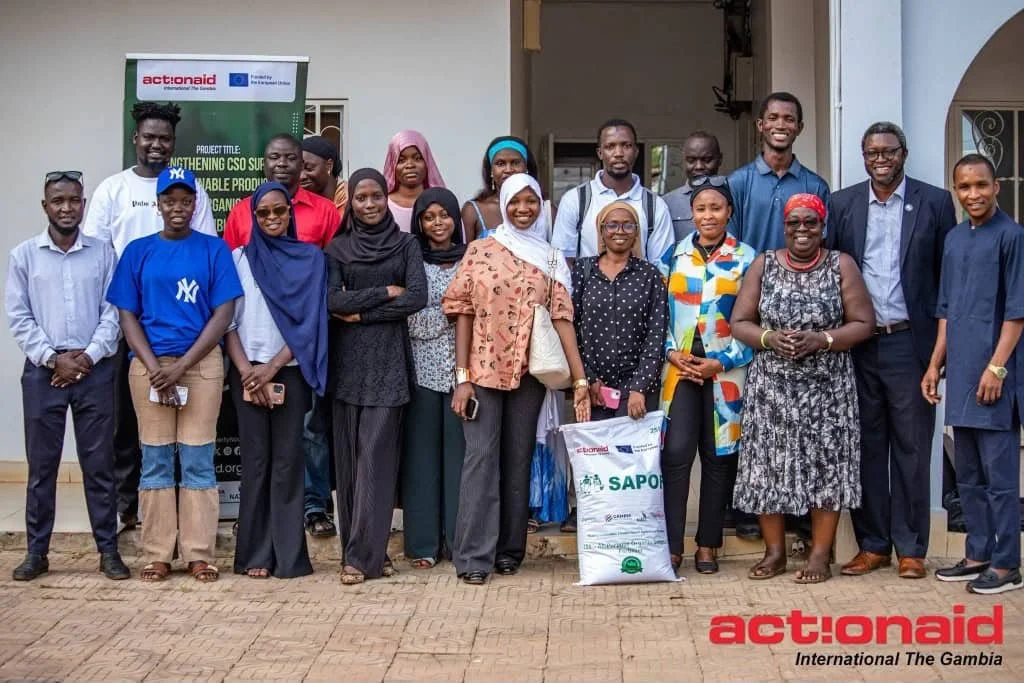
ActionAid Group Photo © ActionAid International The Gambia
By Michaella Wright
ActionAid The Gambia has called for increased investment in organic fertiliser and greater adoption of agroecology, urging a shift towards sustainable farming practices to address declining soil fertility, climate change and farmers' growing dependence on chemical fertilisers.
The call was made during a media engagement in Kanifing on 29th October 2026, as part of efforts to mobilise public support for sustainable agricultural production in The Gambia.
The one-day engagement was held at ActionAid's head office in Kanifing under the project Strengthening CSO Support for Sustainable Production and Use of Organic Fertiliser in The Gambia.
Speaking at the event, ActionAid Project Manager Saikou F. Bah said the initiative seeks to raise public awareness of existing sustainable agricultural practices through media collaboration. The project is being implemented in partnership with the Jawara Agricultural Training Centre, Gambia Participates and SEFAS.
Fafa O. Cham, Head of Programme and Policy at ActionAid International The Gambia, emphasised the importance of partnerships in promoting sustainable agriculture and addressing climate challenges.
"ActionAid cannot do it all alone. Therefore, we need partners who will work with us in our desire to achieve our set objectives," he said.
He highlighted irregular rainfall, flooding, dry spells and dust storms as recurring challenges affecting agricultural production, calling for greater attention to sustainable farming practices.
Meanwhile, Abdou Karim Sagnia, Technical Director of the People's Appropriate Technology Enterprise (PATENT), advocated increased investment in locally produced organic fertiliser to improve soil fertility while creating economic opportunities.
He explained that compost production using cow dung and other organic materials could generate income for livestock owners, women and young people while reducing the country's dependence on imported fertilisers.
"I think it's very important to have the media here because you are our key role to push our agenda forward," Sagnia said.
The speakers urged journalists to use their platforms to educate the public and promote the adoption of agroecology and environmentally sustainable farming practices.
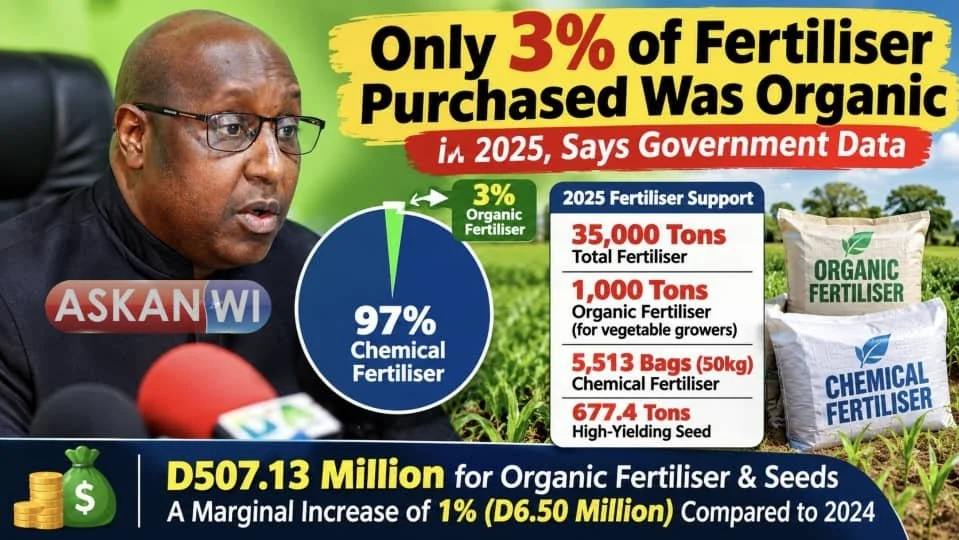
Ministry of Agriculture Fertiliser Infographic © Askanwi Media
An Askanwi review of the government's investment in fertiliser shows that only 3 per cent of the fertiliser purchased in 2025 was organic, meaning that the vast majority was chemical fertiliser. Experts have raised concerns about the potential negative effects of chemical fertilisers on soil health, long-term crop productivity and the environment.
According to the Finance Minister's 2025 Budget Speech, "for the 24/25 season the Ministry provided fertilizer support amounting to 35,000 tons, including 1000 tons of organic fertilizer for vegetable growers and 5,513 bags (50kg) of chemical fertilizer. High-yielding seed amounting to 677.4 tons were also distributed."
Further in his speech, the Minister added that "the budget includes D507.13 million for input subsidy for organic fertilizers and seeds for farmers. This represents a marginal increase of one per cent (i.e. D6.50 million) on this item compared to 2024."
In his 2026 Budget Speech, the Finance Minister highlighted an increase in the Ministry of Agriculture's budget, stating that its "budget is D1.8 billion indicating a significant increase of 83 percent or D794.9 million. This is mainly driven by the D900 million for input subsidies and organic fertilizers (a 77 percent increase) and D300 million for the recapitalization of the NFSPMC."
However, the 2026 Budget Speech does not specify how many tonnes of organic fertiliser would be purchased compared to chemical fertiliser, making it difficult to establish the government's planned allocation between the two types.
The 2027 Budget Speech also provides further details on fertiliser procurement but does not distinguish between organic and chemical fertilisers.
The Finance Minister noted that "in 2025, the Government provided GMD 1.1 billion for crop financing and fertilizer procurement, and GMD 900 million has been allocated in 2025 to support these interventions.
