
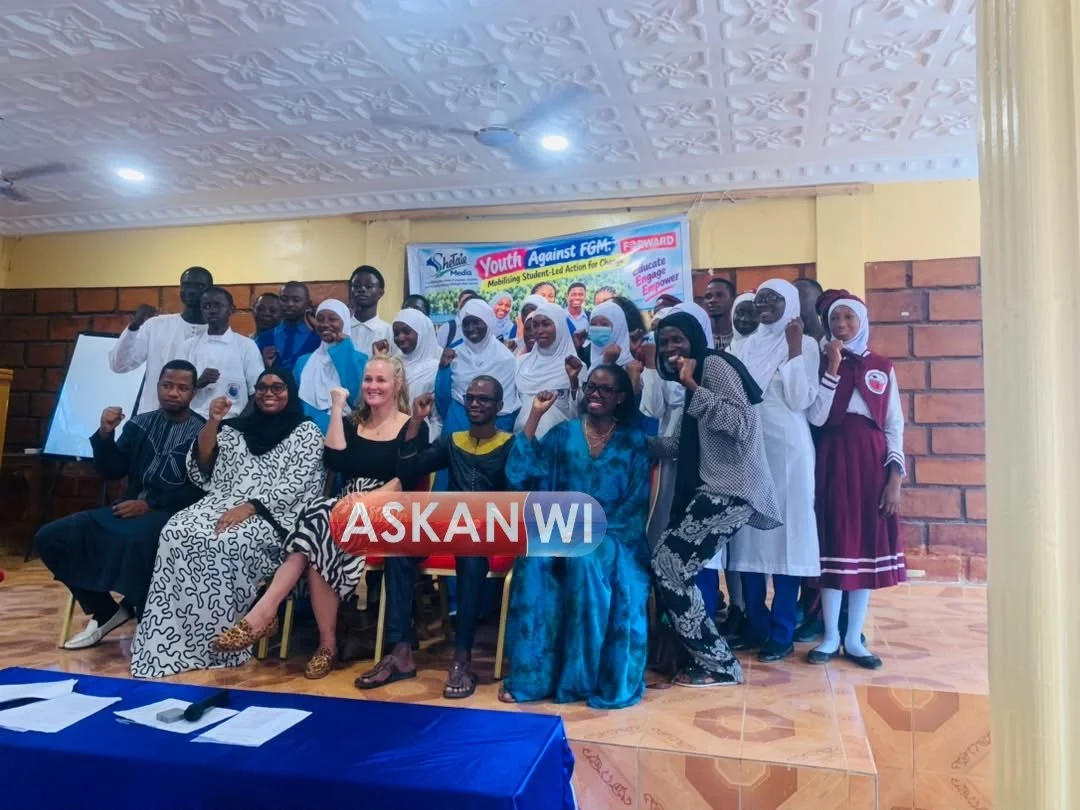
SheTale FGM Group Photo © Askanwi
By Jainaba Ceesay
The Chief Executive Officer of SheTale Media Network, Halimatou Ceesay, has officially declared open a three-day regional training under the project "Youth Against FGM: Mobilising Student-Led Action for Change,” aimed at empowering students and teachers to lead advocacy against Female Genital Mutilation (FGM) in The Gambia.
The training, which runs from 30th October to 1st November 2026, is organised by SheTale Media Network with support from the Foundation for Women's Health Research and Development (FORWARD UK). It brings together students, teachers, media professionals and partner institutions from across the West Coast, Lower River and Upper River Regions.
Speaking at the opening ceremony, CEO Ceesay welcomed the President of the Young Journalists Association of The Gambia, Yankuba Jallow; the CEO of Besel Media, Binta S. Jawo; resource persons; school administrators; teachers; and media and student participants.
On behalf of SheTale Media Network, she thanked FORWARD UK for supporting efforts to empower young people and protect girls from harmful practices.
Ceesay highlighted that FGM remains a serious human rights and public health concern in The Gambia. Citing the 2019–2020 Gambia Demographic and Health Survey, she noted that approximately 73 per cent of women aged 15–49 have undergone FGM, while the United Nations has reported that 65 per cent underwent the practice before the age of five.
She further noted that the UN estimated that 21,198 girls were at risk of FGM in 2026, with the cumulative number projected to reach 150,415 by 2030 if urgent action is not taken. She clarified that these are projections intended to highlight the scale of the challenge.
"These statistics are not merely numbers. Behind each figure is a girl whose rights, health and future deserve protection. They remind us that laws alone cannot end FGM. We need education, sustained community dialogue and the active participation of young people," she said.
She described young people as powerful agents of change who can influence their peers, challenge misinformation and introduce new ideas into schools, families and communities.
According to her, the 12-month project targets 60 students and 20 teachers from junior and senior secondary schools to strengthen school-based advocacy. It will also conduct community outreach in 15 communities across the three regions, engaging parents, caregivers, traditional and religious leaders, alongside radio programmes. A key outcome will be the establishment of an Anti-FGM Student Ambassador Network.
She explained that, over the three days, participants would explore FGM, child rights and protection, sexual and reproductive health and rights, gender-based violence, leadership and advocacy. They will also acquire practical skills in podcast production, radio interviewing, news writing, ethical reporting, digital storytelling and social media advocacy.
She reaffirmed SheTale Media's commitment to amplifying the voices of women, children and minority groups through responsible storytelling that protects survivors' privacy and dignity while ensuring informed consent.
"Our vision is a Gambia where every girl can grow up free from FGM, enjoy her rights, pursue her education and realise her full potential," she said.
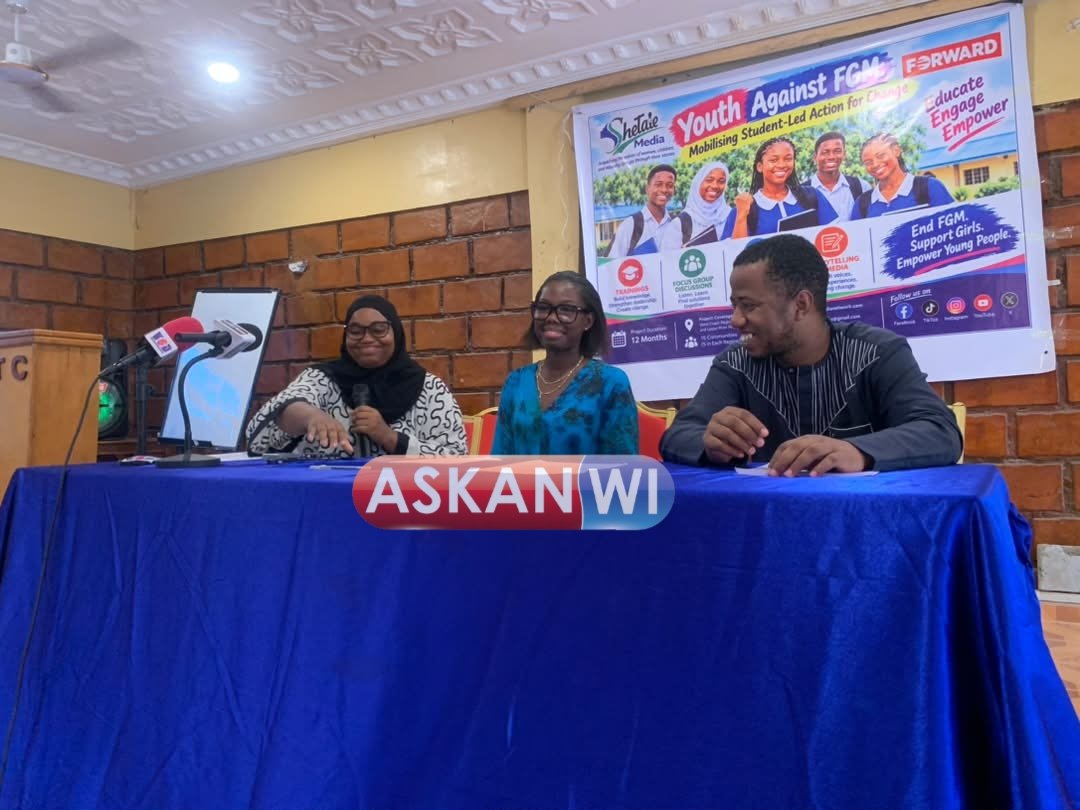
High Table Basel Media, Hakimatou Ceesay and Yankuba Jallow © Askanwi Media
YJAG President Urges Students to Serve People, Not Popularity
Also speaking at the launch, the President of the Young Journalists Association of The Gambia, Yankuba Jallow, urged young journalists to uphold constitutional principles and use the media to serve the people.
"The second aspect is to uphold the principles of the constitution and when you look at the principles of the constitution there are many like the protection of women. Protection of women is a principle of the constitution," Jallow said, adding that dignity, morality, decency, security and peace are all constitutional principles that align with the fight against FGM.
"The media as an institution is essentially to serve the people. It is not like what I see now where you have people who want to instead of serving the people, want to benefit from it and get popularity," he said.
Jallow emphasised that journalism is about telling untold and sometimes uncomfortable stories, citing Halimatou Ceesay as an example for highlighting inspiring stories from rural communities.
"These are stories that actually matter. It is not about you as journalists, you are not too important. The story you tell is what is very important," he said.
He advised students to learn about FGM, consult experts and avoid reporting based on assumptions, stressing that every story should educate the public about the harms of the practice. He also urged them to overcome personal and religious biases to produce fair and balanced reports.
Drawing on his own experience as a former press club member and highlighting Ceesay's journey from court reporting to becoming a CEO, Jallow emphasised that striving for growth and embracing opportunities are essential to success.
He encouraged press clubs to produce original stories by interviewing health workers, teachers and community members about FGM rather than copying content from other media outlets. He also stressed the importance of protecting survivors' identities.
Besel Media CEO Calls on Students to Use Media to End FGM
Delivering a motivational speech, the Chief Executive Officer and Founder of Besel Media, Binta S. Jawo, urged young people to use their voices and media platforms as tools for education and social change.
Reflecting on her 10-year journey, Jawo recounted how she started as a radio presenter at Jannehkoto FM, presenting and producing news in Pulaar. She later worked with Brikama FM and Gainako Online Newspaper before serving as a Fula news anchor at QTV Gambia for three years. She eventually founded Besel Media in August 2025.
"My journey has taught me that you do not need to have everything figured out before you start. Sometimes, all you need is courage, a vision and the willingness to take the first step," she said.
Jawo spoke about the challenges of limited opportunities and scarce resources, urging students to remain focused, embrace criticism and never allow their backgrounds or age to determine their future.
Addressing the media's role in ending FGM, she emphasised the importance of facts, respect and understanding of communities. She called on advocates to educate their peers and promote girls' rights.
She also stressed the need for ethical journalism that protects survivors' dignity, avoids sensationalism and seeks informed consent.
"Ethical journalism is not just about telling stories; it is about telling them responsibly," she said.
Sharing five key lessons from her professional journey, Jawo urged participants to believe in themselves, remain willing to learn, have the courage to speak up for what is right, maintain professionalism and integrity, and never give up.
She noted that leadership is not about holding a title but about responsibility and service. She urged participants to take the skills acquired during the training back to their schools and become ambassadors of positive change.
