

UDP Gambia First Coalition Manifesto Launch © Askanwi Media
By Fatoumata Konteh
United Democratic Party (UDP) Leader Ousainu Darboe and Gambia First Coalition partners launched their manifesto at Penchami Hall on Saturday, 31st October 2026, pledging a one-term presidency focused on national renewal, economic transformation, constitutional reform and improved public services.
Speaking at the launch, Darboe presented the manifesto, titled “The Gambia We Want”, as a social contract between the coalition and Gambians, promising to build a government that prioritises citizens’ needs and ensures accountability in public service.
Under the slogan “One Term, One Vision, One Mission: National Renewal,” Darboe said he was offering himself to serve for one five-year term, with plans to introduce reforms within the first 100 days of his presidency.
He pledged to reduce expenditure in the Office of the President and take a 20 per cent pay cut, arguing that political leaders must lead by example and share in the sacrifices demanded of ordinary Gambians.
“Leadership must begin with sacrifices,” he said, stressing that the government must address the rising cost of living, expensive and unreliable electricity, youth unemployment, agricultural challenges and limited access to affordable healthcare.
On economic reform, Darboe promised to review the 2027 national budget within the coalition’s first 100 days in office, with the aim of eliminating wasteful expenditure and redirecting public resources towards national priorities.
He also outlined plans to invest in irrigation, agricultural mechanisation, food processing and affordable financing for women farmers, while strengthening the fishing and tourism sectors and promoting local production to reduce the country’s dependence on imported food.
On constitutional reform, the UDP leader pledged to introduce a new draft constitution within the first year of his presidency, in line with the 2020 draft constitution that failed to secure adoption by the National Assembly.
He further promised comprehensive security sector reform, saying the country’s security services should be professional, adequately equipped, accountable and politically neutral.
The former vice president under current President Adama Barrow pledged to implement public service reform, promised merit-based recruitment, professional development and greater accountability, alongside improvements in healthcare, education, electricity and water supply.
He said local councils would be strengthened to ensure development reaches communities across all regions, while the Gambian diaspora would be recognised as an important partner in national development.
Emphasising accountability, Darboe said the coalition would establish performance-monitoring mechanisms, publish progress reports and make its administration answerable for its commitments.
He urged Gambians to examine the manifesto and hold the coalition accountable for its promises, describing the document as a roadmap for restoring public confidence in government.
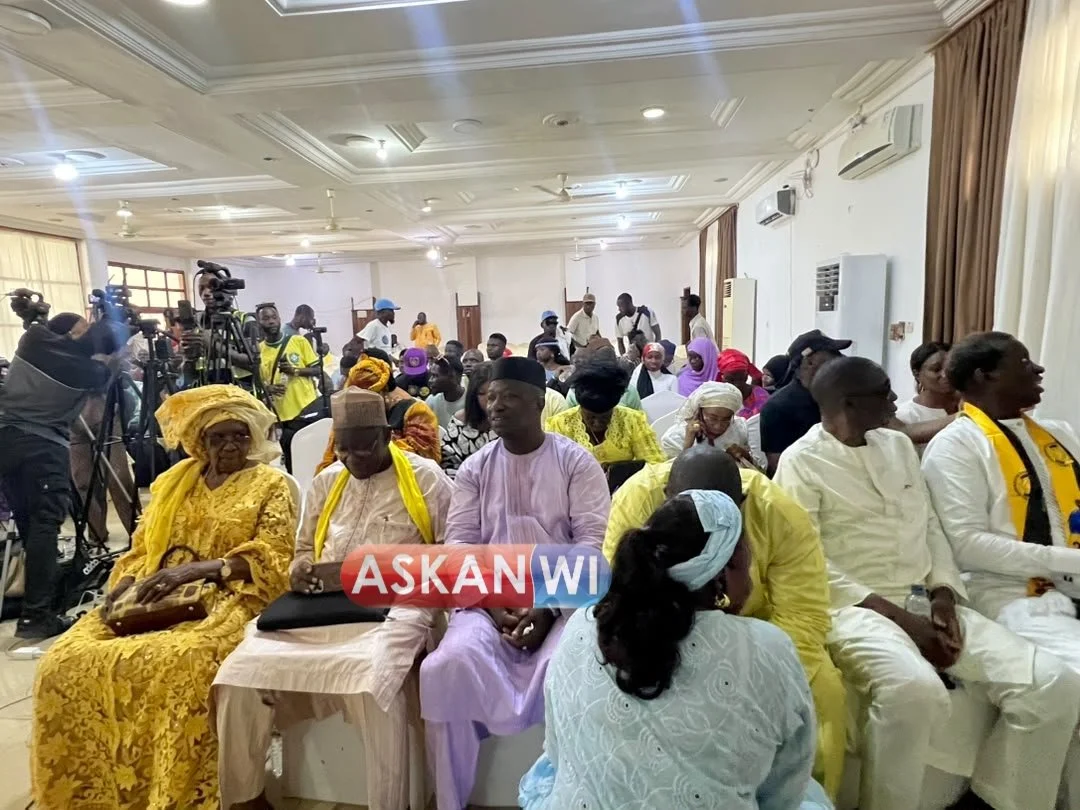
UDP Leaders at Gambia First Coalition Manifesto Launch © Askanwi
The manifesto was developed around four pillars: restoring democratic norms, revitalising the economy and key sectors, comprehensive security sector reform, and rebuilding a professional and independent civil service.
Presenting the policy framework, UDP Represenative Mr Lare Ceesay said the manifesto builds on a vision document developed in 2021 under the title The Gambia We Want, which later became the basis for the party’s public discussions and policy development.
He said the coalition’s long-term ambition was to transform The Gambia into a high-income, economically diversified, technologically advanced and institutionally strong country.
Ceesay argued that the country’s relatively small population, strategic Atlantic coastline, agricultural and fisheries potential, tourism industry, renewable energy resources and diaspora connections could serve as foundations for national development.
He cited Singapore, Mauritius, Seychelles, Estonia and Botswana as countries from which The Gambia could draw lessons in governance, economic diversification, tourism development, digital government and natural resource management.
Meanwhile, Bolong Sonko, representing the Gambia For All (GFA) and allied parties, endorsed the manifesto on behalf of the coalition’s partners, describing it as the product of collective effort and inclusive consultation.
He said the UDP had allowed its coalition partners to contribute to the document, including parties that had already prepared their own manifestos.
Sonko said the approach demonstrated the coalition’s commitment to inclusive governance, adding that the manifesto would serve as a benchmark against which citizens, the media and opposition parties could assess the performance of an elected government.
He also cautioned against the use of ethnicity for political advantage ahead of the elections, describing ethnic politics as an attempt to exploit differences and generate fear among Gambians.
“Where others see ethnic differences, we see complementarity,” he said, maintaining that the country’s ethnic diversity should be treated as a strength rather than a source of division.
In his closing remarks, Minority Leader Alhagie S. Darboe called on coalition leaders, supporters and elected representatives to take the manifesto’s message to every region, constituency and community.
He urged supporters to campaign with discipline, respect and responsibility, while communicating the coalition’s policies and commitments to voters.
The launch brought together UDP leaders, representatives of allied political parties, supporters, invited guests and members of the media as the Gambia First Coalition presented its policy agenda ahead of the December 2026 presidential election.
Darboe concluded by formally declaring the manifesto launched, expressing hope that Gambians would choose a path of progress, democratic governance and national renewal.
