
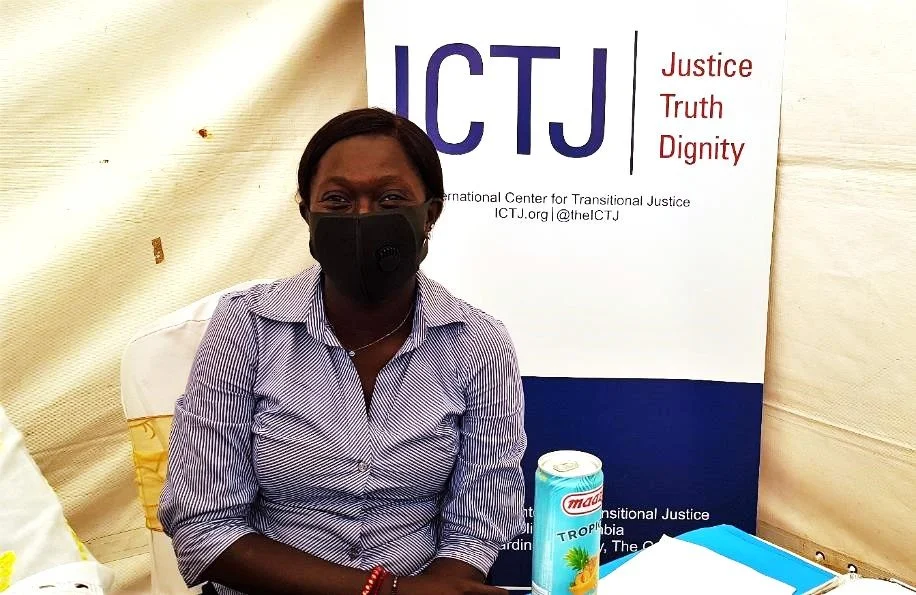
Aisha Jammeh at an event at the Victims Center organised by the International Center for Transitional Justice © Yusef Taylor
By Yusef Taylor, @FlexDan_YT
Aisha Jammeh was around 13 years old when she lost her father. Reflecting on the impact of that loss, she said, “I lost my dad at a very early age, when I was 13 or 14. I didn’t have the kind of childhood that many children have. I was robbed of my childhood.” Aisha’s father, Haruna Jammeh, was a cousin of former President Yahya Jammeh and was allegedly killed by the “Junglers,” a private killing squad that reported directly to the then president.
One of the Junglers, Omar Jallow—commonly known as Oya—confessed at the Truth, Reconciliation and Reparations Commission (TRRC) to participating in the execution of Haruna Jammeh. The TRRC was established to investigate human rights violations committed during the 22-year dictatorship of former President Jammeh. Its final report and recommendations were expected to be submitted in July 2021, after which they could be implemented.
Junglers Execute President Jammeh’s Cousin
During his testimony before the TRRC, Omar Jallow explained that he knew Haruna Jammeh personally and frequently had lunch at his home. He told the Commission that he received orders from Tumbul Tamba, a leader of the Junglers, to transport Haruna Jammeh from the National Intelligence Agency to Kanilai, the home village of former President Jammeh.
Testifying before the TRRC’s Lead Counsel, Essa Faal, Omar described how he assisted senior Jungler Sanna Manjang in executing Haruna Jammeh in cold blood. “So, we tied his neck. But at that time, I was not informed that this was the mission—that we were going to kill Haruna,” he said. “He [Sanna Manjang] was just sitting on top of the car. He jumped down and stamped on Haruna Jammeh’s neck, and he died,” Omar Jallow told the Commission.
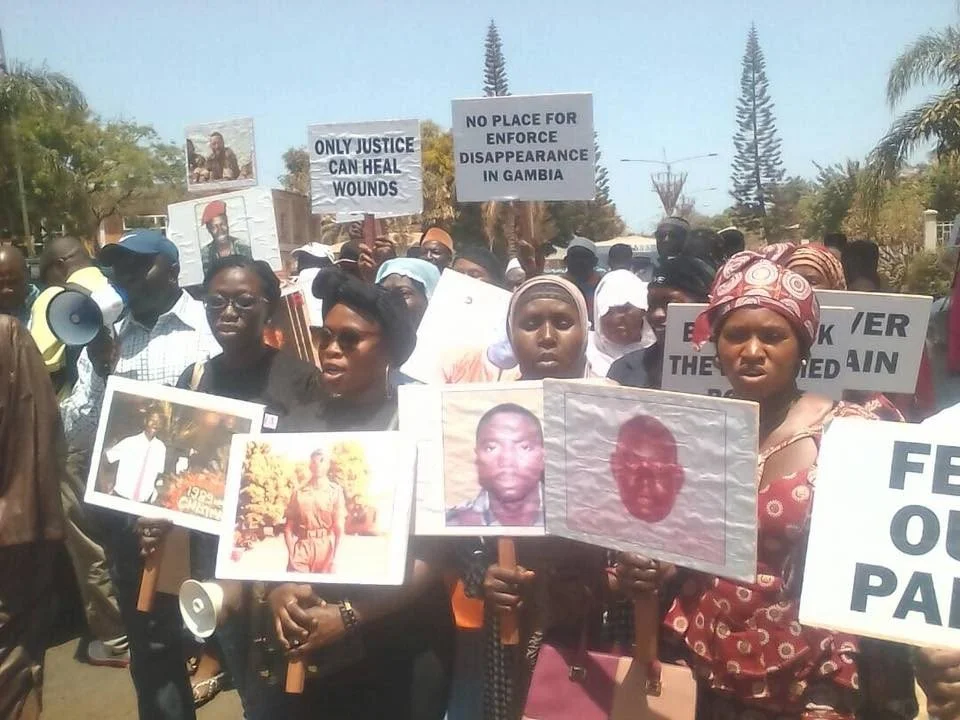
Aisha Jammeh in black on the far right at a Victims Protest march.
Reparations is More than Monetary Compensation
Speaking as staff at the Victims Center, Aisha told Gainako News that “reparations are not just about monetary terms; reparations come in different forms. It could be educational support, medical support, psychosocial support, sustenance and restoration of what you've lost.”
Gainako asked Aisha if acknowledgement of human rights violations from perpetrators can also be considered part of reparations. She responded by including both acknowledgement from perpetrators “and also the process of healing” as part of the reparation efforts.
On a personal level, Aisha explains what reparations mean to her. In her view, reparations means “seeing the alleged perpetrators – I would not even call them alleged anymore, because they have come to the open on the TRRC to confess some of what they’ve done themselves. The murder of my dad. Some of them came openly to say they were part of the people who killed him. So, the word ‘alleged’ – I don’t use it because it’s confirmed that they were the ones that were involved in my dad’s killing. So, for me, reparations mean beyond giving me money, giving me psychosocial support or giving me educational support”.
“It also means seeing the perpetrators being prosecuted because at the end of the day I lost my dad at a very early age when I was 13 or 14, and I don’t have those childhood memories that other children have. Although I have a few, but not to the extent of me finishing my school and having my father be my guide. I haven’t experienced that, so all the time it was my mum, and my mum being a dad at the same time,” she said.
“So, reparations for me and justice for me mean seeing all those people going through the court of law,” said Aisha. In her view, “to attain the Never Again slogan, we need to ensure that justice takes its due course. For justice to take its due course, it has to be people that bear the responsibilities going through a court of law.”
In a moment of altruism, Aisha stressed that she wanted the perpetrators and the victims to be treated fairly “because even if those victims had done something, there are laws in our country,” she argued. In her view criminals or people who had offended the law should have been taken “to court. But just one person cannot just tell you to go and take this person and kill this person, and that’s it.”
“The perpetrators need to be prosecuted because at the end of the day all lives matter,” said Aisha Jammeh.
We Need to Ignite the Conversation Now
Given that the financial investigation (Janneh Commission) of former President Jammeh’s embezzlement of public funds has been concluded but faces challenges of implementation, I asked Aisha what she felt should be done to ensure the TRRC’s recommendations are implemented. In her view “we need to start the conversation now; we need to ignite that conversation”.
Speaking on the importance of starting the conversation, Aisha explained that it’s important to act now while everything is fresh and there’s hype around the process. She added that if things take too long, then the hype dies down and everything can get to “that level until we forget about it. We will not want that to happen to the TRRC process.”
Re-echoing the findings of the TRRC, Aisha noted that “people were being brutalised, women were sexually assaulted, and our grandparents—the elderly people in our communities—were being called witches and wizards.” Highlighting one of the most bizarre and widespread human rights violations, Aisha was referring to the witch-hunting exercise initiated by former President Yahya Jammeh.
The TRRC revealed that in 2009, several elderly people were accused of being witches and deliberately targeted by Jammeh’s witch hunters. The torture they endured ultimately led to the deaths of some victims after they were forced to drink substances that caused severe concussions. Aisha further noted that “people were missing in The Gambia, and people were extrajudicially killed,” stressing that it is incumbent on the government to act to ensure that “all the efforts people put into this process—from the work of the TRRC, to the investigations and the truth-seeking process—do not go in vain.”
“I always say this: it’s important that Gambians and people living in The Gambia ensure that we truly attain the ‘Never Again’ slogan of the TRRC,” Aisha said.
