
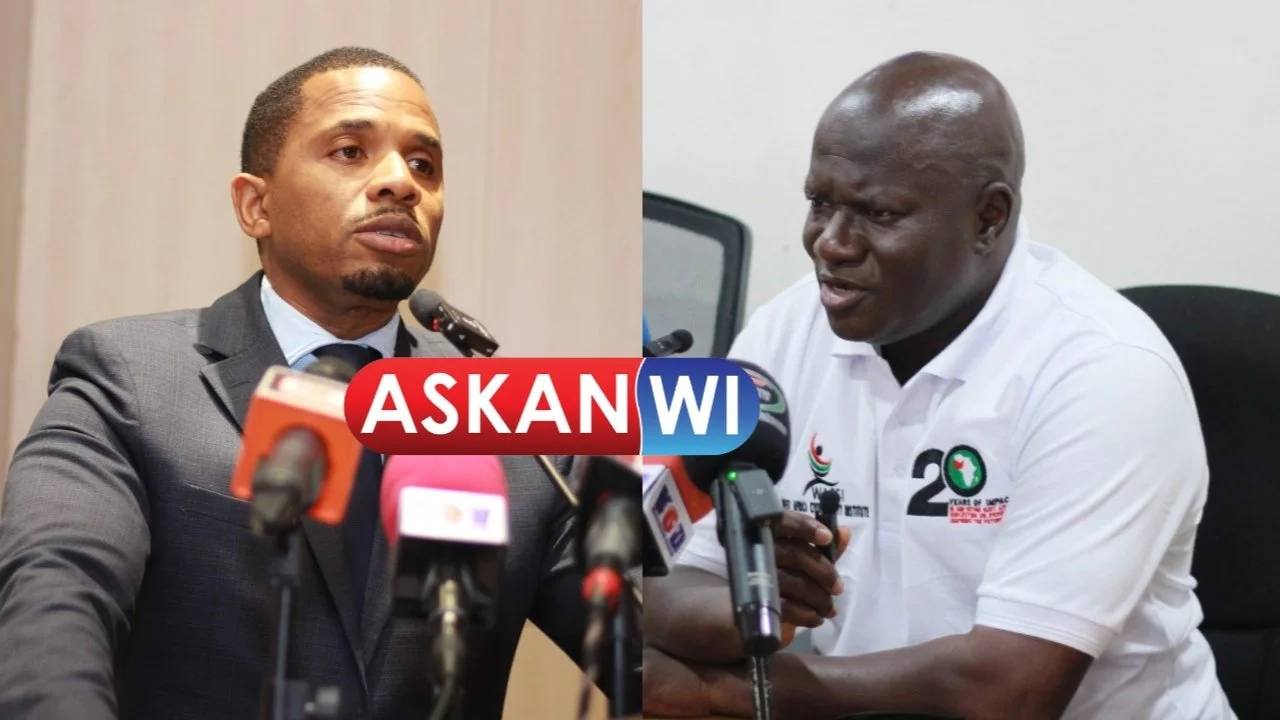
Information Minister Dr Ceesay (left) and Madi Jobarteh (right) © Askanwi Media
Civil Society Statement on the unwarranted attacks by Dr Ismaila Ceesay against Madi Jobarteh & Edward Francis Small Center for Rights & Justice
By CSO Advocates on 23rd January 2026
Civil society actors in The Gambia express deep concern over recent public remarks by Dr Ismaila Ceesay directed at Madi Jobarteh and the Edward Francis Small Center for Rights and Justice. These remarks must be understood within a broader and troubling pattern of delegitimising critical civic voices rather than engaging with the substance of their concerns. In particular, the questioning of the legitimacy of the Edward Francis Small Center for Rights and Justice—and, by extension, the credibility of its founder—raises serious issues for democratic discourse.
At the outset, it is important to state clearly that the legitimacy of civic engagement is not determined by office buildings, servers, or staff strength, but by the substance, accuracy, and public value of the work produced. Across the world, and indeed throughout The Gambia’s own democratic struggle, individual citizens and small initiatives have played decisive roles in advancing accountability, transparency, and human rights.
The Edward Francis Small Center for Rights and Justice has, over the years, contributed consistently to public discourse on governance, the rule of law, and accountability. Whether one agrees with its positions or not, its work has helped stimulate debate, promote civic awareness, and reinforce the constitutional right of citizens to scrutinise public power.
It is also important to situate this discussion within the professional standing and public record of the Center’s founder. Madi Jobarteh is a leading civil society actor and development specialist with over three decades of experience in governance, human rights, and development work. He is widely recognised within The Gambia and across the African continent for his sustained engagement on issues of social justice, democratic governance, and public accountability.
Over the years, Madi Jobarteh has been a consistent and principled advocate for transparency, the rule of law, and citizen participation in governance—both within The Gambia and beyond. His advocacy has never been rooted in personal aggrandisement, but in the conviction that democratic governance must be inclusive, participatory, and accountable to the people. The establishment of the Edward Francis Small Center for Rights and Justice is therefore not incidental but an embodiment of Madi Jobarteh’s long-standing beliefs and commitments. It reflects a deliberate effort to contribute to the building of a better Gambia grounded in institutional accountability, civic responsibility, and democratic participation—not one based on hero worship or personality cults reminiscent of the Jammeh era, which Gambians collectively rejected.
To frame civic accountability efforts primarily around administrative form rather than constitutional freedoms risks shrinking the civic space and sends an unfortunate message that only formally resourced institutions have the right to question governance. Such an approach is contrary to the spirit and letter of our Constitution, which guarantees freedom of expression, association, and participation in public affairs to every citizen—not only to registered or well-resourced organisations.
We further note that the criticisms raised by Madi Jobarteh have largely focused on matters of public interest, including transparency, the use of public resources, and adherence to due process. These are legitimate governance concerns that deserve substantive responses. Democratic governance is strengthened when state officials respond to critique with facts, openness, and engagement, rather than by discrediting the messenger.
Civil society therefore calls for:
Respect for diverse forms of civic engagement, including individual-led initiatives;
A recommitment to constructive dialogue between government officials and accountability actors;
A renewed focus on addressing the substance of governance concerns raised, in the best interest of the Gambian people.
The Gambia’s democracy was built by courageous individuals long before institutions were formalised. We must be careful not to rewrite that history or narrow the space for civic action today.
Date: 23rd January 2026
Endorsed and Signed by:
Salieu Taal, 2. Baboucarr Nyang, 3. Alagie Nyang, 4. Dr Baba Galleh Jallow, 5. Abdoulie Fatty, 6. Imran Darboe, 7. Nfamara Jawneh, 8. Musa Bah, 9. Ajie Fatou Bah, 10. Ebrima Jatta, 11. Aisha Dabo, 12. Lamin K. Danso, 13. Marr Nyang, 14. Fanta J Sowe, 15. Elsie Macauley, 16. Awa Joof, 17. Omar Saibo Camara, 18. Yusef Taylor (Flex Dan), 19. Sheriff Mohammed Kijera, 20. Coach Pa Samba, 21. Siira Ndow, 22. Degan Jobe, 23. Musa Jeng, 24. Haddija Jawara, 25. Yadicone Eribo Njie, 26. Ndey S. Bakurin, 27. Ndella Faye Colley, 28. Demba Ali Jawo, 29. Juka Ceesay, 30. Mam Lisa Conteh, 31. Tukulor Sey, 32. Haddijatou Kinteh, 33. Fatou Badjie, 34. Ndey Jorbateh, 35. Tabu Sarr, 36. Yadicon Njie Oribo, 37. Fatou Jagne Senghore, 38. Awa Dacosta, 39. Adelaide Sosseh, 40. Neneh Freda Gomez, 41. Aisha Tambajang, 42. Fatou Baldeh MBE
