
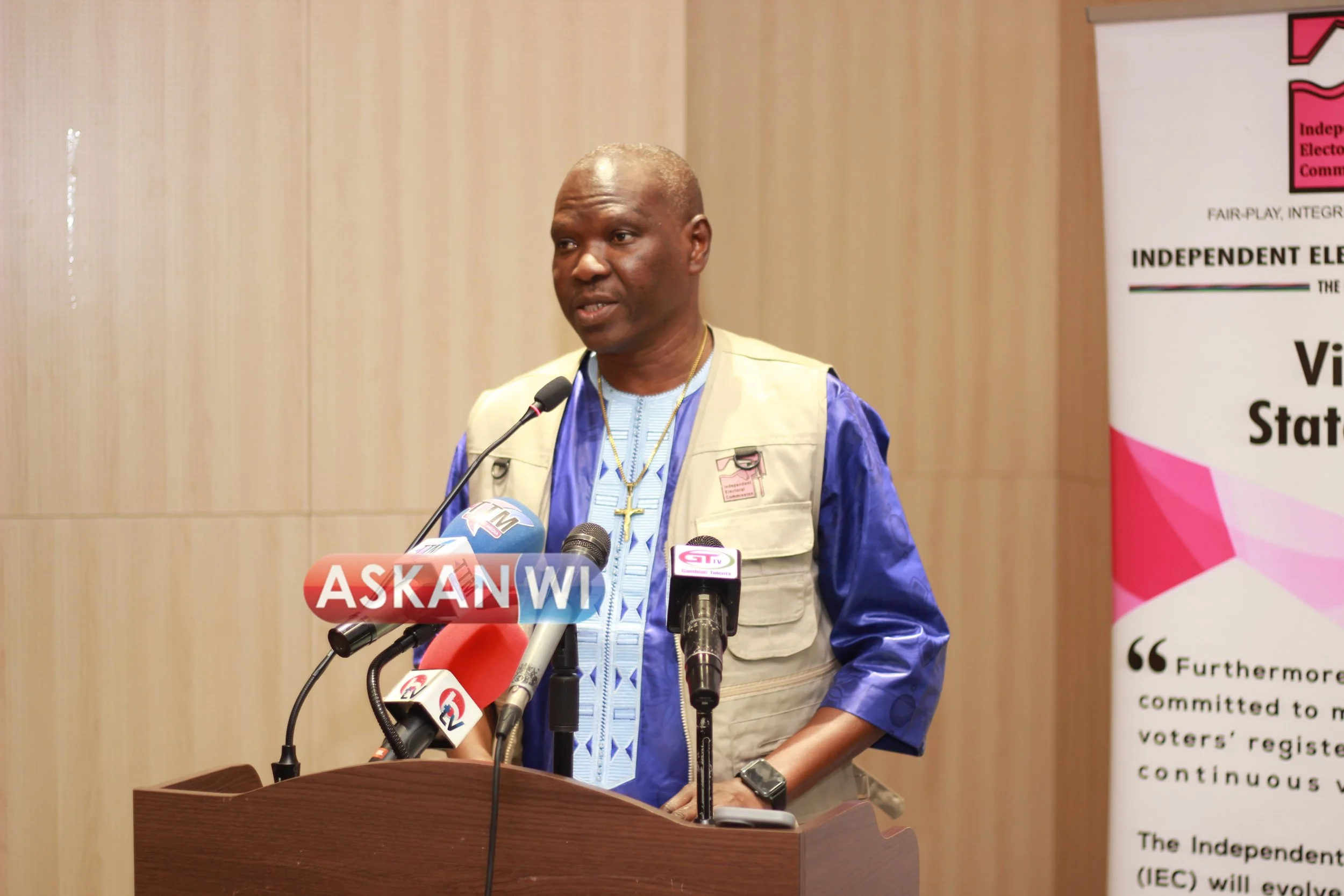
IEC Chair Mr Joseph Colley © Askanwi
By Yusef Taylor, @FlexDan_YT
The Gambia’s Independent Electoral Commission (IEC) held an eventful stakeholder engagement on Thursday, 23rd April 2026 at the Sir Dawda Kairaba Jawara Conference Centre, marked by tense exchanges, the disclosure of personal data, and a flurry of allegations and counter-allegations. During the session, two presenters provided differing figures for the total number of registered voters. Despite the discrepancy, both sets of data suggest that the country will surpass 1 million registered voters by the second week of the registration exercise.
In his remarks, IEC Chairperson Joseph Colley stated that the supplementary voter registration process began on 8th April 2026, with 100 registration teams deployed across 730 centres nationwide. He acknowledged operational challenges, noting that “areas of concern include faulty printer heads and the incorrect setting of registration dates by one of the IEC registration teams.”
Conflicting figures were later presented by IEC Operations Director Samboujang Njie and an IEC consultant. Mr Njie reported that 41,565 supplementary voters were registered between 8th and 15th April 2026, bringing the total number of registered voters to 1,003,722. He emphasised that the figures remain preliminary.
However, the IEC consultant presented a lower figure, indicating that 36,217 voters were registered in the first week, bringing the total to 998,233. The discrepancy was quickly flagged by eagle-eyed civil society advocate Mr Jadama. Despite this, the consultant maintained that “after this week, we are expecting to cross the milestone of 1 million registered voters in The Gambia's database.”
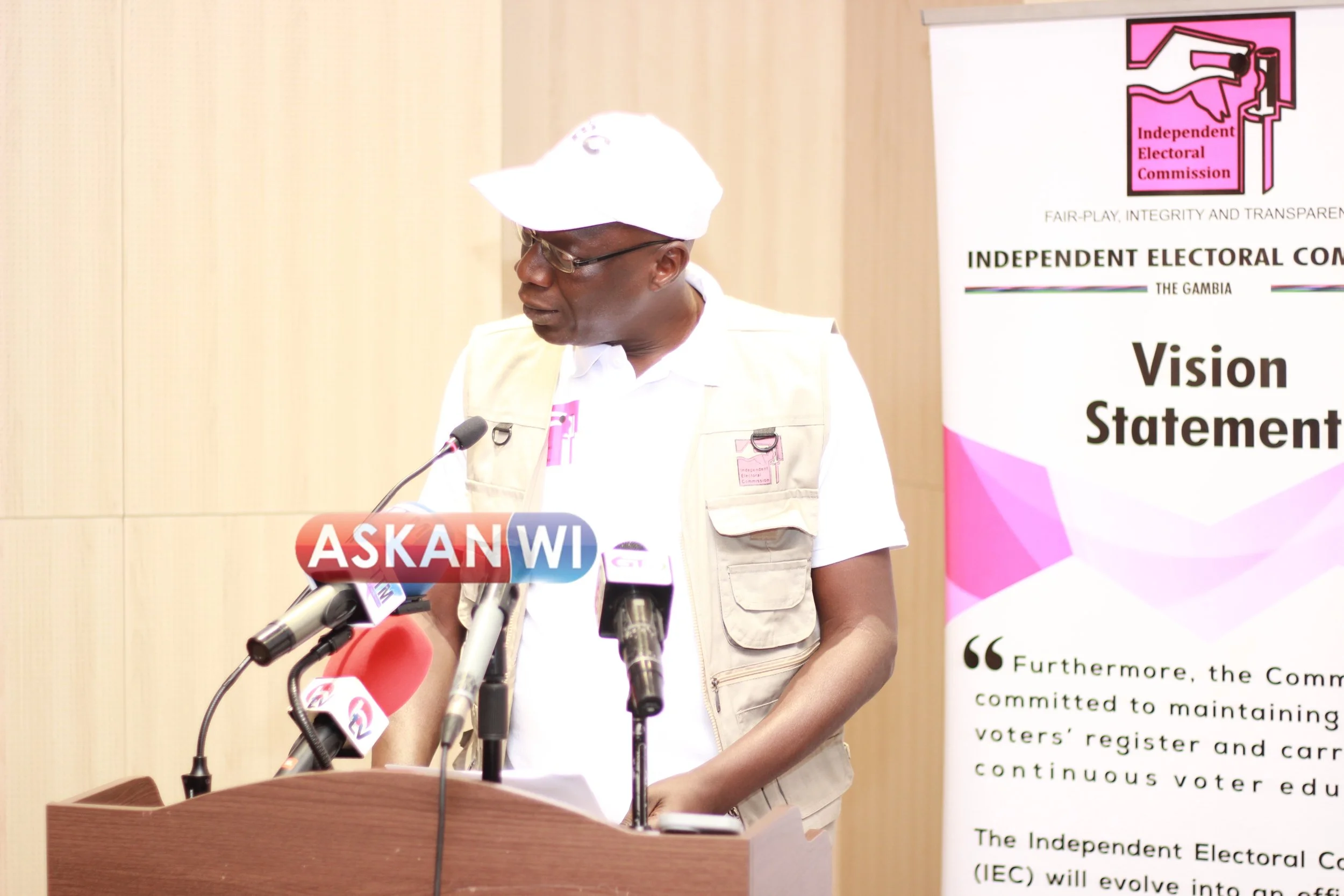
IEC Mr Samboujang Njie © Askanwi
Demographically, nearly 24,000 of the newly registered voters fall within the 18–25 age bracket, while the next largest group—those aged 26–35—accounts for fewer than 6,000 registrants.
Ahead of the often-contentious question-and-answer session, the IEC attempted to highlight “unconfirmed cases” of double registration by projecting suspected offenders. However, following a caution to the IEC Communications Director, the consultant was instructed to halt the display, citing concerns that the information could be published by the media.
One of the most contentious issues raised concerned the Yarambamba region, where 235 voter cards were printed with “August” instead of “April”. According to Mr Njie, the error was caused by an incorrect date setting on a laptop used by a registration team. He noted that swift corrective measures were taken: 235 cards were retrieved, with only 18 still outstanding. All retrieved cards have since been reissued with the correct dates.
Mr Njie also revealed that 25 generators had recently been distributed to address power challenges in parts of the country, where heavy usage had led to equipment strain. These generators are essential for ensuring uninterrupted power supply to voter registration systems and card printing equipment.
Our next publication will focus on the exchanges between the IEC and party representatives, as well as the tensions among the parties themselves.
