
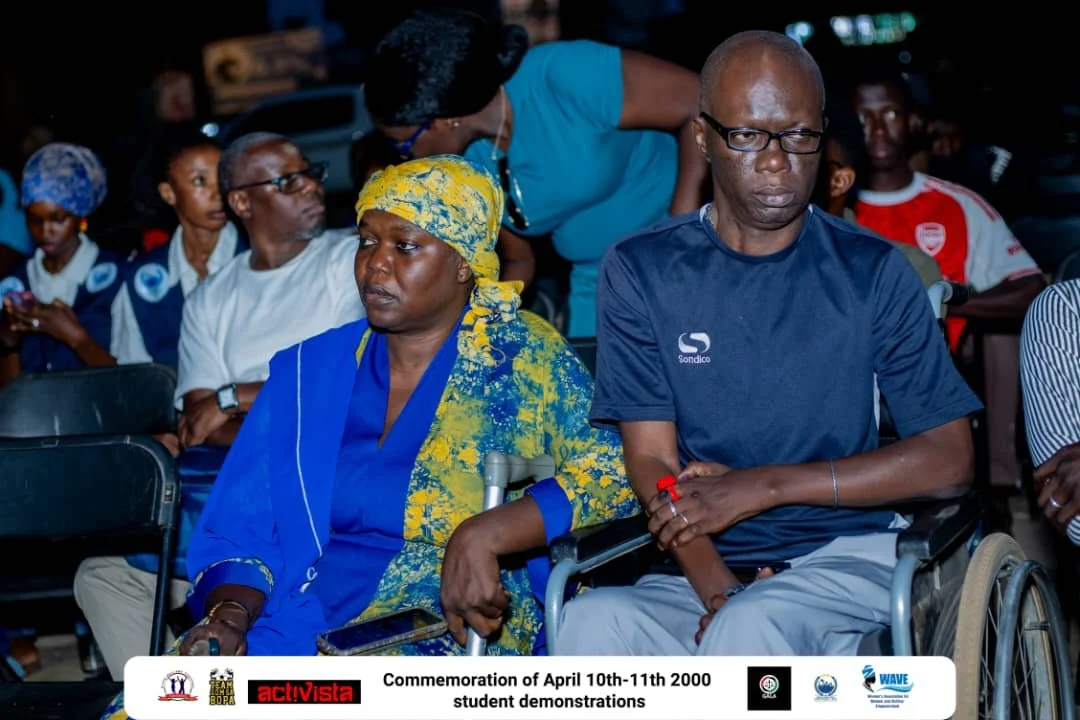
Sainabou Camara Lowe and Yusupha
By Jainaba Ceesay
A survivor of the April 2000 student massacre has criticised President Adama Barrow and his government for their continued silence and neglect, warning that many are suffering and dying without support.
Speaking during the 26th commemoration of the 10th and 11th April 2000 student demonstration held at the Youth Monument at Westfield on Saturday, 11th April 2026, Ms Sainabou Camara highlighted that the month of April remains a painful reminder for victims, describing it as “a dark month” in The Gambia.
However, many Gambians and “President Barrow don’t know that the month of April is a dark month for the victims.”
“April is a month of pain. It is a month when our heroes fell, when future leaders died. Many of us are still struggling because of what happened,” she said. Ms Camara noted that although 26 years have passed since the incident, the trauma remains fresh, adding that many victims continue to battle both physical and emotional challenges.
“All victims of April 10 and 11 are sick, whether [the government] realises it or not. Every year when April comes, it takes us back to a place we do not want to be,” she explained.
Speaking further, Ms Camara expressed disappointment over what she described as the ‘lack of official recognition of the dates', stating that the government failed to adequately commemorate the day through national platforms.
The now defunct Truth, Reconciliation and Reparations Commission (TRRC) notably recommended the declaration of 10th and 11th April 2000 as official school holidays to commemorate the 2000 student massacre.
In its final report in Volume 6, the TRRC recommended that the Ministries of Basic and Secondary Education (MoBSE) and Higher Education (MoHERST) consider declaring one or both days as school holidays or introduce alternative memorialisation measures to ensure remembrance and non-recurrence. The Commission further urged education authorities to establish student engagement mechanisms and promote civic education to prevent similar violations in the future.
Although the government, in its White Paper, formally accepted them and committed to the implementation as part of a national memorialisation plan which was scheduled to begin in the second quarter of 2023. However, as of April 2026, no visible progress has been made, despite repeated appeals from victims, families of those killed, and civil society organisations.
Ms Camara noted that, ‘the government could have used the media, radio, television, and newspapers to acknowledge this day. But nothing was heard. It feels like they do not care about us.’
She further claimed that President Barrow has never directly engaged with victims. “He visited Kanilai, but I have never seen him visit the Victims’ Center. As victims, we have not received that recognition,” she said.
The 10th and 11th April 2000 incident, in which security forces opened fire on student protesters, remains one of the darkest chapters in the country’s history. Although the government has remained silent, CSOs like Fantanka, the Edward Francis Small Center for Rights and Justice (EFSCRJ), the Women Association for Women and Victims Empowerment (WAVE), Gambians Against Looted Assets (GALA), Activista The Gambia and Team Gom Sa Bopa have taken a bold step to convene the 26th commemoration.
Additionally, the CSOs subsequently held meetings with both MoHERST and MoBSE to ensure government participation in the 2027 commemoration and accelerate progress towards implementing related TRRC recommendations.
