
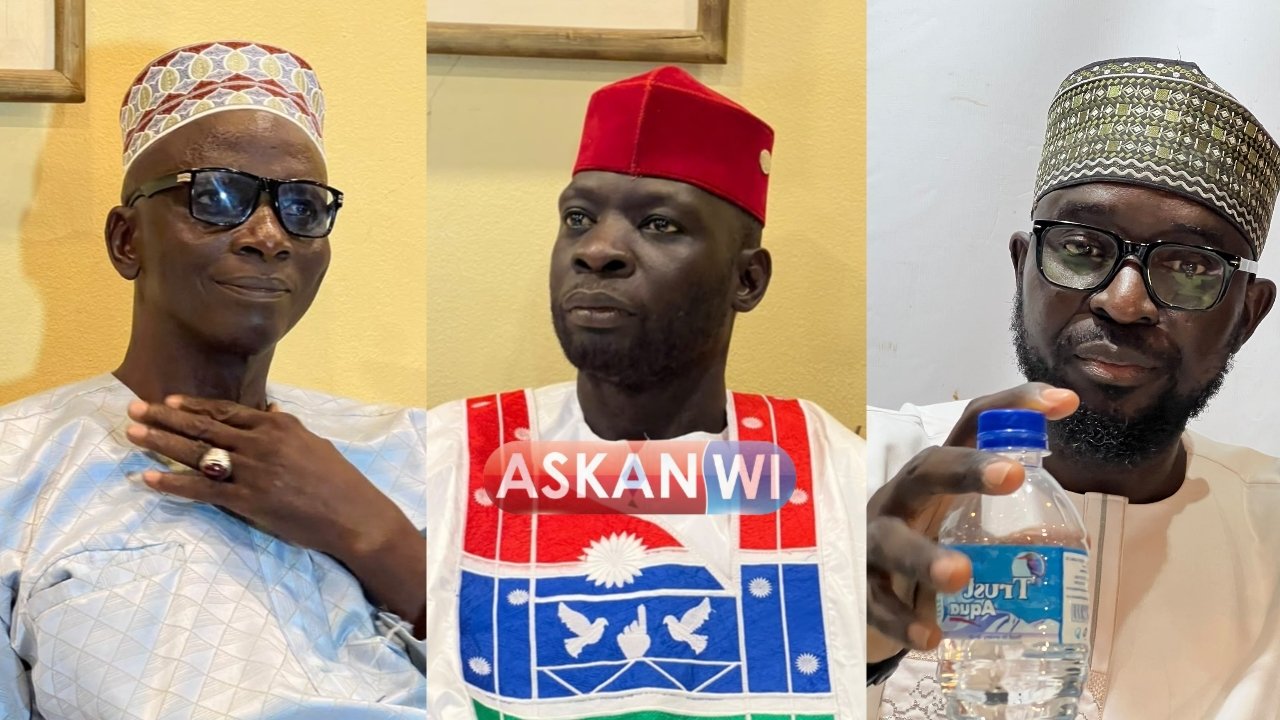
NDP Led Grand Coalition © Askanwi
By Fatoumata Konteh
The NDP/NAFAA/NARD/GLP Grand Alliance has unveiled its joint five-year presidential manifesto, titled “The Gambia We Want to Build,” outlining an ambitious development agenda centred on cultural renewal, economic sovereignty and shared prosperity.
The manifesto was presented by Ousainou Allen, Leader of the National Alliance for Accelerated Advancement (NAFAA), at a launch ceremony held at the Kairaba Beach Hotel on Wednesday, 4th November 2026.
The document sets out the alliance’s development priorities for a proposed five-year governing period beginning in 2027, should it win the December 2026 presidential election.
Speaking during the presentation, Allen described the manifesto as more than an electoral document, saying it also provides an insight into the alliance’s broader development vision, which will be expanded in a more detailed programme containing measurable targets and budget allocations.
He said the alliance’s vision is to build “a sovereign, united and prosperous nation-state anchored in our culture, powered by a productive and inclusive economy.”
Allen explained that cultural renewal would involve strengthening Gambian identity, values, history, heritage and civic responsibility, while ensuring that national development reflects the country’s social and cultural realities.
He also emphasised the importance of economic sovereignty, arguing that The Gambia must make greater use of its available resources—including fertile agricultural land, water resources, sunlight, the River Gambia, the ocean and human capital—to drive development.
Under its economic agenda, the alliance is proposing to create 150,000 decent jobs within five years, produce at least 50 per cent of the country’s food requirements locally, and ensure access to safe drinking water for 90 per cent of the population.
The manifesto also targets 95 per cent child immunisation coverage, the mobilisation of more than D20 billion in development financing, and the expansion and rehabilitation of roads to improve transportation and economic productivity.
On education, Allen said the alliance intends to strengthen technical and vocational education and training (TVET), with a target of having 25 per cent of school-going children enrolled in the sector.
He further proposed greater recognition and integration of students attending traditional Islamic learning centres, including Dara and Majalis, into the national education system, arguing that no category of children should be excluded from educational opportunities and government support.
The alliance also pledged to improve teachers’ welfare, strengthen apprenticeship programmes and expand practical skills training to prepare young people for employment after graduation.
Other priorities outlined in the manifesto include food processing and agro-industrial development, affordable and reliable electricity, digital infrastructure, data sovereignty, improved port and airport facilities, and stronger support for small businesses.
On social inclusion, the proposed programme highlights support for women, children, widows, single mothers and persons with disabilities, alongside plans to expand digital connectivity and create employment opportunities for vulnerable groups.
Allen also stressed the importance of justice, accountability, transparent public procurement and an efficient public service, arguing that development would be difficult to achieve without responsible leadership and the proper management of public resources.
The manifesto further identifies the Gambian diaspora as a major development partner, with Allen noting that remittances and diaspora investments could be better channelled towards national development and industrial growth.
The alliance, led by the National Democratic Party (NDP), brings together the National Alliance for Accelerated Advancement (NAFAA), National Alliance for Reconciliation and Development (NARD), and the Gambia Labour Party (GLP).
The presentation also outlined two central pillars of the proposed development agenda: cultural renaissance and economic sovereignty, alongside a third component focused on implementation and commitments.
The alliance says its overall objective is to build a stronger and more prosperous Gambia through people-centred leadership, productive investment and shared national development.
