
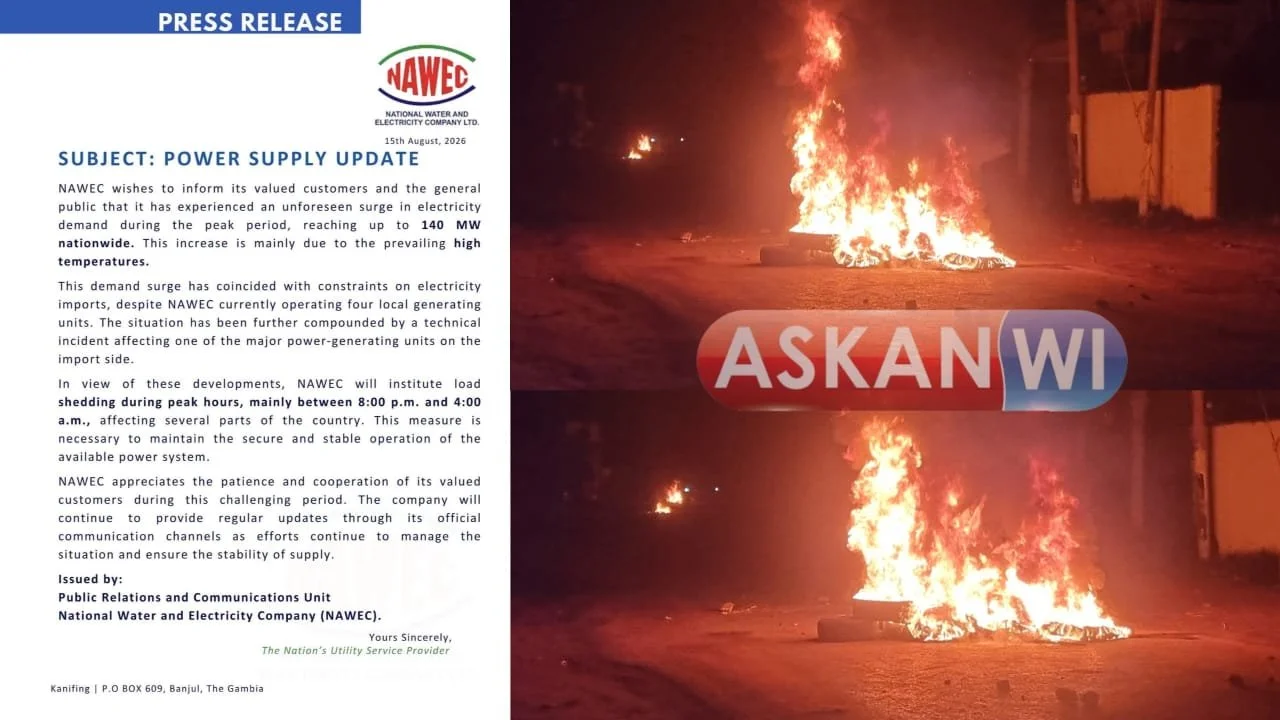
NAWEC Statement, Protestors Caused Fires © Askanwi
By Edward Dalliah, Jr.
Prolonged electricity blackouts have triggered protests across the Greater Banjul Area and West Coast Region, with residents taking to the streets to express frustration over worsening power outages.
The protests, which began in Banjul last night before spreading to parts of other regions, saw some demonstrators holding candles while others burned tyres in the streets.
In Manjai, our reporter witnessed youth burning tyres in protest against the prolonged electricity outages. Reports circulating online also indicated that police fired tear gas at protesters in some parts of KM, particularly West Field, although the intervention was later stopped.
In a video published by the Voice Out Digital Media on Facebook, Police Intervention Unit Commanding Officer Lamin B. Sarr was seen engaging protesters in an attempt to disperse the crowd.
Sarr acknowledged their frustration, but urged the protesters to consider the potential consequences of burning tyres and clashes with the police.
“What is happening does not make anyone happy,” Sarr told the protesters. ‘One thing I will advise you is that we are all youths. It is not our wish to tear gas you, and it is not something we are happy about. But if you set fires and we throw tear gas, people in their houses, elderly women and men who are sick, and pregnant women are the ones who will suffer.’
He added: “Our own brothers and sisters and our parents will suffer. You and I can be here until tomorrow, but at the end of the day, who will be the winner? We are all going to be losers.” His appeal was aimed at calming the protesters and preventing further confrontation.
The latest protests come amid months of persistent electricity shortages. The prolonged outages began around May 2026 and appeared to improve in July before worsening again in August.
In a press release issued on 15th August 2026, the National Water and Electricity Company (NAWEC) said it had experienced an “unforeseen surge in electricity demand during peak periods, reaching up to 140 megawatts (MW) nationwide due to high temperatures.”
The utility company said the “surge in demand coincided with constraints on electricity imports, despite NAWEC operating four local generating units.” The situation, NAWEC added, was “further compounded by a technical incident affecting one of its major generating units on the import side.”
As a result, NAWEC announced that it would introduce load-shedding during peak hours, mainly between 8:00 p.m. and 4:00 a.m. However, since the announcement, several areas have reportedly experienced blackouts extending well beyond the stated load-shedding period, with some residents experiencing outages lasting up to 24 hours.
The situation has renewed concerns about the country’s domestic electricity generation capacity and its reliance on imported power.
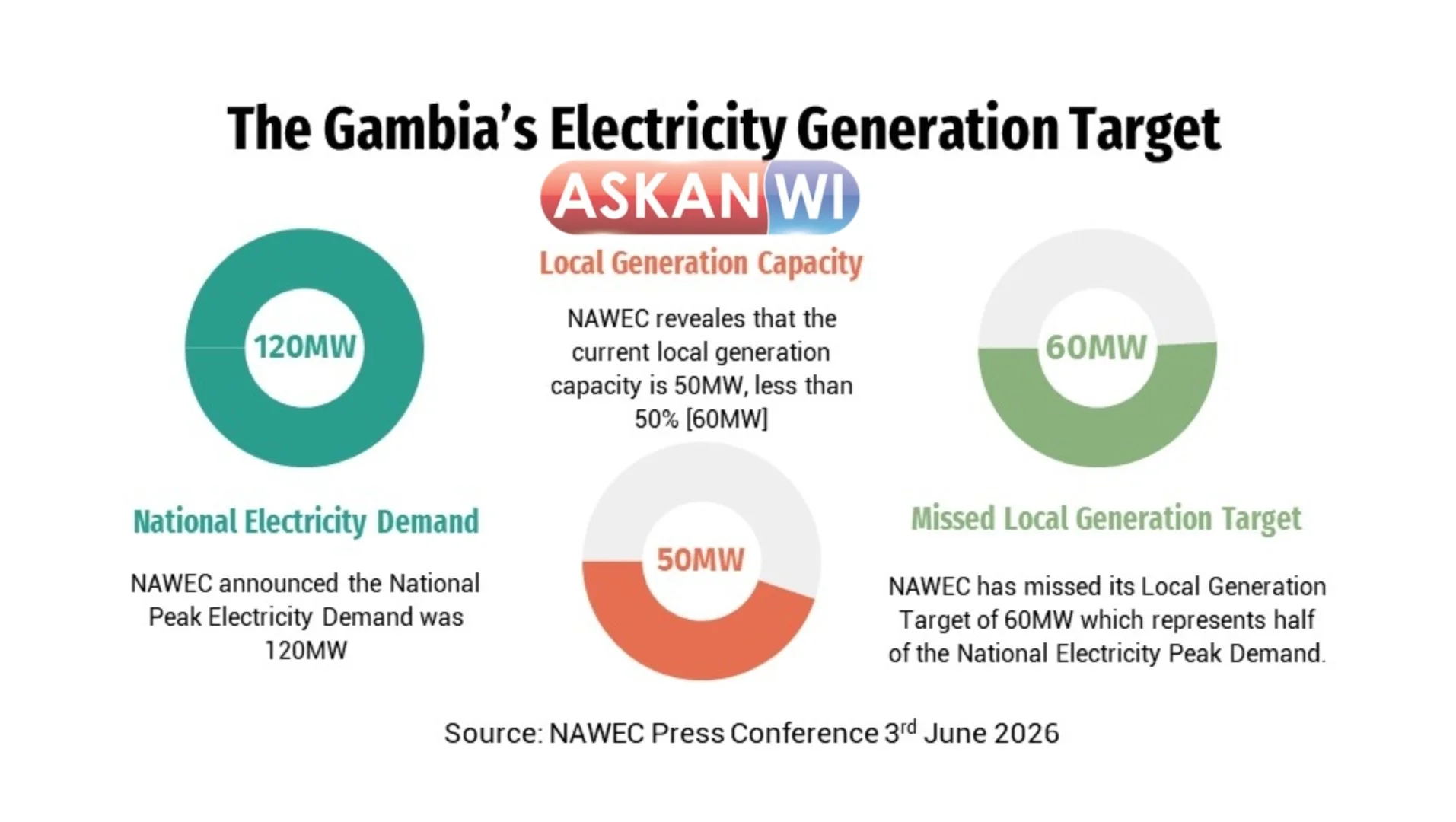
NAWEC Electricity Targets © Askanwi
Generation Capacity Concerns
The current crisis also raises questions about whether the expansion of electricity access has outpaced the country’s ability to generate sufficient power locally.
During a press conference in June 2026, our reporter questioned NAWEC’s Deputy Managing Director about the company’s focus on achieving universal access to electricity at a time when domestic generation capacity remained insufficient to meet growing demand.
Responding to the question, the Deputy Managing Director Sompo Ceesay said the government had invested significantly in increasing local generation capacity since President Adama Barrow came to office. He told our reporter that “more than 50 MW of new generation capacity” had been added, describing the increase as “significant.”
He argued that the investments demonstrated that there had been no neglect of electricity generation. On the issue of expanding access, he said the question should be viewed in terms of what the alternative would be.
“On the issue of access, the best way to understand is what is the alternative,” he said. “Should we leave half the country without access and just focus here? Is that the right way to approach development?” He added that denying access to electricity to a large portion of the population would not be morally or ethically justifiable.
However, the latest outages have brought the generation challenge back into focus. As more customers are connected to the national grid, insufficient domestic generation means NAWEC continues to rely heavily on imported electricity to meet demand.
While imported electricity can help bridge the supply gap, disruptions to imports can quickly translate into prolonged blackouts for customers, exposing the vulnerability of a system that remains heavily dependent on external supply.
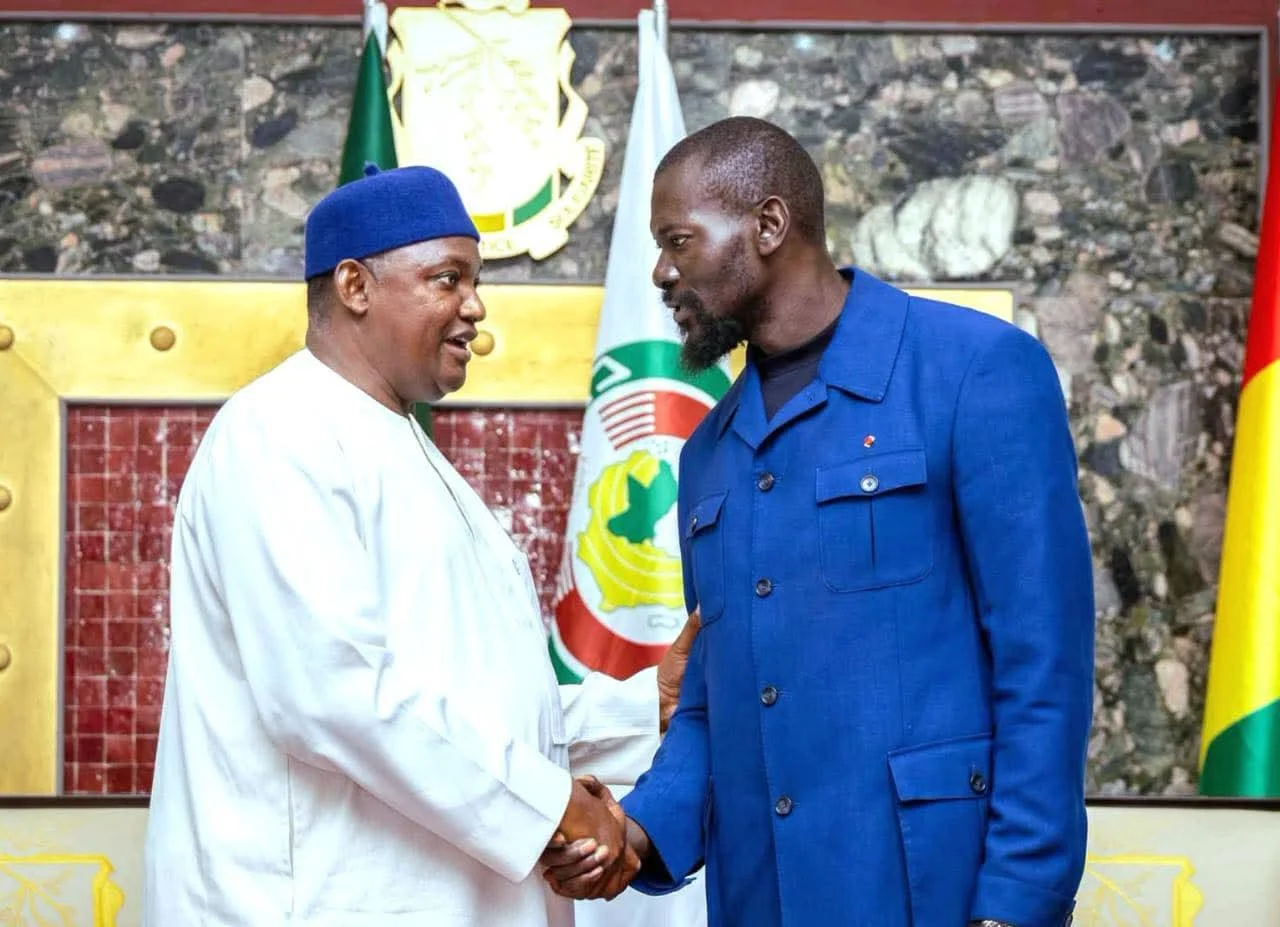
President Barrow meets Guinea President Dumbuya © State House
President’s Guinea Visit
Amid the latest electricity crisis, President Adama Barrow last week travelled to Conakry, Guinea, on a working visit accompanied by the Minister of Energy and Mines, Nani Jawara, and NAWEC Managing Director Galo Saidy. However, despite the visit, the situation has not improved.
The continued outages and the protests they have triggered have placed renewed pressure on NAWEC and the government to address both the immediate electricity shortage and the longer-term gap between growing demand and domestic generation capacity in a sector that has received millions of dollars and euros in donor funding.
