
Bureau de Change Murder Trial: Court Admits Autopsy Report Despite Defence Objection
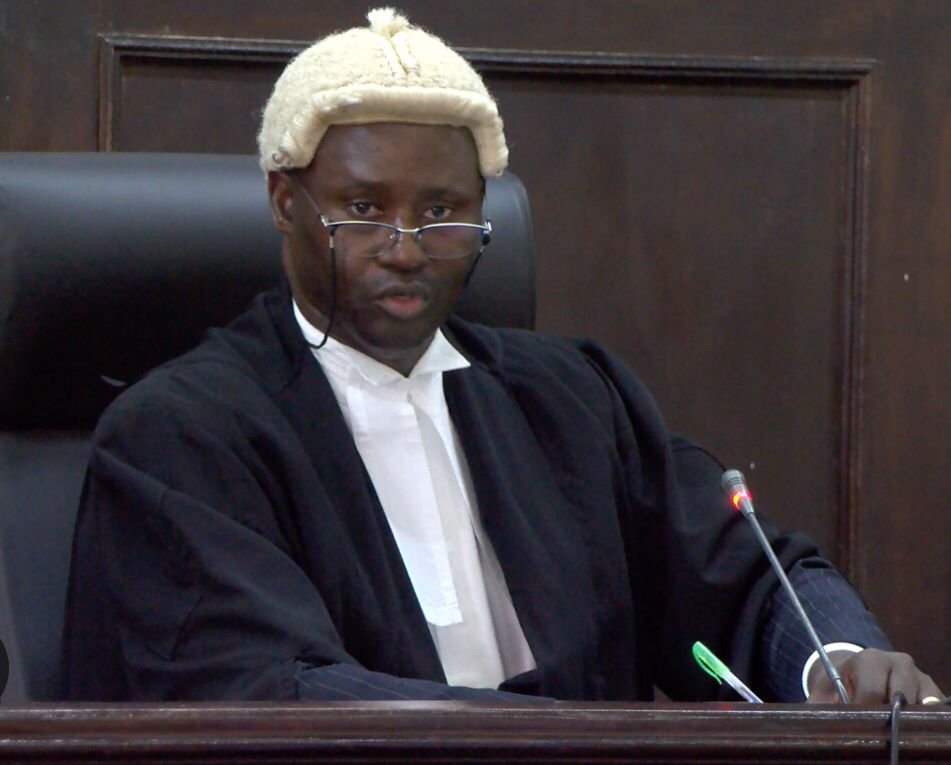
Justice Jaiteh of the High Court
By Fatoumata Jaiteh,
The trial over the murder of Bureau de Change staff member Fatoumatta Kargbo took a decisive turn on Tuesday, 3rd March 2026, when the High Court in Banjul admitted the post-mortem report into evidence, overruling strong objections from the defence.
Suspect Harouna Tine could face the death penalty or life in prison if found guilty of stabbing Karbo to death in a killing that has left the nation in shock.
The case involved the stabbing to death of Fatoumatta Kargbo on 19th January 2024 at a Bureau de Change at Westfield. The main suspect, Harouna Tine, has been charged with murder under Gambian law. Police prosecutors stated that the offence is framed as “murder contrary to Section 187, punishable under Section 188 of the Criminal Code (Cap 10:01, Volume 3 Laws of The Gambia 2009)".
If found guilty, Tine could face the death penalty or life imprisonment. However, Tine has pleaded not guilty to the murder charge, although police say he was found unconscious at the scene after stabbing Kargbo with a knife.
The case was initially brought before the Kanifing Magistrate Court and transferred to the High Court, which has the jurisdiction to try murder cases. Tine was remanded in Mile II Central Prison pending the outcome of his case.
Presiding over the matter, Justice Ebrima Jaiteh held that excluding the autopsy report on grounds of administrative delay would undermine the court’s duty to ascertain the truth in a criminal trial involving the loss of life. Harouna Tine is alleged to have killed Fatoumatta Kargbo, a forex bureau staff member.
The day’s proceedings featured the testimony of Prosecution Witness Nine (PW9), Dr. Ousman Leigh, a consultant pathologist with 11 years of experience. Dr. Leigh told the court that he has conducted more than a thousand post-mortem examinations since 2015.
Dr. Leigh, formerly attached to the Edward Francis Small Teaching Hospital (EFSTH), testified that he conducted the post-mortem examination on Fatoumatta Kargbo on 22nd January 2024.
According to his findings, the deceased sustained a penetrating injury to the heart, passing through the chest cavity, which houses the lungs, and piercing the covering of the heart. He said the injury was consistent with a fatal wound capable of causing death.
The medical certificate issued by Dr. Leigh listed the cause of death as resulting from the penetrating chest injury.
Following the testimony, State Counsel Fatoumata Drammeh applied to tender the post-mortem report into evidence.
Defence counsel Samuel Ade immediately objected on two principal grounds.
First, he argued that although the report was dated 22nd January 2024, it was only served on the defence on 2nd March 2026—more than two years later and just a day before it was sought to be tendered.
Second, Ade submitted that the delay constituted a breach of Section 241 of the Criminal Procedure Act 2025, which governs disclosure and procedural compliance in criminal trials.
He further argued that the late service violated Section 24(3) of the 1997 Constitution of The Gambia, which guarantees that any person charged with a criminal offence shall be given adequate time and facilities for the preparation of their defence.
Counsel for the accused maintained that admitting the report under such circumstances would prejudice his client and compromise his constitutional right to a fair hearing.
In response, State Counsel Drammeh contended that the defence had been given more than 48 hours’ notice prior to the tendering of the document.
She further argued that the service of court processes is a judicial administrative function and not one directly controlled by the prosecution. As such, she said, any delay in service could not fairly be attributed to the State.
The prosecution maintained that all statutory requirements had been met and urged the court to admit the report, describing it as a critical piece of evidence in establishing the cause of death.
In his ruling, Justice Jaiteh framed the central issue as whether the prosecution had complied with statutory requirements, not whether the report had been served at a later stage than desired.
“The document is relevant and material to the issues before this court,” the judge held.
He noted that the prosecution could not be held accountable for delays arising from judicial administrative processes beyond its control.
“This is a criminal trial involving the death of Fatoumatta Kargbo. A post-mortem report prepared by a qualified pathologist is central and material in any case where the cause of death is in dispute,” Justice Jaiteh said.
He further reasoned that excluding such evidence purely on account of administrative delay would undermine the truth-seeking function of the court.
“To exclude the post-mortem report in these circumstances will impede the court’s duty to ascertain the truth and determine the matter on its merits,” he added.
The judge accordingly overruled the defence’s objection and granted the prosecution’s application to tender the post-mortem report into evidence.
With the autopsy report now formally admitted, the prosecution closed its case, with no further witnesses to testify. The matter was adjourned to 10 April 2026 for the hearing of the defence case.
