
Missed Inflation Target: Central Bank Governor Responds
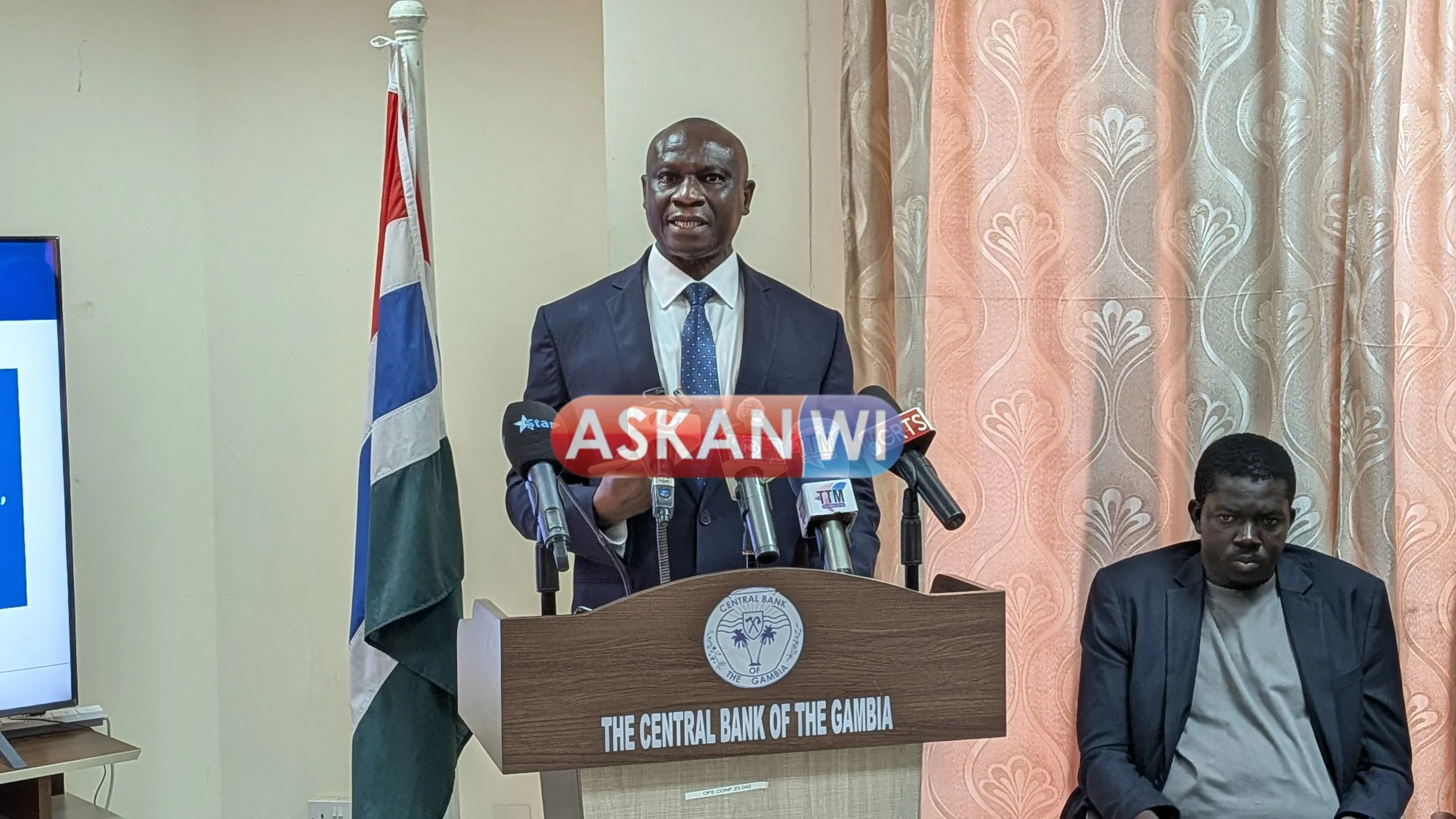
Central Bank Governor 20th August 2026 © Askanwi
By Edward Dalliah, Jr
The Central Bank of The Gambia (CBG) had projected a 5% medium-term inflation target at the end of 2025; however, by January 2026, headline inflation had only declined to 6.4%, down from 6.6% in December 2025.
Our reporter questioned the Central Bank Governor Buah Saidy about the missed 5% medium-term inflation target at the latest Monetary Policy Committee (MPC) press briefing held on 20th August 2026.
Back on 4th December 2025, during an MPC presser, Governor Buah Saidy informed our reporter that the bank's efforts to achieve its 5% medium-term inflation target depended largely on increasing local food production, an approach he stressed went beyond the mandate of the Central Bank.
According to Governor Saidy, the Central Bank was “trying to ensure that we achieve this 5% medium-term target through increased domestic food production, and that is not the responsibility of the Central Bank alone but the entire government machinery.”
“But every Gambian must be willing to go back to the farms. We have to increase our food production. We cannot depend on imports,” he told the reporter, adding that by the “first quarter of 2026, we should be able to reach the medium-term target through increased domestic food production.”
Our reporter followed up by asking Governor Buah Saidy about their target during the more recent MPC press briefing held on 20th August 2026.
According to Governor Saidy, “Headline inflation declined to 7.0% in July 2026, from 7.6% in June and 7.5% in May, reflecting easing food-price pressures.” He added: “However, inflation remained above the Central Bank's implicit target of 5.0%, indicating that overall price pressures remain elevated in the economy.”
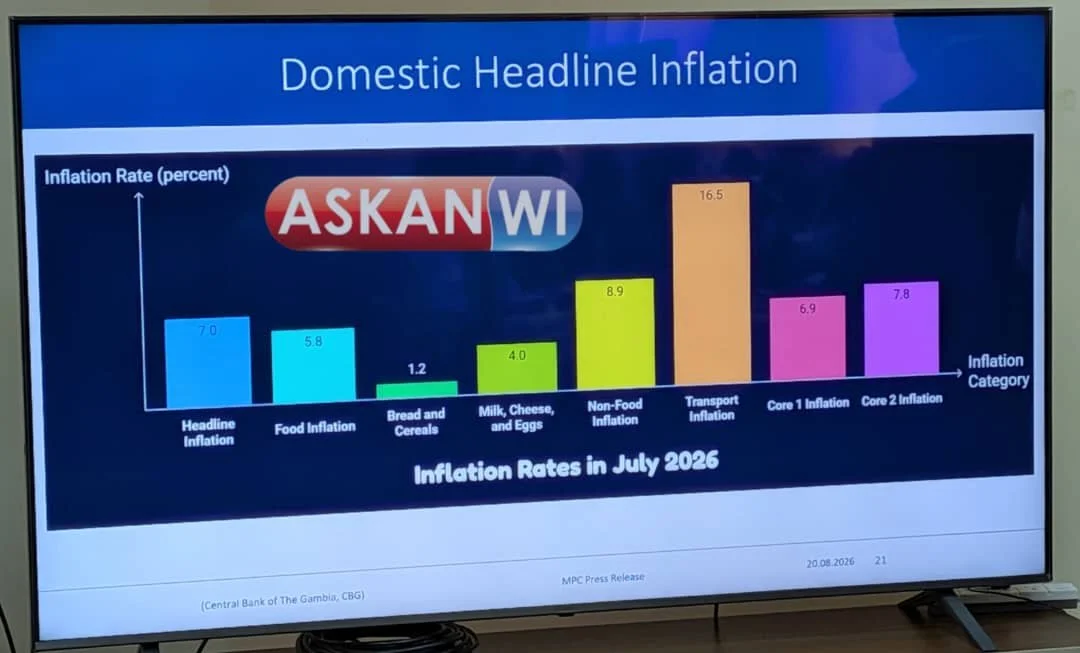
Domestic Headline Inflation - July 2026 © Askanwi
During the question-and-answer session, our reporter referred to his question from the previous year, when Governor Saidy pledged that The Gambia should be able to reach the 5% medium-term target by the first quarter of 2026. Our reporter then asked when the Central Bank expects to reach the target.
In response, Governor Saidy asked our reporter: “My friend, do you live on planet Mars or another planet? Because I don’t think if you live on planet Earth you will be asking this question simply because of the events happening around the world, the geopolitical tensions.”
He added: “I mean, I will go back to COVID; from COVID we come to Russia-Ukraine War, those are major geopolitical shocks or external shocks to our economy, and then we came to this most recent Middle East crisis. All those have implications for the domestic economy and our forecast.”
A comparison of the governor’s responses last year and this year, however, shows a shift in emphasis, from domestic food production and agricultural productivity to external shocks as major factors affecting inflation.
In his response last year, Governor Saidy expressed optimism that The Gambia could reach the 5% medium-term inflation target by the first quarter of 2026, placing significant emphasis on increasing domestic food production and strengthening the agricultural sector.
But in August 2026, he pointed to external shocks, including the COVID-19 pandemic, the Russia-Ukraine war, and the recent Middle East crisis, as factors that had affected inflation and the Bank’s forecasts.
“I was very confident that by the time we got here, inflation would be at our medium-term target of 5%, because we were down all the way from 18.3% in September 2023 to 6.4%, and we expected that the disinflation trend to continue,” he said.
He added: “But thanks to the conflict in the Middle East, inflation started increasing, and we just announced it has decreased from 7.2% to 7%. Our projections for the end of the year to the first quarter of 2027, we expect to be within the medium-term target. Again, that is contingent on both domestic and external risks not materialising.”
The Central Bank’s delayed inflation target comes against the backdrop of The Gambia’s continued heavy dependence on imports and a relatively narrow export base, factors that put additional pressure on the economy and expose domestic prices to external shocks.
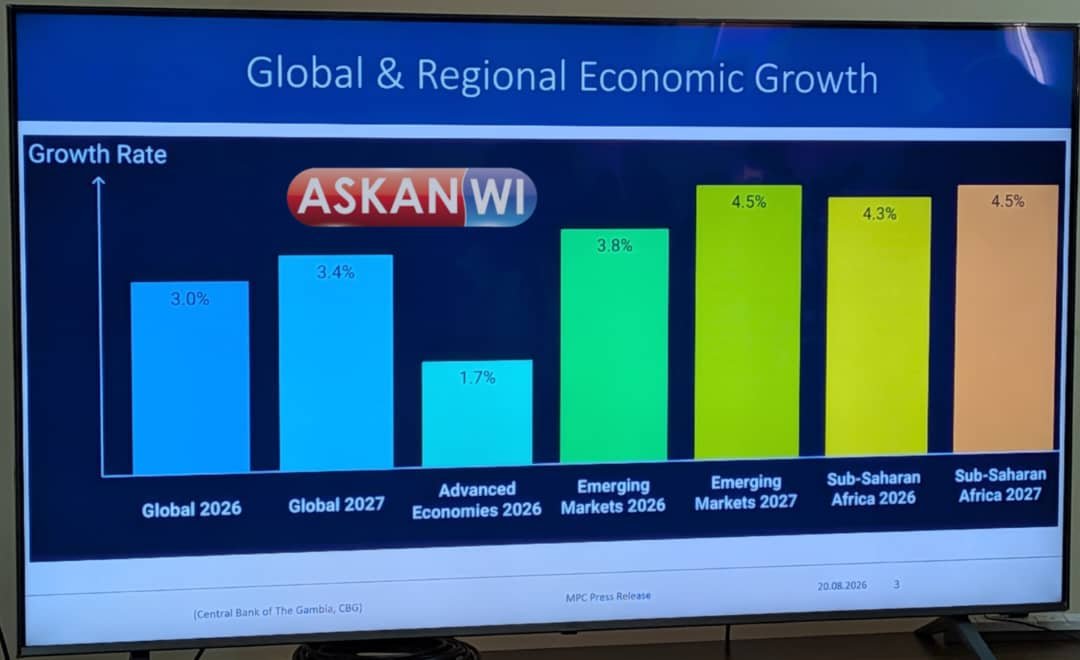
Global & Regional Economic Growth © Askanwi
Economist and agropreneur Dr. Ousman Gajigo told Askanwi that “The Gambia imports 90% of the rice we consume.” A review of the Gambia Bureau of Statistics (GBoS) International Merchandise Trade Statistics (IMTS) also revealed that rice topped the “Imports of Selected Products for 2024” category, with imports amounting to D4.8 billion.
The same data showed that The Gambia recorded a record trade deficit of D64.6 billion in 2024, driven by rising imports and a narrow and undiversified export base. According to Governor Saidy during the recent MPC briefing, “Total exports increased by 21.9% to US$171.0 million, occasioned by higher re-exports and exports of edible fruits and oil seeds, while imports moderated by 2.6% to US$413.5 million.”
“Nonetheless, compared with the corresponding period of 2025, the goods account deficit widened marginally by 1.1%, reflecting the continued high import dependence of the economy,” he added.
Although the government continues to promote agricultural investment and describes agriculture as the backbone of the economy, the longstanding call to reduce dependence on imported food has yet to translate into sufficient domestic production.
The slogan “Eat what you grow and grow what you eat” has been promoted over the years, from the first administration of President Dawda Jawara, through the former administration of President Yahya Jammeh, and is now being echoed by the current administration of President Adama Barrow.
But the reality on the ground tells a different story. President Barrow’s second National Development Plan, dubbed “YIRIWAA” (2023–2027), identifies agriculture as a priority sector and positions it as central to food security, economic transformation, and macroeconomic stability.
However, the government’s 2024 YIRIWAA Progress Report noted that agriculture’s contribution to growth declined during the year under review, with its share falling to 20.6%, compared with 23.4% in 2023. The report further stated that the sector’s growth rate declined to -1.1%, down from 3.7% in 2023.
With inflation standing at 7.0% in July 2026, according to Governor Saidy, the Central Bank remains above its 5% medium-term target. The continued dependence on imports, particularly for essential food commodities, means domestic prices remain vulnerable to international price movements and external shocks.
The Central Bank’s latest projection now places the achievement of the 5% medium-term inflation target between the end of 2026 and the first quarter of 2027, subject to domestic and external risks.
Meanwhile, Askanwi’s review of the Gambia Bureau of Statistics website found that the latest International Merchandise Trade Statistics available are for the first quarter of 2025. This means that, as of August 2026, the statistics for subsequent quarters have not yet been published, leaving a gap of more than a year in the country’s publicly available merchandise trade data.
