
WACA Launches $5 Million Livelihood Project to Benefit Four Thousand Individuals
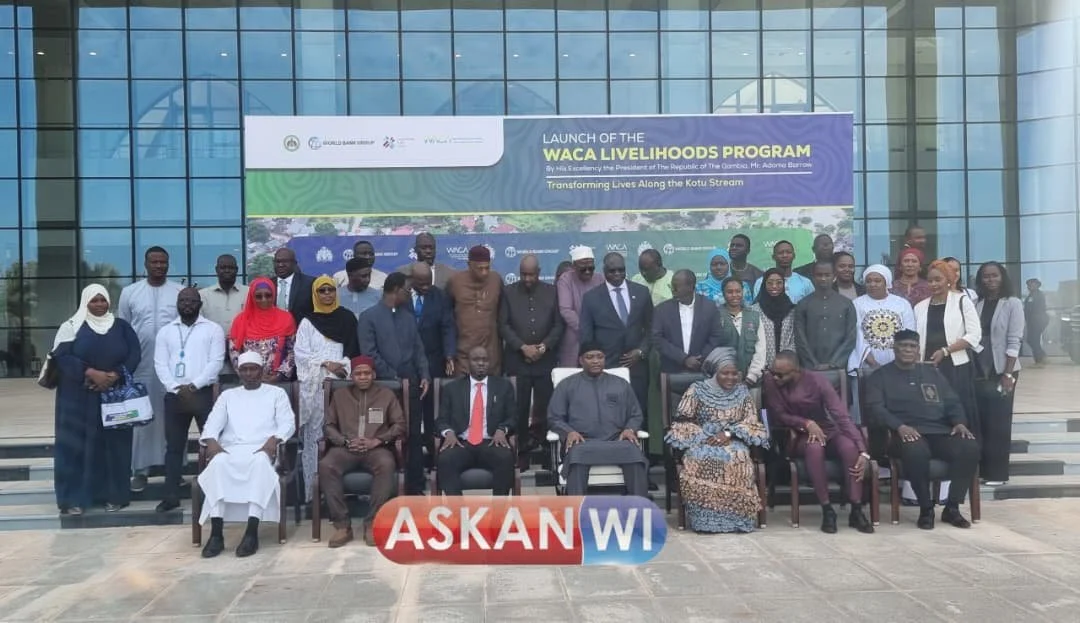
WACA $5 Million Project Launched © Askanwi
By Edward Francis Dalliah, Jr.
President Adama Barrow has announced the launch of a $5 million livelihood support project under the West Africa Coastal Areas (WACA) program, aimed at benefiting at least 4,000 individuals and strengthening community resilience along the Kotu Stream.
The project was officially launched on Tuesday, 23rd December 2025, at the Sir Dawda Jawara Conference Center, where President Barrow said the initiative would transform livelihoods while promoting sustainable economic opportunities in vulnerable coastal communities.
Giving his keynote address, the President said, “The WACA Project Livelihoods Programme, whose goal is to decisively transform lives and strengthen resilience with a budget of five million US dollars, ---will support four thousand (4,000) beneficiaries over the next two years.”
He explained that “the first phase [of the program] will disburse $1.6 million for 1,500 beneficiaries, [and] the target groups are individual enterprises, livelihood groups, farmer-based organisations, and producer groups operating along the Kotu Stream.”
The West Africa Coastal Areas (WACA) Project is a regional initiative supported by the World Bank designed to help coastal countries in West Africa by strengthening resilience against erosion, flooding, and climate change. The project combines coastal protection, ecosystem restoration, and livelihood support for vulnerable communities. The Gambia is part of phase two of the project (2023–2027), with a special focus on the Kotu Stream, a flood-prone area that the project seeks to reprofile and restore.
In a recent interview with Askanwi, WACA Communication Specialist Mr. Abdoulie Sey explained that the livelihood component is specifically designed to support communities whose economic activities depend on the Kotu Stream. Responding to questions about gardeners and other producers along the stream, he said they “will receive technical and financial support to improve their production capacity” as part of the project’s “livelihoods component” targeting producer and farmer groups within the project area.
Historically, the Kotu Stream has served as a habitat for aquatic life, a natural watercourse, and a major hub for gardening and small-scale economic activities. The new livelihood project is expected to revitalize income opportunities for communities whose livelihoods are closely tied to the stream.
President Barrow, in his keynote address, noted that “the reason for targeting these groups is to protect their livelihoods and stimulate entrepreneurship, food security, and climate adaptation at the grassroots level.” He further emphasised the project’s social inclusion focus, saying, “Priority will be given to our women, youths, and persons with disabilities to build sustainable livelihoods in various areas, such as urban agriculture, tie and dye production, solid waste management, social enterprises, and high-impact industries.”
Also speaking at the event, World Bank representative Mr. Mattar Touray described the launch as a major step forward for community resilience and climate adaptation. He said the launch “marks a critical milestone”, adding that “the program will have a delivery [of] entrepreneurship training for three hundred individuals and twenty groups with the focus on climate smart practices, such as research, recycling, composting and urban farming.”
The International Trade Center (ITC) echoed similar sentiments. Representing the ITC, Mr Yusupha Keita said the initiative reflects strong alignment with national development priorities. He noted that the project “tells a powerful story, a story anchored in the National Development Plan, shaped by the leadership of the government, supported by the World Bank project and brought to life through collaboration with communities along the Kotu stream.” His remarks aligned with President Barrow’s assertion that “the project is tagged to our commitment to the National Plan – Yiriwa and our vision for a prosperous and climate-resilient economy.”
The NDP 2023–2027 identifies climate resilience as “a critical enabler” with the strategic objective of “building household and community resilience to address shocks and crises arising from climate change, economic volatility, and to counter the effects of pandemics like COVID-19.”
Speaking on behalf of the WACA Project, Mr Massaneh Ceesay said the livelihood programme forms part of the broader $45 million WACA initiative and is grounded in extensive community engagement. He explained that “the livelihood program is designed based on a comprehensive study that was conducted in 2024 by the WACA Project along the Kotu stream.”
According to Mr Ceesay, the assessment directly engaged communities to identify real needs and opportunities. “The study assessment engages the communities directly, giving women, youth persons with disability, as well as local entrepreneurs, the opportunity to share their perspective on existing livelihood challenges livelihood challenges, market opportunities and skills gap that exist along the Kotu stream area,” he said.
He added that “their inputs help us shape the program, which we hope will deliver a meaningful and sustainable impact on the intended beneficiaries.” As the programme seeks to benefit at least 4,000 individuals within two years, Askanwi will closely monitor its progress.
